


B2B CONTENT MARKETING STRATEGY: THE ABM-LED COMPLETE GUIDE
Contents
- What’s B2B content marketing?
- Why ABM changes every content decision you make
- FAQ: ABM and content marketing basics
- How to build an ABM content strategy from scratch
- FAQ: ABM content strategy
- ABM content types: what to create and when
- High-performing lead magnets for ABM programs
- FAQ: ABM content types
- The ABM content funnel
- FAQ: ABM content funnel
- Personalizing content for ABM at scale
- How to scale ABM content personalization without losing quality
- FAQ: ABM content personalization
- ABM content distribution: where accounts actually engage
- How to build an ABM content distribution plan
- FAQ: ABM content distribution
- Measuring ABM content performance
- How to set up ABM content measurement
- FAQ: ABM content measurement
- The ABM content tech stack
- FAQ: ABM content tech stack
- FAQs: ABM-led B2B content marketing
- Turtl takeaway
See Turtl for yourself
B2B content marketing was built on a simple premise: publish helpful content, attract the right audience, and convert them into customers. That model works. It still does. But for revenue-focused teams targeting specific named accounts, it has a structural gap.
Traditional B2B content reaches whoever shows up. ABM-led content starts with the accounts you want and works backward. Every piece gets planned, built, and distributed with specific buying groups in mind. The content does not wait for the right people to find it. It goes to find them.
This guide covers how to build a B2B content strategy with ABM at the center: what that changes about your content plan, your content types, your personalization approach, your distribution, and how you measure what actually works.
If you want a grounding in ABM strategy, start with Turtl's ultimate guide to account-based marketing. This guide picks up from there, focused entirely on the content side.
What’s B2B content marketing?
ABM-led B2B content marketing is a content approach where your target account list (TAL) defines your content plan, not the other way around. Instead of creating content to attract a broad audience and filtering for fit, you identify which accounts matter most to your business and build content that speaks directly to their industries, challenges, buying committee roles, and account stages.
The core shift is directional. Traditional B2B content marketing is inbound: attract, engage, convert. ABM content marketing is account-specific and outbound-first: identify, engage, close.
How it differs from traditional B2B content marketing
| Traditional B2B content | ABM-led content |
| Built to attract a broad audience | Built for named accounts |
| Success measured in traffic and MQLs | Success measured in account engagement and pipeline |
| Personalized at segment level | Personalized at account and role level |
| Distribution is passive (SEO, social) | Distribution is active (direct, paid, sales-led) |
| Content is repurposed by channel | Content is built for the buying committee |
This does not mean SEO and organic content stop mattering. High-quality, search-optimized content builds brand authority and brings in net-new accounts that can feed your TAL. The difference is in how the rest of the content program is built: from account data up, not from topic ideas down.
Why ABM changes every content decision you make
When your content exists to serve specific accounts, the questions you ask before writing anything change:
- Who, specifically in this account, are we trying to reach?
- What stage is this account at?
- What does this persona care about at this stage?
- What content format is most likely to reach them?
- How will we know if this account engaged?
These questions produce better content because they are answered with real account data, not persona assumptions. And content built this way performs better across every metric that matters: engagement rate, sales cycle length, deal size, and win rate.
What makes content "good" in an ABM context?
In traditional B2B content marketing, quality means great writing, strong visuals, and content that earns trust. In ABM, those criteria still apply, but the primary measure of quality is resonance with the account. A technically mediocre asset that speaks directly to a target account's current challenge outperforms a beautifully produced piece that could be for anyone.
Engagement data tells you what resonates. Behavioral signals from your content platform show which pieces your target accounts actually spend time with, which they share internally, and which they bounce from. This is how you improve: not by guessing, but by reading what accounts show you.
Related: How to surface real-time buying signals from content engagement to sales
FAQ: ABM and content marketing basics
Do you need a full ABM program running before ABM-led content marketing makes sense?
No. You can start small. Even identifying your top 20 target accounts and building one content asset tailored to their industry is an ABM content move. You do not need a formal ABM program running before you can shift your content decisions toward account-centricity.
Can ABM-led content coexist with SEO-focused content?
Yes, and it should. SEO content builds topical authority and surfaces your brand to in-market buyers who are not yet in your TAL. ABM content closes the gap between brand awareness and account-level pipeline. Manage them as separate programs with separate KPIs, then cross-link them to support each other.
What is the difference between ABM content and personalized content?
Personalization is a tactic. ABM is a strategy. ABM content is planned from account selection through to distribution and measurement. Personalization is one of the tools used to execute it. You can personalize content without running ABM, but effective ABM always uses personalization.
How to build an ABM content strategy from scratch
Building an ABM content strategy means starting with accounts, not ideas. The process below works whether you are running a 1:1, 1:few, or 1:many ABM program.
Related: How to start an ABM program that scales | Your ABM needs a system, not more campaigns
How to build an ABM content strategy: step by step
Step 1: Define your target account list before you touch your content plan
Your TAL is the foundation. Without it, you are creating content for a hypothetical audience. With it, you are building content for real organizations with known characteristics.
Work with sales and customer success to build a TAL using:
- CRM data on closed-won accounts (what do your best customers look like?)
- Intent data from platforms like 6sense or Demandbase to identify in-market accounts
- Firmographic filters: industry, company size, tech stack, revenue
- First-party engagement data from your existing content
Once your TAL is set, segment accounts by tier (1:1, 1:few, 1:many) and assign content types accordingly.
Step 2: Map content to buying committee roles
B2B purchases involve an average of six to ten stakeholders. A single piece of content rarely speaks to all of them. Before planning content, map the key roles in your typical buying committee:
- Economic buyer (CFO, VP Finance): focused on ROI, cost justification, risk reduction
- Champion (Director or VP of the relevant team): focused on outcomes, ease of implementation, team adoption
- End user (practitioner level): focused on workflow, day-to-day value, ease of use
- Technical buyer (IT, Security): focused on integration, compliance, data handling
- Blockers (Legal, Procurement): focused on risk, contract terms, vendor credibility
Each role needs different content. Your champion needs thought leadership and outcome case studies. Your economic buyer needs ROI calculators and executive briefings. Your technical buyer needs integration guides and security documentation.
Step 3: Map content to account stages, not just funnel stages
ABM uses account stages, which are more precise than traditional funnel stages because they reflect where an entire buying group is, not where one lead is.
| Account stage | Content goal | Example formats |
| Target (unaware or cold) | Build awareness with the account | Industry reports, thought leadership, LinkedIn sponsored content |
| Engaged (active signals) | Deepen engagement across key roles | Personalized ebooks, account-specific landing pages, buying committee briefs |
| MQA (marketing qualified account) | Accelerate to sales conversation | Executive briefings, ROI case studies, peer benchmarks |
| Opportunity (sales-active) | Support the deal | Deal-specific one-pagers, competitive comparisons, proposal content |
| Customer | Expand and retain | Success content, product updates, upsell case studies |
Related: What's an ABM funnel and how to create one
Step 4: Choose content types by ABM tier
Not every account gets the same treatment. Assign content tiers based on account value and available resources:
- 1:1 (strategic ABM): Bespoke, account-specific assets. Executive briefings, custom reports, one-to-one meeting content. Built by a dedicated team member for a single high-value account.
- 1:few (ABM lite): Cluster-level personalization. Content built for groups of similar accounts (same industry, same challenge, same buying stage). One asset serves five to ten accounts with light personalization.
- 1:many (programmatic ABM): Technology-driven personalization at scale. A master asset is dynamically personalized for hundreds or thousands of accounts from CRM and intent data. Turtl's Personalization Engine is built for this.
Step 5: Create your account content plan
With your TAL, buying committee map, account stages, and content tiers defined, build a content plan by mapping:
- Which accounts need content this quarter?
- At what stage are they?
- Which roles in the buying committee have we not yet reached?
- What content format serves that role at that stage?
- Who creates it, and how does it get delivered?
This replaces the traditional editorial calendar with an account-driven content schedule.
Content strategy goals: B2B content marketing with ABM intent
Your content goals should align with account pipeline outcomes, not just engagement metrics:
- Pipeline creation: Content that moves cold target accounts to engaged status
- Pipeline acceleration: Content that moves MQAs to open opportunities faster
- Deal support: Content that reduces friction inside active sales cycles
- Expansion revenue: Content that surfaces upsell and cross-sell signals in existing accounts
- Brand authority: SEO and thought leadership content that builds credibility at scale (feeds the TAL)
Related: ABM campaigns: examples that turned targets into pipeline | How ABM data refines your ideal customer profile
FAQ: ABM content strategy
How many accounts should I build personalized content for?
It depends on your tier structure. 1:1 ABM can realistically cover five to 15 accounts per content resource at any given time. 1:few can handle groups of five to 20. 1:many ABM should use technology to handle the rest of your TAL at scale.
Should content strategy be a marketing or sales function?
It should be shared. Marketing defines content types, creates assets, and manages distribution. Sales provides account intelligence, identifies key contacts, and delivers content directly. The content plan should be reviewed jointly in a regular pipeline meeting.
How often should the content plan be updated?
At a minimum, quarterly. Account stages change, TALs evolve, and intent signals shift. A static content calendar built on assumptions from six months ago will miss live account movements.
What is a buying committee brief, and when should I use one?
A buying committee brief is a short, role-specific content asset that maps your solution's value to the specific priorities of each stakeholder in a target account. Use them when an account reaches MQA stage and your sales team is preparing for active engagement.
What B2B content marketing KPIs matter most in an ABM program?
Account engagement rate (what percentage of your TAL is actively engaging), buying committee coverage (how many roles per target account have seen your content), account stage progression velocity, and content-influenced pipeline value. Traffic and downloads are secondary signals.
ABM content types: what to create and when
The right content format depends on three factors: ABM tier, buying committee role, and account stage. Below is a practical breakdown.
1:1 ABM content: high-touch, account-specific
At the 1:1 tier, content is bespoke. Every asset references the specific account, their industry, their stated priorities, and your solution's fit for their situation.
Account-specific thought leadership. Research-led content that speaks directly to the account's industry context and the challenges their peers are navigating. This earns credibility before sales conversations begin.
Executive briefings. A concise, data-driven document that quantifies the business case for your solution in the context of the account's specific revenue or operational goals. Built for the economic buyer. Short, financially framed, and forward-looking.
Personalized proposal content. Beyond the standard proposal template, this includes account-specific ROI modeling, reference customers from the same industry, and content tailored to known objections.
Custom case studies. If you have customers that closely match the target account in industry, size, and use case, a case study presented with their specific context is far more persuasive than a generic proof point. A financial services champion reads a fintech case study differently from a generic "we helped a B2B company grow" narrative.
1:few ABM content: cluster-level personalization
At the 1:few tier, you build content for a cluster of similar accounts rather than a single one. The goal is enough personalization to feel relevant without the time cost of fully bespoke assets.
Industry-specific ebooks and guides. A well-researched guide that speaks directly to the challenges of a specific vertical earns attention from clusters of accounts in that space. Healthcare technology, financial services, and manufacturing all have distinct content needs that justify dedicated assets.
Persona-level email sequences. Email content tailored to specific roles (champions vs. economic buyers) in accounts at a similar stage. Personalized email sequences consistently outperform generic nurture streams on open rate, click rate, and reply rate.
Vertical landing pages. Dedicated pages that speak to a specific industry's use case. These serve both organic search and ABM paid campaigns targeting that vertical.
Peer benchmark reports. If you have aggregate data from customers in a sector, a benchmarking report gives a cluster of accounts something directly relevant. They see themselves in the data and want to understand how they compare to peers.
1:many ABM content: personalization at scale
At the 1:many tier, technology carries the content personalization load. A single master asset is adapted at volume for hundreds or thousands of accounts, with dynamic fields pulling in account-specific data.
Programmatic personalized documents. A master white paper, ebook, or guide built in a platform like Turtl that auto-populates account name, industry context, relevant use cases, and tailored proof points at send. GiveSmart halved their bounce rate within two weeks of deploying this approach.
Personalized landing pages. Account-specific URLs or cookied experiences that surface industry-relevant messaging, use cases, and social proof when a target account visits your site.
Automated nurture content. Behavior-triggered content journeys where the specific asset delivered changes based on what a contact from a target account has already engaged with.
Related: 7 AI ABM content personalization tactics for 2026 | Scaling 1:1 ABM content personalization | ABM automation in 5 steps
High-performing lead magnets for ABM programs
When content is designed to capture demand from target accounts rather than attract anonymous leads, the format criteria shift. The best ABM lead magnets for 1:many programs:
- Interactive white papers with dynamic personalization by industry
- Personalized interactive ebooks built around vertical use cases
- Online reports with benchmarking data relevant to the account's sector
- Interactive guides with reader-led content paths
- Digital brochures personalized to the account's known challengesRelated: What is a brochure? How ABM teams build digital brochures that drive pipeline
How to choose the right content type for your ABM tier
- Identify the account tier (1:1, 1:few, or 1:many).
- Determine the account stage (target, engaged, MQA, opportunity, customer).
- Identify the buying committee role you are trying to reach.
- Cross-reference tier, stage, and role to select the appropriate format.
- Check whether existing content can be adapted before building from scratch.
- If creating new content, define the personalization variables (account name, industry, pain point, proof point) before writing begins.
- Use a modular content strategy to make repurposing faster and more systematic.
FAQ: ABM content types
How much personalization is required for 1:many content to be effective?
Research from Turtl Labs shows personalized content increases engagement by up to 84%. Even light personalization (company name, industry, relevant use case) outperforms generic content. The test: does this feel written for them, or written for everyone?
How do I repurpose existing content for ABM?
Start by identifying your highest-performing existing assets. Adapt them with account or persona-level variables. A white paper becomes an account-specific report. A case study cluster gets organized by industry. A webinar recording becomes a highlight reel personalized to the viewer's role. A modular content strategy makes this significantly faster.
What content formats work best for reaching CFOs and economic buyers?
Concise, financially framed content performs best with economic buyers: one-page business cases, ROI calculators, peer benchmarks, and brief executive summaries. Long-form educational content rarely lands at this level. Lead with the number, then provide the supporting rationale.
When should video be used in ABM content?
Video works well at the engagement stage, particularly for demonstrating product value to champions and end users. Short (under three minutes), specific, and ideally personalized video messages also work well in sales outreach at 1:1 and 1:few tier. Generic product demo videos underperform at the strategic account level.
The ABM content funnel
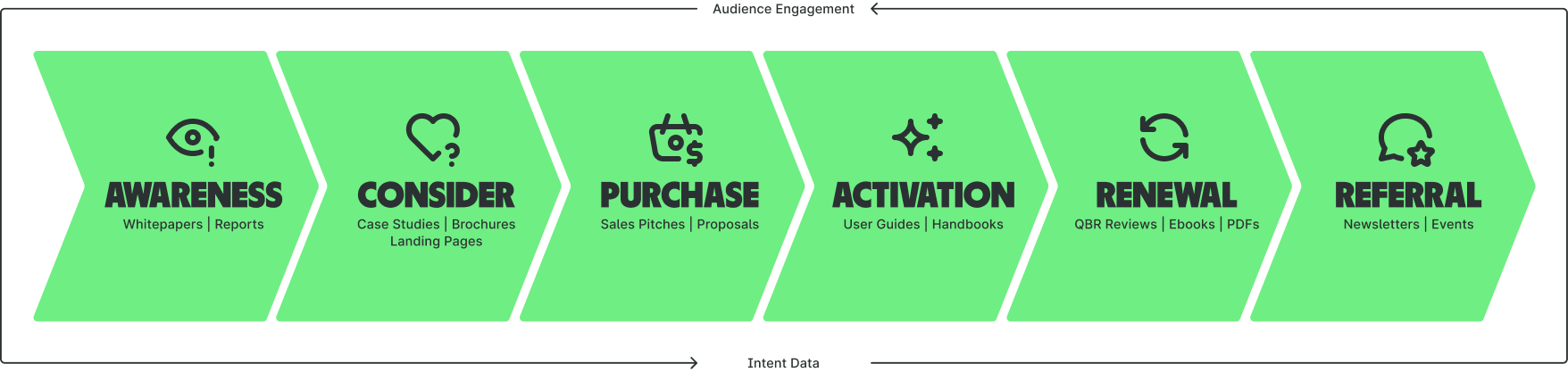
The traditional B2B content funnel maps content to awareness, consideration, and decision stages. The ABM content funnel operates at account level rather than lead level. The critical difference: you are managing engagement across an entire buying group, not an individual contact.
Related: What's an ABM funnel and how to create one | Account-based marketing vs. lead generation: what's the difference?
![]()
Awareness at account level
At the awareness stage, target accounts may not know your brand or may know it only vaguely. Your content goal is to establish relevance and credibility with the specific roles you want to reach before any formal sales contact begins.
Content for this stage should be genuinely useful independent of your product. Industry research, thought leadership on emerging challenges, and benchmarking data work well because they offer value before asking for anything in return.
Distribution at this stage relies on paid LinkedIn targeting (by company and job title), organic search for industry-specific queries, and content amplified through industry publications and partner networks.
Related: Thought leadership content marketing: how to build authority | Next-gen ABM: How 4 top leaders are preparing
Engagement: content for every buying committee member
When an account shows early signals of interest (content engagement, site visits, intent data spikes), your priority shifts to reaching more members of the buying committee and deepening engagement across roles.
This is where content personalization pays off most directly. A champion who downloaded your ebook is one signal. That same champion, plus their CFO engaging with a peer benchmark report, plus their IT lead reading your security documentation, is a buying group moving. That pattern predicts pipeline.
Content at this stage should be role-aware. Use buying committee mapping to identify which roles you have reached and which you have not, then build content designed to close those gaps.
Decision: deal-specific assets
At the decision stage, your content supports an active sales process. The goal shifts from building awareness and engagement to reducing friction in the buying decision.
Decision-stage content includes:
- Competitive comparison sheets built for the specific alternatives in play at this account
- Implementation roadmaps showing the path from purchase to value, reducing perceived risk
- Reference customer introductions: peers in the same industry who can speak to their experience
- ROI models built specifically for the account's size, team structure, and use case
Sales and marketing need tight coordination at this stage. Content requests from sales should receive fast turnaround, and marketing needs visibility into which accounts are in active discussions to prioritize their production queue.
Retention and expansion content
ABM content does not stop at closed. Retention and expansion content keeps existing customers engaged, surfaces upsell and cross-sell moments, and generates the case studies and referrals that feed your next acquisition cycle.
Retention content includes: product release notes framed as business impact updates, success story features that make customers feel recognized, benchmarks that show a customer's performance relative to peers, and renewal-focused ROI summaries that quantify the value delivered to date.
Expansion content follows the same account-based logic as acquisition: identify the new team, map the buying committee, and build content that speaks to their specific situation.
Related: How content personalization can boost performance and build pipeline
Content analytics for account journeys
Content analytics transform how you manage the ABM funnel. Generic web analytics show you what is popular on your site. Account-level analytics show you who is doing what inside your content.
Turtl Analytics identifies known readers at target accounts, shows read time, shares, video plays, and page-level engagement, and integrates directly with your CRM to trigger content workflows based on what each account engages with. This is how engagement data translates into pipeline action rather than sitting in a dashboard.
FAQ: ABM content funnel
How is an ABM content funnel different from a demand generation funnel?
A demand gen funnel is built around individual leads and their conversion journey. An ABM funnel is built around account engagement and buying group progression. The inputs, content, metrics, and handoff points all differ. The key measure in an ABM funnel is account engagement breadth (how many roles are engaged) and account stage progression (how quickly accounts move from target to MQA to opportunity).
At what point does an account qualify as an MQA?
MQA thresholds vary by business, but a common framework includes: the account is in your TAL, engagement has been recorded from at least two different roles in the buying committee, and engagement velocity has increased in recent weeks (more sessions, more pages, more content opens). Agree on the threshold with your sales team before the program launches.
How do I avoid over-weighting top-of-funnel content in an ABM program?
Audit your content by account stage. If most of what you are producing is awareness content, you will underperform on decision and expansion stages. A balanced ABM content mix typically looks like 40% awareness, 30% engagement, 20% decision, 10% retention. Adjust based on where most accounts currently sit in your pipeline.
Can content support the entire ABM funnel, or does sales need to take over at some point?
Both functions are always active. The balance shifts: content-led engagement dominates early stages; sales-led conversations with content support dominates later stages. Effective ABM teams define clear handoff triggers and maintain content support through the deal cycle. Content does not stop when a sales opportunity opens.
Personalizing content for ABM at scale
Personalization is what separates ABM content from B2B content marketing with a new label. The practical challenge for most teams is that deep personalization at scale sounds expensive, slow, and manual. Done with the right tools and process, it is none of those things.
Related: Scaling 1:1 ABM content personalization | 7 AI ABM content personalization tactics for 2026 | A complete guide to B2B personalization
Account-level personalization
Account-level personalization means content that references the specific organization: their industry, their known challenges, their publicly available priorities (from earnings calls, press releases, job descriptions), and your solution's fit for their specific situation.
Even basic account-level personalization (company name, industry, use case) reliably improves engagement. The more variables you pull from CRM data and intent signals, the more relevant the content feels.
Buying committee personalization
Role-based personalization goes one level deeper. The same account might receive different content for different stakeholders: an executive summary for the CFO, a detailed capabilities overview for the champion, a technical integration brief for IT.
Turtl's Personalization Engine supports this from a single master document. Different sections, proof points, and messaging display based on the role of the reader. One build serves the whole buying committee.
AI-driven personalization at scale
AI changes the economics of personalization. Where manual 1:1 personalization was limited to the highest-value accounts, AI-assisted personalization now applies account-level relevance across a full TAL.
Hatch, Turtl's Revenue AI Agent, reads engagement data across your content program and identifies what each account has engaged with, what they have not, and what they should receive next. It converts account engagement signals into content recommendations without requiring manual analysis.
Tools like 6sense and Demandbase supply the intent data. Turtl personalizes and delivers the content. Your CRM orchestrates the workflow. Together, these form an ABM content system that personalizes at volume without proportionally increasing resource costs.
Related: How Turtl and 6sense turn intent into revenue | Turtl x Demandbase: turning account intelligence into revenue-driving content | AI in ABM: how we should be using it | How to run ABM with AI agents in 2026
How to scale ABM content personalization without losing quality
- Build a personalization variable map. Identify every field that can be dynamically populated: company name, industry, pain point, relevant case study, ROI figure, product tier. Gather this data from CRM and intent platforms.
- Create a master content template. Design the core asset with modular sections that swap based on account or role variables. One master document should serve the full range of personalization combinations.
- Define the rules. Document which content block shows for which industry, which proof point triggers for which account size, which role sees which messaging. Complete this before building in your platform.
- Connect your CRM. Link your content platform to HubSpot or Salesforce so personalization variables pull directly from account records. Manual variable entry per send does not scale.
- Set engagement triggers. Configure your CRM to deliver specific follow-up content when accounts hit engagement thresholds. An account that reads page 3 of your ebook triggers a follow-up case study relevant to their industry.
- Test before launching. Send the full range of account variable combinations to a test list before deploying to your TAL. Broken personalization (wrong company name, mismatched industry, incorrect proof point) damages credibility faster than no personalization.
- Measure by account, not by send. Report on which accounts engaged, how deeply, and across how many roles. Individual open rates are noise. Account engagement breadth is signal.
Using Turtl's Personalization Engine, we are now able to generate highly engaging, customized customer-facing documentation in minutes, rather than hours. We have seen the amount of time it takes to deliver a piece of content decrease by about 80-90%.
Jamie King, ABM Manager @ Jabra
Business name goes here
Reader-led personalization
One technique that consistently improves nurture performance: let the reader choose what they see. A reader-led form inside a Turtl Doc asks what the reader wants to explore, and the content auto-adjusts to show the relevant section. Readers get relevance. You get intent data about what they care about most.
FAQ: ABM content personalization
What is the minimum level of personalization that moves the needle?
Company name and industry-relevant proof points are the minimum effective floor. Above that, any additional variable adds incremental engagement. The ceiling is a fully bespoke 1:1 asset. Most teams get strong results with three to five variables.
How do I personalize content for accounts I do not know well yet?
Use industry and firmographic data as your starting point. Intent data providers signal what topics an account is actively researching. Even without a direct relationship, you can personalize to industry, company size, and intent theme with confidence.
Can I use the same platform for both creation and personalization?
Yes, and it is worth doing. A single platform for content creation and personalization reduces friction between building and deploying. Turtl is designed for exactly this workflow: build once, personalize at scale, track engagement at account level.
What does AI actually do in the personalization workflow?
Depending on the tool, AI recommends which content to send based on engagement history, generates initial personalized copy for review, identifies accounts showing similar engagement patterns and suggests content clusters, and surfaces accounts whose signals suggest readiness for a sales conversation. AI handles the pattern recognition and routing. Creative and strategic work stays with your team.
ABM content distribution: where accounts actually engage
Creating the right content is half the challenge. Getting it in front of the right people in your target accounts is the other half. ABM distribution is more active and direct than traditional B2B content distribution.
LinkedIn and paid social
LinkedIn is the most direct channel for reaching specific companies and job titles. ABM-specific tactics include:
Company-targeted Sponsored Content. Promote content to employees of specific companies combined with job function or seniority filters. Effective for warming cold target accounts at scale.
Matched Audiences. Upload your TAL directly into LinkedIn Campaign Manager to create an audience of known target companies. Serve them sequential content across the buying journey.
Conversation Ads. Direct-message style formats that deliver personalized content to specific roles. These work well for MQA-stage accounts where direct engagement is appropriate.
Personalized email sequences
Email remains one of the highest-converting ABM channels when content is genuinely relevant. Generic nurture sequences kill engagement. Account-specific and role-specific sequences earn attention.
Best practices for ABM email:
- Build sequences by buying committee role, not by job title
- Reference specific engagement behavior in the email copy
- Use dynamic content blocks to swap proof points and case studies by industry
- Coordinate send timing with sales outreach to avoid conflicting messages to the same account
Related: ABM automation in 5 steps
Website personalization for target accounts
Target accounts visiting your website should see content relevant to their industry and account stage, not the same homepage as everyone else. Website personalization tools (including integrations with 6sense and Demandbase) identify account-level visitors and serve tailored experiences.
Personalized elements can include: hero messaging by industry vertical, social proof from relevant customers, calls to action appropriate to the account's current stage, and content recommendations pulled from engagement history.
Related: How to turn anonymous traffic into account intelligence | Why your intent signals are not working
Sales enablement content
In ABM, sales reps are content distributors. They deliver personalized assets directly to buying committee members at the right moment. Marketing's job is to ensure those assets exist and are easy to find, customize, and deploy.
A strong ABM sales enablement library includes: account-specific one-pagers, industry-specific case study packs, competitive response sheets, buying committee briefing templates, and ROI calculators that reps can populate with account-specific data.
Related: What is a one-pager and how to use it in your ABM strategy | Best ABM content platforms for sales enablement and buying signals
Events and webinars
Events are underused in ABM. A targeted roundtable for ten accounts in the same vertical produces stronger pipeline movement than a general webinar for a thousand anonymous attendees, because the conversation can be tailored to participants' shared context.
ABM event tactics include: account-invitation-only roundtables by industry, executive dinners for 1:1 strategic accounts, virtual workshops customized to a cluster of accounts in a shared buying stage, and co-hosted content with a partner organization that shares your target accounts.
Digital PR and content partnerships for ABM
Targeted content partnerships earn trust with accounts that have not yet engaged directly. Co-authored research with industry bodies, contributions to publications your target accounts read, and collaborative reports with complementary vendors all extend reach into account clusters your paid channels might not reach efficiently.
Partner with organizations and individuals that share your target audience. Build relationships by inviting contacts from target ABM accounts to co-create content.
How to build an ABM content distribution plan
- Map your active accounts to distribution channels. Where are the contacts in your target accounts most reachable? LinkedIn, email, direct outreach, or events?
- Define content by stage and channel. What content gets served at LinkedIn awareness stage? What gets delivered by email when an account reaches MQA? What does sales deliver in the active opportunity stage?
- Set up CRM-triggered distribution. Configure automated content delivery based on account stage changes and engagement triggers. An account reaching MQA should automatically trigger a personalized follow-up sequence.
- Assign content delivery to roles. Some content should be marketing-delivered (automated sequences, ads). Some should be sales-delivered (direct email, one-pagers). Agree on the split before the program runs.
- Monitor account-level engagement by channel. Track which channels produce the deepest engagement for accounts at each stage. Invest in what works per account type.
FAQ: ABM content distribution
How do I avoid account fatigue when running multi-channel ABM campaigns
Coordinate across channels with a single view of the account. If sales is already in active conversation, marketing should suppress paid ads to avoid redundant touchpoints. Use a shared account activity log in your CRM so every team knows what the account has seen and heard.
Should content be gated in ABM programs?
In most ABM contexts, no. Gating content with a form creates friction at the worst moment, and you already know who your target accounts are. Use ungated content distribution with tracked URLs or built-in analytics (as in Turtl Docs) so engagement is captured without requiring a form fill.
How do I reach buying committee members whose contact details I do not have?
Use paid social (LinkedIn company targeting) for cold outreach to roles you cannot reach directly. Intent data platforms identify which roles are actively researching relevant topics at your target accounts. ABM distribution is proactive; do not wait for inbound contact.
How does content distribution differ for expansion vs. acquisition accounts?
Expansion accounts have an existing relationship with your brand. Distribution can use more direct channels (customer success touchpoints, product notifications, customer community content) and can reference their specific usage data and outcomes. Acquisition accounts need more educational, brand-building content before direct outreach lands.
Measuring ABM content performance
Traditional content metrics (traffic, downloads, form fills) miss most of what matters in ABM. The question is not "how many people downloaded this ebook?" It is "which accounts engaged with this ebook, how deeply, and what happened next in the pipeline?"
Related: How to measure ABM content engagement in 2026 | 9 essential ABM metrics to track and measure success | Content marketing ROI: the metrics for success
Account engagement metrics
These measure how well your content reaches and moves accounts, not individuals:
- Account coverage: What percentage of your TAL has engaged with at least one piece of content?
- Buying committee reach: How many distinct roles in a target account have engaged with content?
- Engagement depth: How much time does the average person in a target account spend with your content?
- Engagement velocity: Is engagement from a target account increasing over time or plateauing?
- Content-to-MQA conversion: Which pieces of content most reliably precede an account reaching MQA stage?
Turtl Analytics surfaces these signals at account level. You can see which target accounts are engaging, who specifically inside those accounts is reading, and how engagement compares across the buying committee.
Pipeline influence and revenue attribution
The revenue question for ABM content is: which content assets appear in the path to closed business?
Multi-touch attribution across an ABM program should track:
- Which content pieces a closed-won account engaged with before the opportunity opened
- Which content types appear most frequently in the paths of fast-closing deals
- Which content pieces appear in deals that expanded post-close
This data tells you where to invest. If accounts that engaged with your executive briefings close 30% faster than those that did not, you produce more executive briefings.
Related: Best ABM content platforms with revenue attribution | Data overload is killing ABM. Here's how to fix it.
Showing content ROI to leadership
Attribution is harder in B2B than in B2C. Sales cycles involve multiple touchpoints, multiple buyers, and months of engagement. But attribution is not impossible; it just requires the right setup.
The metrics that earn budget approval in ABM programs:
- Accounts that engaged with three or more content pieces progressed to MQA X% faster
- Accounts where buying committee coverage exceeded two roles had a Y% higher win rate
- Content-influenced pipeline generated $Z last quarter
- Average deal size for accounts in active content sequences vs. those not in sequences
These frames convert content performance from marketing language into revenue language.
How to set up ABM content measurement
- Define your measurement framework before launch. Agree on which metrics define success: account coverage, engagement breadth, and pipeline influence should anchor it.
- Integrate your content platform with your CRM. Enable account-level engagement data to flow directly into pipeline reporting.
- Tag content by account stage and ABM tier. This lets you report performance in context, not just overall numbers.
- Set up account-based dashboards. Replace lead-based dashboards with a view showing account stage, engagement score, buying committee coverage, and next best action.
- Review performance at account level monthly. Track which accounts moved stages, which stalled, and which content produced the movement. Use these insights to refine your content plan quarterly.
FAQ: ABM content measurement
How do I prove the ROI of ABM content to leadership?
Connect account engagement to pipeline stages and closed revenue. Show: accounts that engaged with X content pieces progressed to MQA Y% faster; accounts where buying committee content coverage exceeded Z roles had a N% higher win rate; content-influenced pipeline generated $X last quarter.
What should I do when an account shows strong engagement but no sales conversation has started?
Flag it as an MQA and trigger a sales handoff. High engagement without sales contact is a missed opportunity. Build an automated alert that fires when an account crosses your MQA engagement threshold so no opportunity sits uncontacted.
Is it possible to attribute closed revenue directly to specific content pieces?
Direct single-touch attribution is rarely accurate in B2B. Multi-touch attribution across your CRM, content platform, and website analytics gives the most honest picture of which content contributed to which deals. The goal is influence evidence, not false precision.
How do I measure content effectiveness for accounts that never convert?
Track disqualification rates by engagement level. If high-engagement accounts consistently do not convert, your content is attracting the wrong accounts or creating engagement without advancing intent. That is a signal to audit content-to-account fit and TAL quality.
The ABM content tech stack
An ABM content program requires technology for five functions: content creation and personalization, intent data, CRM and marketing automation, content distribution, and analytics.
Related: The ABM technology stack every B2B team needs | Best ABM platforms in 2026: the top tools for B2B marketers
Content creation and personalization
Turtl is built for ABM content: create once, personalize at scale, track engagement at account level. The Personalization Engine populates account-specific variables across a master document for 1:many deployment. Hatch, Turtl's built-in Revenue AI Agent, analyzes engagement data and surfaces next-best-content recommendations for each account.
Intent data platforms
6sense and Demandbase identify which companies are in-market based on research behavior across the web. This intent data feeds your TAL, informs your content strategy, and triggers personalized content sequences when accounts show elevated buying intent.
Turtl integrates directly with both platforms: intent signals from 6sense or Demandbase trigger personalized Turtl content for the relevant account without manual intervention.
CRM and marketing automation
Salesforce and HubSpot are the standard CRM layers in ABM stacks. Your CRM should hold account stage data, contact records for each buying committee member, and engagement data from your content platform. Marketing automation orchestrates the content delivery sequences.
Distribution channels
LinkedIn Campaign Manager, email (via your marketing automation platform), and your website CMS handle the distribution side. Connecting your intent data platform to your website CMS enables real-time account-based website personalization.
What the full stack looks like
A mature ABM content tech stack typically includes:
- CRM: HubSpot or Salesforce
- Content platform with personalization: Turtl
- Intent data: 6sense, Demandbase
- ABM advertising: LinkedIn Campaign Manager, Terminus, or RollWorks
- Sales intelligence: LinkedIn Sales Navigator
- Analytics: Turtl Analytics integrated with CRM dashboard
Related:
How Turtl and 6sense turn intent into revenue
Turtl x Demandbase: turning account intelligence into revenue-driving content
FAQ: ABM content tech stack
How do I build an ABM content stack if I am starting from scratch?
Start with three tools: a CRM (HubSpot or Salesforce), a content platform with built-in personalization (Turtl), and a source of intent data (6sense, Demandbase, or Bombora). Add specialist tools for distribution, enrichment, and analytics as the program matures. Do not over-invest in technology before your process and content are proven.
Do I need a dedicated ABM platform alongside these tools?
Dedicated ABM platforms (Terminus, RollWorks) add value for larger programs by centralizing account targeting, advertising, and engagement tracking. For teams early in their ABM journey, a CRM plus content platform plus intent data layer is often sufficient before the added complexity is justified.
How does Turtl integrate with existing marketing technology?
Turtl integrates with Salesforce, HubSpot, Marketo, Pardot, 6sense, Demandbase, and most major CRM and marketing automation platforms. Engagement data flows directly into your CRM, enabling account-level lead scoring and automated content triggers. See all Turtl integrations.
What should I look for in an ABM content analytics platform?
Prioritize: account-level engagement tracking (not just individual contact activity), buying committee visibility (how many roles have engaged), content attribution to pipeline stages, and CRM integration so engagement data informs sales actions. Generic web analytics do not deliver this.
FAQs: ABM-led B2B content marketing
What is ABM-led B2B content marketing?
ABM-led B2B content marketing is a content strategy where your target account list defines what you create, for whom, and how it gets distributed. Instead of building content for a broad audience, you build content for specific named accounts, mapped to their buying committee roles and account stages.
What is the difference between B2B content marketing and account-based marketing?
B2B content marketing is a strategy for producing and distributing content that attracts and retains business customers. ABM is a strategy for identifying and engaging high-value target accounts. ABM-led content marketing is what happens when your content program is built to serve your ABM strategy rather than running independently of it.
How do you create content for an ABM program?
Start with your target account list, map the buying committee roles in your target accounts, identify which account stage each account is at, and build or adapt content for each combination of role and stage. Use a platform that supports personalization at scale for 1:many programs, and reserve fully bespoke content creation for 1:1 strategic accounts.
What content formats work best for ABM?
At 1:1 tier: executive briefings, bespoke case studies, and custom reports. At 1:few tier: industry-specific ebooks, vertical landing pages, and persona-level email sequences. At 1:many tier: dynamically personalized documents, personalized landing pages, and automated nurture content. The most effective formats depend on the account stage and the buying committee role being targeted.
How do you measure ABM content performance?
The primary metrics are account engagement coverage (how many TAL accounts have engaged), buying committee reach (how many roles per account have engaged), account stage progression velocity, and pipeline influence (how content engagement correlates with deal velocity and win rates).
What is the role of AI in ABM content?
AI drives two key functions in ABM content: personalization at scale (dynamically adapting content variables for hundreds of accounts from CRM data) and engagement analysis (identifying patterns in account behavior that signal readiness for a sales conversation or a new content asset).
Do you need a full ABM program before ABM-led content marketing makes sense?
No. You can start small. Even identifying your top 20 target accounts and building one content asset tailored to their industry is an ABM content move. You do not need a formal ABM program before you can shift your content decisions toward account-centricity.
How do you prevent cannibalization between ABM content and SEO content?
Keep them in separate content programs with separate KPIs. SEO content is measured on traffic, rankings, and broad-audience lead capture. ABM content is measured on account engagement and pipeline influence. Both contribute to revenue, through different paths. Cross-link between them where relevant to improve site authority and keep accounts that discover you via search engaged.
How many accounts should I build personalized content for?
It depends on your tier structure. 1:1 ABM can realistically cover five to 15 accounts per content resource at any given time. 1:few can handle groups of five to 20. 1:many ABM should use technology to handle the rest of your TAL at scale.
What is a buying committee brief in ABM?
A buying committee brief is a concise document that presents your solution's value proposition to a specific stakeholder role in a target account. For a CFO, it leads with financial impact and risk reduction. For a champion, it leads with operational outcomes and peer proof points. For IT, it leads with integration, security, and implementation requirements.
How does intent data improve ABM content strategy?
Intent data from platforms like 6sense and Demandbase shows which companies are actively researching topics relevant to your solution. This tells you which accounts to prioritize in your TAL, which topics to weight in your content for that account cluster, and when to trigger personalized outreach.
Is ABM content marketing suitable for smaller B2B teams?
Yes. Small teams should focus on 1:few and 1:many ABM content, where technology carries the personalization load. A small team with a focused TAL of 50 to 100 accounts, a solid content platform, and intent data can run an effective ABM content program without large headcount.
Should content be gated in ABM programs?
In most ABM contexts, no. Gating content with a form creates friction and you already know who your target accounts are. Use ungated content distribution with tracked URLs or built-in analytics so engagement is captured without requiring a form fill.
How do I reach buying committee members whose contact details I do not have?
Use paid social (LinkedIn company targeting) for cold outreach to roles you cannot reach directly. Intent data platforms identify which roles are actively researching relevant topics at your target accounts. ABM distribution is proactive; do not wait for inbound contact.
Turtl takeaway
B2B content marketing built for ABM is built to close. When content is planned from account selection through to distribution and measurement, it stops being a brand-building activity and starts being a revenue mechanism. Every piece exists to move a named account closer to pipeline.
Turtl is built for exactly this: create content once, personalize it for every account in your TAL, track engagement at the buying committee level, and connect content performance directly to pipeline. Hatch, Turtl's Revenue AI Agent, reads engagement signals across your program and surfaces the next best action for every account.