









.jpg?width=1976&height=1480&name=Turtl%20x%20OneAdvanced%20(1).jpg)






Contents
- What an AI agent is and what it is not
- The four jobs AI agents do well in ABM today
- How to repurpose one asset into an ABM campaign with AI
- What AI agents do not replace
- Building an AI-assisted ABM workflow for a lean team
- The honest state of AI agents in ABM
- Frequently asked questions
Head of Product Marketing and AI GTM @ Turtl, Award-Winning PMM and globally recognized PMM leader. Author of the best-selling book "The Product Momentum Gap.”
See Turtl for yourself
The math of ABM has always been brutal for lean teams. Running a meaningful program across 100 target accounts requires research, content creation, personalization, distribution, and measurement. Most B2B marketing teams doing this have two or three people responsible for all of it.
AI agents change the production side of that equation. They absorb the parts of the workflow that were previously manual, time-consuming, and bottlenecked by headcount: briefing to draft, one asset to many versions, engagement data to content recommendation. Strategy, judgment, and account intelligence still require humans. The execution layer is where AI changes the capacity math.
This guide covers what AI agents actually do in an ABM context today, where the limits honestly are, and how to build a workflow around them when your team is small and your account list is not.
What an AI agent is and what it is not
The term "AI agent" is doing a lot of work across vendor marketing right now. It is worth being precise before building a workflow around a definition that may not match the actual capability.
An AI agent is a system that takes a goal or a brief, executes a sequence of tasks toward that goal, and produces an output, requiring less step-by-step instruction from the user than a traditional tool does. The distinguishing feature is that the agent handles the intermediate steps, not just the final output.
In practical ABM terms: you give it a brief to create an account-specific version of a case study for a financial services firm at the evaluation stage, and the agent drafts the copy, applies the relevant personalization variables, and surfaces a ready-to-review version, without requiring you to specify every sub-step.
What AI agents do not do today, at least reliably, is orchestrate an entire ABM program end to end without human decision-making at the strategy layer. Account selection, program design, budget allocation, and the judgment calls about which accounts to invest in belong to the humans on your team. AI handles the execution layer. Vendors who imply the strategy layer is also automated are overselling.
The four jobs AI agents do well in ABM today
1. Content generation from a brief
This is where AI agents deliver the most immediate return for lean ABM teams. Given a structured brief with account context, asset type, audience role, and core argument, an AI agent drafts the content. Your team reviews, edits, and approves. The production bottleneck shifts from writing to reviewing.
For teams running ABM across 50 to 200 accounts, this means a single content strategist can brief and approve at a volume that previously required three or four writers. Brief quality still determines output quality. AI executes a brief precisely, which means a vague brief produces vague content at volume.
2. Personalization at scale
Once a core asset exists, AI agents populate the variable layer: the account-specific elements that make each version feel relevant. Company name, industry framing, the applicable proof point from your content library, persona-specific messaging. Each account gets a version built from the same structural template, with the variable fields populated from CRM data.
This is the job Hatch, Turtl's AI Revenue Agent, is built for. Hatch takes a brief, drafts account-ready content, and works within Turtl's personalization engine to generate versions across your account list using data already in your CRM. One copywriter with Hatch produces the output that previously required a full content team.
.webp?width=1300&height=841&name=dynamic-perso_v2%20(1).webp)
3. Content repurposing across accounts and formats
A long-form asset, whether a white paper, a detailed guide, or an interactive report, contains more reusable content than most teams extract from it. AI agents change the repurposing math. You can take one strong piece of content and instruct an AI agent to produce account-specific email sequences, persona-targeted summaries, chapter-level follow-up content, and sales one-pagers from the same source material.
The workflow for a lean team: one strong base asset, briefed and approved by a strategist. An AI agent then produces the downstream versions. A nurture email for the financial services cluster. A persona-specific summary for CFO contacts at mid-market accounts. An abbreviated version for the sales team to use in follow-up sequences. The strategic work happens once; the AI handles the adaptation.
One constraint to be clear about: AI repurposing amplifies the quality of the original. It executes the argument you built at scale. A source asset with weak positioning produces repurposed versions with weak positioning, faster.
4. Signal interpretation and content recommendations
AI agents surface patterns in engagement data that would take hours to find manually: which sections of your content are generating the most time-on-page across a cluster of target accounts, which proof points are driving repeat visits, which accounts are showing engagement patterns that correlate with accounts that previously moved to a demo.
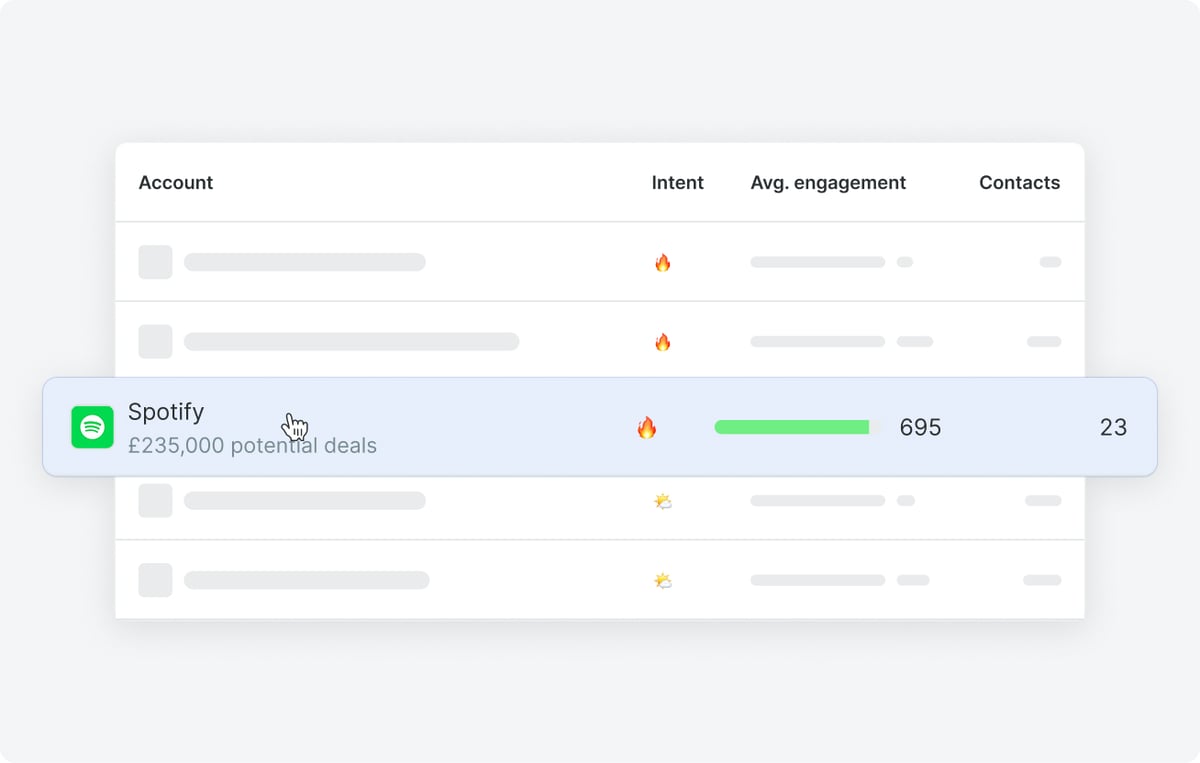
This is what Hatch's analytics layer does inside Turtl. It interprets engagement data, identifies what is working across accounts, and surfaces recommendations for what to adjust in the next content cycle. For a lean team, this replaces the analyst role in the content performance loop, surfacing evidence rather than making the decisions.
How to repurpose one asset into an ABM campaign with AI
Here is a practical workflow for a team of two or three running ABM across 100 accounts with an AI-assisted production model.
Start with one strong long-form asset. A white paper, a guide, or a detailed industry report with enough substance that repurposing it into shorter formats produces content with real depth. Brief it properly: defined audience, clear argument, relevant proof points, strong structure.
Extract the chapter-level content architecture. Identify which sections of the asset are relevant to which personas and account stages. The ROI methodology section is for the economic buyer. The integration overview is for the technical evaluator. The workflow chapter is for the champion. This mapping becomes your repurposing brief.
Brief the AI agent for each downstream format. For each repurposed format, give the agent the relevant section of the source asset, the target persona, the account cluster it is going to, and the distribution channel. For example:
-
Email sequence for financial services CFOs at late-stage evaluation.
-
Summary for sales follow-up in the technology cluster.
-
Chapter-level PDF for champions who engaged with the ROI section.
Populate personalization variables from CRM data. Connect your CRM to the personalization layer so that account-specific fields including company name, industry, and the relevant proof point from your library populate automatically in each version.
Review, approve, distribute. Human review at the asset level, not the individual-version level. One approval covers the template and the personalization logic. From that point, the campaign runs.
A team of two can sustain this workflow across a 100-account list. The production constraint is no longer headcount. It is brief quality and review speed.
What AI agents do not replace
Strategy is still human work. Account selection, program design, the judgment about which accounts deserve 1:1 treatment versus 1:few, the call about whether a message is landing: none of this is automated. AI agents execute on the decisions your team has already made.
Brief quality determines output quality. Teams that expect AI to compensate for weak strategy or vague direction produce more content, faster, that does not convert. The investment in better briefing pays off faster than any AI tooling.
Relationship signals require human judgment. AI can surface which accounts are warming up, but whether it is the right moment to escalate a conversation, what a stakeholder's resistance actually signals, and how to frame a follow-up call require human reading of context that AI cannot replicate reliably.
Building an AI-assisted ABM workflow for a lean team
The practical architecture for a small team running ABM with AI agents has four components.
-
A brief library. Templates for each content type and each account tier, with variable fields defined and the personalization logic documented. The brief library is what makes AI output consistent. The agent executes the brief, so a well-structured brief library means consistent output quality across every asset.
-
A proof point library. Customer references, data points, and case study summaries tagged by industry, company size, use case, and persona. AI agents pull from the library when generating account-specific content. Without it, agents produce generic placeholders where specific proof should be.
-
A CRM-connected personalization layer. Account data feeding variable fields automatically, so no manual data entry sits between the account record and the personalized asset. When this is configured correctly, the team's effort concentrates entirely on strategy and review.
-
An engagement feedback loop. Analytics that surface what is working at the account and cluster level, connected back to the brief library so the next production cycle starts from what the data showed. This is the difference between an AI-assisted content program and a content program that produces more volume without improving.
The honest state of AI agents in ABM
Full end-to-end orchestration, where an AI agent plans a campaign, selects accounts, sequences touches across channels, adjusts strategy based on signals, and closes the attribution loop automatically, is where the technology is heading. But, it is not reliably where it is today.
What teams can build now is a meaningful acceleration of the production and personalization layer. For lean teams, that is already a significant operational shift: it moves the ceiling on how many accounts a small team can run a real ABM program for.
The teams best positioned when full orchestration arrives are the ones building brief libraries, proof point systems, and CRM integrations now. The infrastructure matters as much as the AI layer built on top of it.
Frequently asked questions
What's the difference between an AI agent and AI-assisted content tools like ChatGPT or Jasper?
AI agents handle multi-step workflows autonomously. They take a goal, execute a sequence of tasks, and deliver an output without step-by-step instruction, whereas tools like ChatGPT and Jasper require you to drive each step manually. In an ABM context, the practical difference is that an AI agent can take a brief, apply personalization variables from your CRM, and produce a set of account-ready assets in one flow. A general AI writing tool produces one draft at a time and puts the sequencing work back on the user.
What data does an AI agent need to personalize ABM content effectively?
At a minimum, AI agents need specific data (including company name, industry, company size, and the relevant pain point or use case from your CRM) to personalize content. The more data the agent can pull from, such as deal stage, persona role, prior content engagement, and matching proof points, the more relevant each version becomes. The core infrastructure requirement is a CRM that is clean, tagged, and connected to the personalization layer. Account data with gaps or inconsistent tagging produces personalization that reads as generic despite the AI.
How do you measure whether AI-generated ABM content is actually performing?
To measure how AI-generated content is performing, teams must track engagement at the account level, not just aggregate click or open rates. The signals that matter in ABM include time spent on specific content sections, return visits from the same account, specific proof points that drove re-engagement, and whether engagement patterns correlate with pipeline movement. AI agents that include an analytics layer, like Hatch inside Turtl, surface these patterns automatically. Without account-level engagement data, it is difficult to distinguish whether personalization is improving performance or just increasing output volume.
What should go in an ABM content brief for an AI agent?
A brief that produces useful AI output requires six elements: the target account or account cluster, the persona and their role in the buying decision, the stage of the buying cycle, the core argument the content should make, the relevant proof point or case study to include, and the format and distribution channel. Vague briefs simply produce vague output at volume.