









.jpg?width=1976&height=1480&name=Turtl%20x%20OneAdvanced%20(1).jpg)









Contents
- Why isn’t AI working in ABM?
- How should ABM teams actually be using AI in 2025?
- How does AI make ABM more human?
- Step-by-step: How to humanize ABM
- How does AI turn ABM data into actionable insight?
- How can AI support decision-making in ABM programs?
- Key takeaways
- Free playbook: ABM 2030
See Turtl for yourself
AI is everywhere in ABM. So much so that 94% of organizations now use it to prepare marketing activities. But ask teams how using it helps their bottom line? You can bet on some seriously lukewarm, vague responses.
Despite what AI evangelists preach from their LinkedIn pulpits, AI isn’t the second coming. What it is is a tool with the power to change how teams work and perform for the better – as long as we use it right.
In 99% of teams, AI is being used to crank out more output, faster. But here’s the (uncomfortable) reality: if we’re squaring up against machines on analysis, scale, and speed, we’ve got a very hard battle ahead. That’s why we’ve got to get smarter with how we’re deploying AI in our workflows. Outcomes, not output. Value, not volume. You get the gist…
Sounding a little pie-in-the-sky? Don’t worry, we break down exactly how to make this a reality below.
Let’s get into it.
Why isn’t AI working in ABM?
AI isn’t working in ABM because most teams are using it as a production shortcut instead of a strategic lever. It’s speeding up output (copy, research, automation) but not improving decision-making, B2B personalization, or revenue impact. Without a clear role for AI inside ABM workflows, the promise of transformation stalls at surface-level efficiency.
ABM campaigns still feel generic, dashboards still look bloated, and marketers are still struggling to answer the inevitable C-Suite question: “So… how is our ABM moving the needle on revenue?”
The issue isn’t adoption. It’s ambition.
To put it short, we’re thinking too small. Most teams have slotted AI into the most manual parts of their workflow, like writing (68% of Account-Based GTM programs cite copywriting as their primary AI use case), summarizing, and creating visuals, because those wins are immediate and visible. But ABM doesn’t live or die by how fast you ship content. It lives or dies by relevance, timing, and judgment.
When AI is boxed into a purely executional role, ABM becomes faster but flatter. More automated, less human. And that’s dangerous at a time when buying groups are expanding, intent is harder to read, and leadership expects marketing teams to prove commercial value – not just activity.
How should ABM teams actually be using AI in 2025?
AI’s role in ABM should be about vision, not execution. The teams squeezing the most out of AI are doing things differently. Instead of shoehorning it in for short-term efficiencies, they’re using it to redesign how decisions get made, how signals are interpreted and acted on, and how humans show up at the moments that matter.
To reap the full benefit of AI in our workflows and systems, we’ve got to ask questions like ‘How can AI help me spot and close high-intent leads?’ or ‘Where am I missing opportunities to convert prospects?’ AI, in its best form, filters noise and elevates what actually deserves attention.
In practice, that looks like using AI to connect engagement signals across accounts your ABM funnel, surface real buying behavior, and highlight intent indicators that all too often fly under the radar. And, of course, funneling these into your CRM so you can get an accurate status update at a quick glance.
From there, AI becomes your trusted guide to revenue heaven. It empowers ABM automation and can recommend next-best actions based on real behavior: which account is heating up, which stakeholder just shifted intent, which content is accelerating deals rather than stalling them. Turtl’s AI agent, Hatch, does these recommendations very well. ‘Can we see that in action?’, we hear you ask. But, of course – check it out below.
Personalization also changes shape. Instead of static personas and overused segments, AI makes buyer-aware experiences possible – all grounded in intent, context, and timing. That's relevance that feels real.
Connecting the dots like this lets ABM teams shift focus from saving labor to sourcing real opportunities. That’s when AI keeps its word and starts delivering growth where it matters most: pipeline and revenue.
How does AI make ABM more human?
It sounds backwards, but this is where AI can make a colossal difference.
For years, marketers have been buried under admin, analytics dashboards, and siloed info. The sheer volume alone makes real intent signals almost impossible to spot, let alone act on. That, in turn, hurts commercial performance – which spells trouble for marketers on the hook for revenue.

AI removes that drag. By handling the signal-sorting, pattern-spotting, and prioritization that humans simply can’t do as well at scale, it gives marketers back space to think, interpret, and respond like humans. All without the constant pressure of catching and routing leads as soon as they heat up.
In human-first, AI-assisted ABM, teams define the problem, like scaling content personalization or improving conversions, then design AI-supported steps to make it a reality. AI handles mechanical work. People handle meaning and narrative.
The irony is this: the more AI absorbs the work it’s best at, the more human ABM becomes. Better timing. Better context. Better conversations. Not automation for automation’s sake, but support that lets teams connect with the right people, at the right time, with the right message. That’s how scalable ABM that retains its human touch happens.
Step-by-step: How to humanize ABM
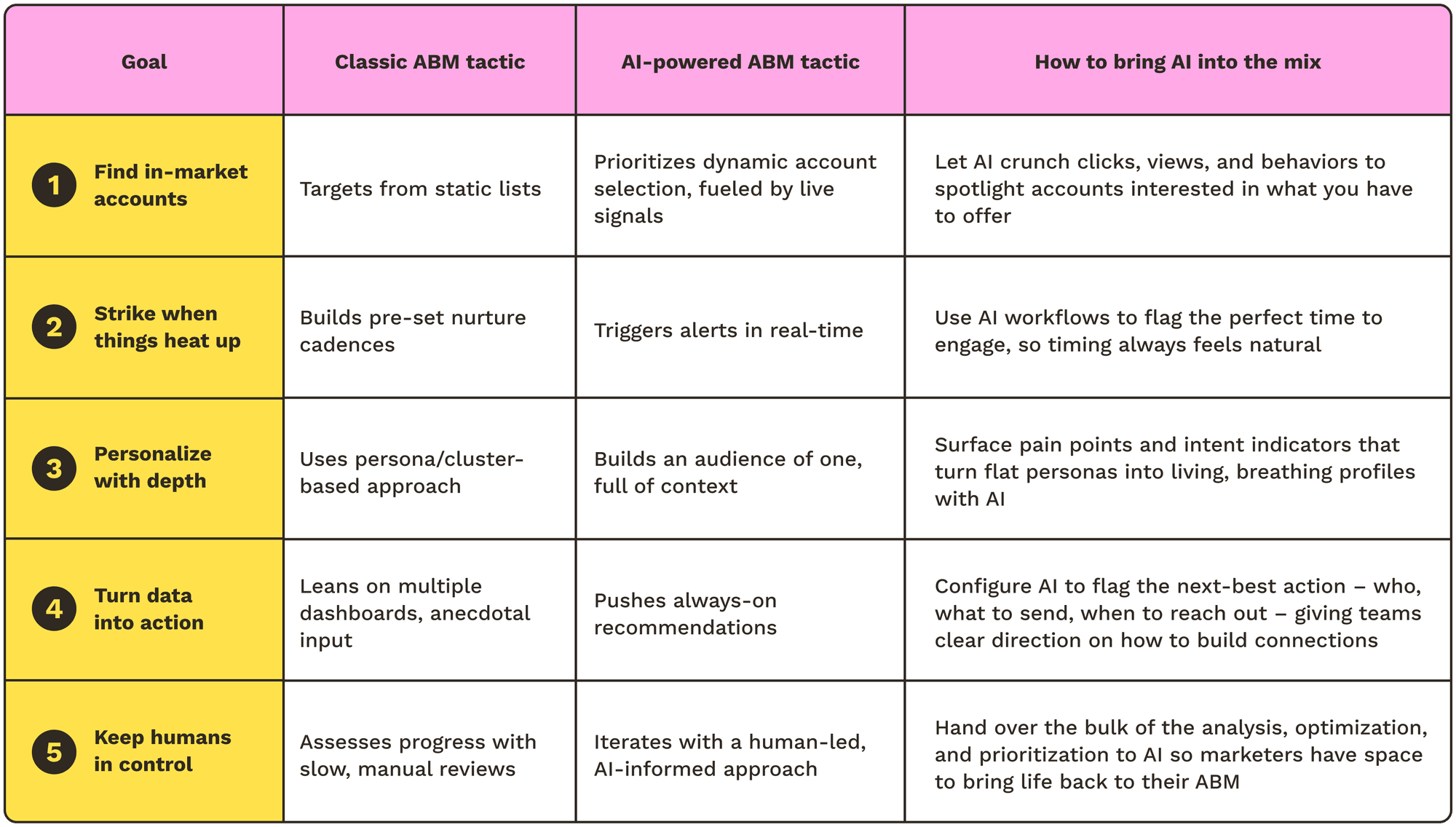
How does AI turn ABM data into actionable insight?
AI turns ABM data into actionable insight by filtering through extensive data sources, identifying true intent and engagement signals for signal-led ABM, and surfacing those to ABM teams.
Data volume isn’t an issue for most ABM teams. But extracting intel from their data is.
Clicks, views, time spent, repeat visits, and account-level engagement all pile up fast. On its own, none of it tells a story. AI’s real value is in connecting those fragments into patterns that humans can act on.
By analyzing behavior across accounts and stakeholders, AI can reveal intent trends, spotlight friction points, and separate curiosity from genuine buying signals. And because insight only matters if it leads somewhere, you’ll need AI-supported ABM systems that go beyond explaining performance and deliver next-steps (like Hatch does).
How can AI support decision-making in ABM programs?
In the strongest ABM programs, AI informs decisions without replacing them. Instead of basing ABM tactics and strategy on subjective signals, AI tools arm teams with cold, hard proof of what’s working, what to personalize, and when to engage.
At this point, ABM teams finally get off the hamster wheel. Marketers funnel energy into assets and activities they can be confident will land. Sales teams chase accounts that are giving all the right signals. The C-Suite’s confidence and trust in teams improve as they make headway towards the ABM metrics that benchmark their success.
Suddenly, doubling down on what works feels less risky. Because it’s backed by real insight, not instinct alone.
Key takeaways
- AI should drive decisions, not just output. Speeding up production doesn’t improve relevance, judgment, or revenue impact.
- Outcomes matter more than activity. ABM succeeds on timing, relevance, and intent – not volume of content.
- Signals, not dashboards, show buying intent. AI adds value when it filters noise and surfaces real in-market behavior.
- Personalization must be buyer-aware. Real intent and context beat static personas and generic automation.
- Human-led, AI-supported ABM performs best. AI handles patterns and admin; people handle meaning, trust, and relationships.
Ready to put this into practice? Here's how to build an AI-assisted ABM workflow for a lean team
ABM 2030
Want to future-proof your ABM with AI, signals, and revenue-focused systems?
ABM 2030 is a practical playbook that shows you how. It's a roadmap to a better future for teams on the hook for revenue.