









.jpg?width=1976&height=1480&name=Turtl%20x%20OneAdvanced%20(1).jpg)









Contents
- Account based marketing campaigns vs. systems
- What are some ABM system benefits?
- How do ABM systems improve the account based marketing customer journey?
- How do I get account based marketing orchestration right?
- WTF is a revenue marketer?
- Key takeaways
- Free playbook: ABM 2030
See Turtl for yourself
Most ABM teams are running on a treadmill. They work hard, pump out campaigns, collapse after a sprint well done, then start the whole thing over. But they stay in the same spot, nowhere closer to the end goal. It’s exhausting, it’s inefficient, and frankly, it’s time to change tack.
With 47% of marketing leaders reporting rising expectations to deliver revenue in the last five years, we can’t afford any part of our marketing machine to move slowly or – even worse – stagnate. But that’s exactly what happens when we run ABM as isolated projects, not compounding systems.
If you’re still trying to meet demands with one-off bursts of ABM activity (and burning out in the process), we promise there’s a better way.
Account based marketing campaigns vs. systems
Account based marketing campaigns are short-term, standalone efforts that solely focus on landing target accounts. They use up significant team resources but may not support a cohesive ABM strategy or broader business objectives.
Because they’re often one-and-done, account based marketing campaigns rarely deliver insight into what’s working, why, and what you should do to scale success. The result is wasted effort, siloed activities, and ABM that’s slow to grow.

In contrast to the spaghetti-at-the-wall approach, an account based marketing system is a cohesive, connected feedback loop. It doesn’t stop when the sprint ends. Instead, every move you make feeds the next one.
Insights you gather from account based marketing content and experiences fuel actions, actions generate outcomes, and outcomes validate those original insights. The result is ABM that builds on itself to deliver consistent and scalable revenue results.
What are some ABM system benefits?
The main ABM system benefits lie in its ability to act as a compass for commercial teams. It’s a silo-buster that gives focus and direction. And by doing that, it unlocks better ABM efficiency, scalability, and ROI. An ABM system made up of strategy, execution, and attribution, built around business goals, snaps things into focus.
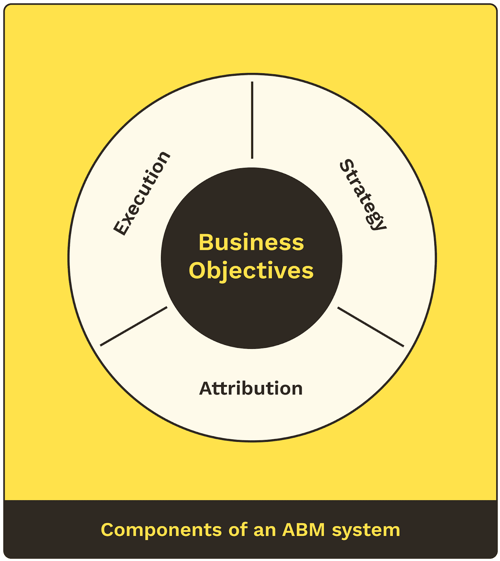
A system-led approach allows you to:
-
Drive predictable growth: The biggest flaw of the campaign model? It starts at zero every single time. With an account based marketing system, you’re constantly learning and refining for better results – creating a compounding loop that grows revenue reliably.
-
Get teams on the same page: When you think in systems, not bursts, you start solving the organizational issues that are currently choking 74% of ABM programs. Priorities are clear, debates between departments disappear, and anything that doesn’t move the needle gets dropped.
-
Win back creative freedom: This is the paradox. The more you laser your ABM in on metrics that matter most to the business, the more trust you earn from the C-suite. And that trust is your ticket back to the creative, human-focused work that got you into marketing in the first place.
How do ABM systems improve the account based marketing customer journey?
ABM systems improve the account based marketing customer journey by using engagement insights, intent signals, and responsive outreach to engage with prospects when they’re showing genuine interest.
Instead of shoehorning B2B buyers through the ABM funnel, they navigate the buyer journey on their own terms, at their own pace. An account based marketing campaign forces a buyer into your timeline. An ABM system adapts to theirs.
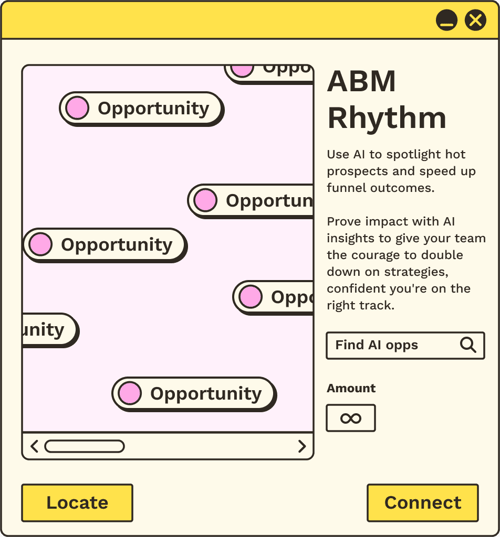
By using AI in ABM to crunch real-time behaviors and signals, ABM systems are fine-tuned to flag the exact moment when a potential buyer indicates they’re seriously considering your business – so Marketing and Sales can jump into action at the perfect time to nudge them further in the right direction.
How do I get account based marketing orchestration right?
To get account based marketing orchestration right, start by getting your direction and objectives crystal clear; these will guide how you build your ABM system. To find that focus, ask yourself questions like: What big picture goals do I want my ABM to move the dial on? What activities should I do to make this happen? What tools will I need?
When it comes to goals, pipeline and revenue growth are top of the list for virtually every marketing team in 2025. And for account based marketing orchestration that delivers these, Marketing, Sales, and Customer Success need to rally around the ABM objectives you’ve defined earlier. This means:
-
Anchoring to outcomes: Every move must be tied to a business objective (like entering a new market or sales pipeline acceleration). If not, you’re at risk of veering off track.
-
Using signals as your compass: You have to separate the signal from the noise for signal-led ABM. Don't chase every click; zero in on the high-value intent that shows an account is actually ready to talk.
-
Leaning into the identity shift: This one’s for the marketers. We’ll hold your hand while we say this: driving revenue is now a core part of a marketer’s job description. That means getting comfortable thinking and moving like traditional commercial departments.
Once teams show their efforts are having an impact where it counts most, the pressure to "prove your worth" lifts. Sales and Customer Success breeze through quotas and targets, and Marketing wins the space to do their best work. That's why, if you want an easier, more enjoyable life as a marketer, it's time to ditch the campaign manager mindset and step into the role of a revenue marketer.
WTF is a revenue marketer?
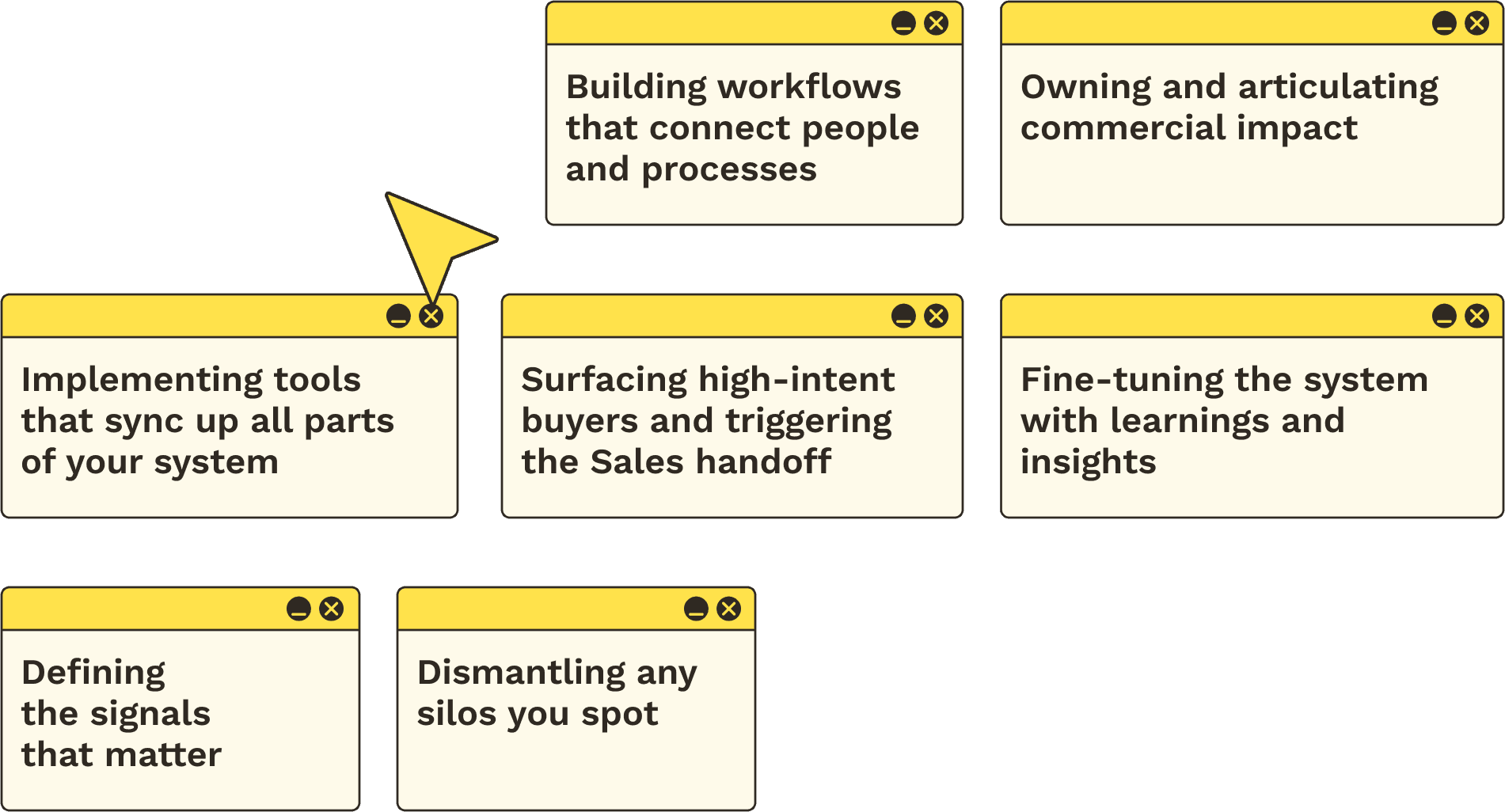
You can spot revenue marketers a mile off because how they think, plan, and act is focused on one thing: optimizing for revenue impact.
Here are some of their key characteristics:
Key takeaways
-
ABM campaigns create activity but not momentum. One-off account based marketing campaigns reset to zero every quarter, limiting insight, scalability, and long-term revenue impact.
-
ABM systems are built to compound. A connected ABM system uses insights, actions, and outcomes in a continuous feedback loop that drives predictable, scalable growth.
-
Direction and alignment are non-negotiable. High-performing ABM teams are focused on achieving shared business objectives, such as pipeline acceleration or market expansion.
-
Signals beats guesswork. Using B2B buyer intent data and AI-driven insights allows Marketing and Sales to engage accounts at the right moment, on the buyer’s timeline, not yours.
-
The future of ABM is strategic, not tactical. Teams that treat ABM as a long-term growth engine, not a series of campaign, will outperform in complex, trust-led buying environments.
For most, it’s not a lack of effort that’s standing in the way of scalable, revenue-driving ABM; square-one strategies are the true culprit. Campaigns give you motion, but systems give you momentum. Design your ABM as a connected, insight-driven system, focus it around commercial outcomes, and set your team on it. We promise the wins will come rolling in.
Ready to start building ABM with scaling and staying power?
Download our free account based marketing playbook, ‘ABM 2030’ for practical frameworks, insights from ABM experts, and strategies to future-proof your program.

ABM 2030
Want to future-proof your ABM with AI, signals, and revenue-focused systems?
ABM 2030 is a practical playbook that shows you how. It's a roadmap to a better future for teams on the hook for revenue.