









.jpg?width=1976&height=1480&name=Turtl%20x%20OneAdvanced%20(1).jpg)




.png?width=619&name=a-cute--mischievous--anthropomorphic-turtle-made-f%20(1).png)
Contents
- What is B2B buyer intent data?
- Why do I need B2B buyer intent data?
- B2B buyer intent data use cases
- Are all types of B2B buyer intent data created equal?
- How B2B data enrichment improves lead segmentation and management
- Top B2B buyer intent data providers
- How to source, clean, and validate B2B buyer intent data
- What teams need B2B buyer intent data and why?
- The dangers of bad B2B buyer intent data
- How Turtl delivers revenue-fueling B2B buyer intent data
- Key takeaways
See Turtl for yourself
Here’s a (not so) fun fact: Today’s buyers go through 70% of their journey before speaking to Sales. That means prospects have researched you from every angle, weighed you up against competitors, and forged a fairly strong opinion of you – all before your rep has even had the chance to say ‘hello’.
When we’re up against a laundry list of preconceived opinions, every opportunity to meet prospects where they’re at and show we understand them counts. And to do that, we need real, reliable insights into their wants, needs, behaviors, and pain points. That’s where B2B buyer intent data comes into play.
This guide breaks down the types of B2B buyer intent data, how to use it (beyond just helping Sales), why quality matters, what teams need it, where it goes wrong, and how to operationalize it.
What is B2B buyer intent data?
B2B buyer intent data is information that reveals how interested an audience is in purchasing a product or service. It gives insight into their online behaviors and what these show about the audience’s needs, pain points, and buying readiness.
If you want to know who your buyers really are – not the personas in your slides or the titles in your CRM, but the real-life humans behind the screens – you need B2B buyer intent data.
Why do I need B2B buyer intent data?
You need B2B buyer intent data because it shows which companies are actively researching solutions like yours, what topics they care about, and when they’re most likely to buy.
Without intent data, you’re operating in the dark... And not the cinematic “film noir” kind, where you’ve got the clues to solve the case. The “My ABM’s fueled on crossed fingers and blind faith” kind. B2B buyer intent data turns the lights on, unveiling the key characters in your soon-to-be success story – and what they’re getting up to.
Companies that invest in intent data grow faster than those using traditional demographic targeting, with 99% of companies using intent data reporting improved ROI and intent-led outreach boosting win rates by up to 50%. When teams rely purely on firmographics or engagement metrics, they fall into the same traps again and again:
- Prioritizing accounts that look good on paper but aren’t actually in-market.
- Nurturing leads who downloaded an ebook but have zero purchase intent.
- Serving Sales weekly lists of “promising accounts” that go nowhere.
B2B buyer intent data cuts through that noise. It shows you which accounts are heating up, which personas are leaning in, where they are in their buying journey, and whether the timing is even remotely right to reach out. And when you’ve got hard evidence under your belt, it’s crystal-clear where, when, and who to direct attention to. No arguments needed.
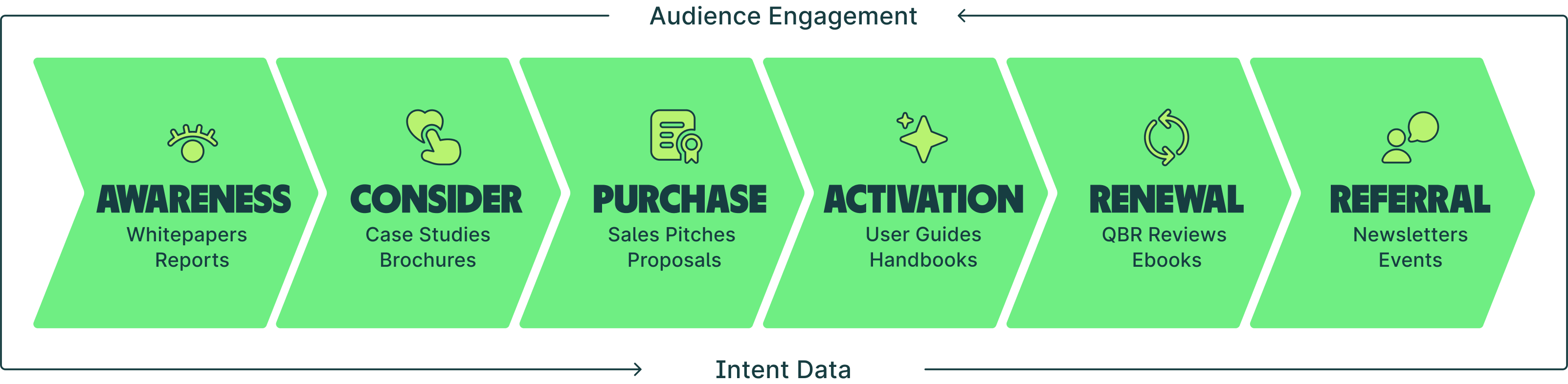
B2B buyer intent data use cases
Segment dynamically for sharper targeting
B2B buyer intent data lets you segment audiences by real buying behavior, not just job titles or company size. Using these intent insights, you can funnel them into responsive, stage-specific content journeys that nudge them further in the right direction. Sharper segmentation means you're not treating a 10k employee enterprise the same as a 20-person startup – and tailored experiences build the trust and connection that closes deals.
Help Sales to sell better
Better conversations lead to better deals; it’s that simple. When Sales knows what topics stakeholders linger on, ignore, or share internally (*ahem* the exact type of insights you get with Turtl), outreach shifts from generic guesswork to sharp, context-rich conversations buyers genuinely want to have. Suddenly, reps aren’t cold-calling in the dark. They’re walking in with behavioral intel that makes every message land.
Spot and stop churn
Ever been blindsided when a seemingly in-the-green account just ups and leaves? Yeah, us neither… When teams rely solely on NPS scores to gauge temperature, they miss signs that an account is about to bail out. With B2B buyer intent data, teams can spot churn long before it hits the dashboard. When product usage dips and first-party content engagement drops or – even worse, competitor research spikes – that’s a surefire sign they’re heading for the door.
Land more upsells
The same signals work in the opposite direction too. Deep, repeated content engagement is one of the strongest predictors of upsell readiness. It’s an underused but powerful way to stay ahead of customer health – and boost your revenue.
Pack a bigger punch with your personalization
B2B personalization hits harder when it’s shaped by what buyers have shown they care about, e.g., the topics they explore deeply, the ones they skip, and the paths they naturally follow. Some platforms, like Turtl, even adapt content on the fly based on these signals, quietly elevating content personalization without the team lifting a finger.
Score and manage leads with confidence
If Sales is drowning in leads (a good problem to have!), intent-led lead scoring is a lifebuoy. It sorts the tyre-kickers from the white-hot prospects, so reps know exactly who to call first. Score them by intent, not intuition – the hotter the signal, the faster you dial. Ranking prospects based on real buying indicators is a cheat code to revenue growth.
Let’s go beyond theory.
The Best Company is trying to prioritize leads without B2B buyer intent data, leaning on traditional engagement metrics and on-the-ground feedback instead.
Someone at Account A downloads a white paper and clicks a few top-of-funnel blogs:
- Marketing flags them as “high-intent” and rushes them to Sales.
- Sales pushes hard – calls, emails, follow-ups.
-
A week goes by and it’s crickets. Another one bites the dust.
Meanwhile, Account B quietly shows real buying signals:
- Three stakeholders reading your buying-stage content
- A spike in third-party research around your category
- A pricing-page visit at 9:12pm (never a coincidence)
The true opportunity? Account B.
But without intent data, it goes unnoticed – and revenue slips away.
Are all types of B2B buyer intent data created equal?
Absolutely not. While all have their merits, some sources are better reflections of buyer intent than others. Let’s break it down.
First-party intent data
This data is the undisputed champion. It includes everything buyers do inside your ecosystem – from website journeys, content engagement, product usage, email interaction, and even event attendance. Because it’s permission-based and contextual, it’s your closest reflection of true B2B buyer intent.
Second-party intent data
This data comes from platforms with a direct relationship to the user. Think software platforms tracking real product interactions and on-site behavior. It’s aggregated and anonymised for privacy, then packaged into insights that give teams deeper buyer context.
Third-party intent data
This data fills in the blind spots. It shows what buyers research across the wider web, like solution articles, review sites, comparison pages, and analysis content. When third-party data is high quality and transparently sourced, it reveals category-level demand.
When B2B buyer intent data sources come together, you build a clear buyer story. Each source adds context, from in-product behavior to wider market research. Combining first and third-party data creates a 360° account view that aligns every GTM team around the same truth – and that’s when your revenue engine really kicks into gear.
How B2B data enrichment improves lead segmentation and management
Imagine B2B buyer intent data as a set of clues. Enrichment is what turns those clues into a full case file. B2B data enrichment fills the gaps: job titles, industries, tech stack, company size, roles in the buying committee, locations, revenue bands. With enriched data, you get the full picture – which makes for more accurate segmentation.
Enrichment also matters majorly for lead management. When Sales receives leads enriched with buying-stage indicators, persona-level interests, and complete contact intelligence, they stop wasting hours chasing dead ends. Conversion rates rise, cycle times shorten, and outreach becomes significantly more relevant.

Top B2B buyer intent data providers
The ecosystem is crowded, but a handful of intent data providers consistently deliver real value.
-
Bombora for reliable category surge data.
-
G2 for high-intent bottom-of-funnel research signals.
-
6sense for predictive modelling and in-market identification.
-
ZoomInfo for enrichment and contact-level insights.
-
Clearbit for real-time firmographics.
-
TrustRadius for competitive research indicators.
-
Turtl for deep, behavioral intent signals embedded in content engagement.
How to source, clean, and validate B2B buyer intent data
Here’s where teams often fall apart. They collect data, then let it gather dust.
Information becomes outdated. Fields go missing. Domains break. Personas shift. Buyer behavior evolves. And before long, your revenue engine is running on a swamp of low-quality, contradictory B2B buyer intent data.
Maintaining a healthy intent data ecosystem calls for a disciplined system.
1. Source from credible places that reflect real buyer behavior
Don’t follow every intent signal you can find. Listen to the ones that matter:
-
First-party engagement: Content depth, return visits, scroll behavior, chapter-level insights.
-
Third-party intent: Category research, competitor comparisons, review site activity.
-
CRM interactions: Call notes, email threads, meeting outcomes.
-
Product usage: Logins, feature adoption, drop-offs.
2. Clean things up regularly
B2B data decays at around 30% per year, so you’ll need a regular cleaning process to keep records in check:
-
Regularly removing duplicates
-
Standardising job titles and industries
-
Validating domains and contact details
-
Purging disengaged or irrelevant accounts
-
Fixing misrouted forms or lead-source errors
3. Enrich missing context for more usable signals
Whether it’s for signal-led ABM or customer health monitoring, one type of data alone can’t give you a full view of accounts (B2B buyer intent data included). Data points like the ones below give that all-important missing context:
-
Firmographics: Size, industry, location
-
Technographics: Tools in their stack that indicate readiness or blockers
-
Buying committee roles: Who influences, who signs, who needs nurturing
-
Historic engagement: Past interactions across channels
4. Validate everything against closed-won deals – or bin it.
To get rid of data points that actively mislead your GTM teams, you’ve got to validate them. Validation means:
-
Running correlation analysis with RevOps
-
Comparing high-intent patterns against real wins
-
Stress-testing whether signals actually change prioritization
-
Removing signals that don’t consistently predict pipeline or deal movement
If a signal doesn’t drive action, alignment, or revenue? Ditch it.
What teams need B2B buyer intent data and why?
Marketing teams use it to prioritize audiences, design personalized campaigns, and understand demand signals across segments.
Sales teams use it to time outreach, tailor messaging, and map buying committees.
RevOps uses it to orchestrate lead scoring, routing, forecasting, and reporting.
Customer Success uses it to spot churn risk or expansion interest long before it becomes verbalised.
Product teams use it to validate user problems and track emerging themes across verticals.
The dangers of bad B2B buyer intent data
No type of data is more dangerous than bad data. Misleading signals send Sales charging after accounts with zero intent, low-quality third-party data throws out false positives, and dashboards crammed with contextless “engagement” lull marketers into thinking things look better than they are.
Bad data doesn’t just slow growth – it unravels alignment. Marketing gets defensive, Sales leaders get sceptical, and suddenly your forecasts read more like fiction than revenue reality. To sum it up, bad data equals wasted time, money, and effort. Which spells disaster for teams under pressure to deliver ROI and revenue from every move they make.
How to evaluate B2B buyer intent data quality
Low-grade data smells off before you even scroll. And it costs you big. Gartner reports that poor data quality costs companies at least $12.9 million per year on average. With stakes that high, it’s beyond important to get (and stay) on top of data quality.
Judging quality comes down to five questions:
- Is it fresh?
- Is it sourced transparently?
- Does it tie to real behavior?
- Can it be validated independently?
- Does it correlate with pipeline and revenue?
If the answer is ‘no’ to more than one of these, it’s probably time to do some spring cleaning of your data sources.
How Turtl delivers revenue-fueling B2B buyer intent data
Most intent tools tell you someone looked. Turtl tells you who cared – and what they cared about. Instead of surface-level clicks, you get journey-aligned behavior: what buyers read twice, linger on, revisit, or share internally.
Those intent signals flow straight into your CRM and MAP, giving Sales real context, Marketing true buying-stage insight, and RevOps a signal layer they can trust. Simply put: Turtl doesn’t just show intent. It helps you act on it – instantly, intelligently, and at scale.
Key takeaways
- B2B buyer intent data shows who’s actively researching and ready to buy, before Sales ever gets involved.
- Most buyers complete ~70% of their journey independently, making intent data critical for timing and relevance.
- Intent data outperforms demographics by revealing real buying behavior, not just titles or company size.
- First-party intent data is the strongest signal, especially when combined with second- and third-party insights.
- High-quality intent data fuels better targeting, personalization, and revenue alignment across GTM teams.