








.jpg?width=1976&height=1480&name=Turtl%20x%20OneAdvanced%20(1).jpg)







Contents
- Why data overload is a problem for ABM teams
- Data vs signals explained
- How to identify real buyer intent signals in ABM
- How do first-party intent signals improve ABM results?
- How do you combine first- and third-party data to get a full view of target accounts?
- How does AI help ABM teams spot real intent signals faster?
- How do signals improve ABM segmentation?
- Building a signal-led ABM system
- Key takeaways
See Turtl for yourself
If you’re running ABM today, you’ve probably had this moment. You check in on your dashboards. Scores and engagement are sitting high. Everything seems to be ticking along nicely. Yet, on the ground, this so-called progress is nowhere to be seen. Pipeline moves at a snail’s pace, Sales waste their energy on the wrong accounts, and your team spends more time trying to decipher mountains of data than acting on it.
To find those needles of actual insight, we’ve got to sift through a hefty data haystack. But, using tools and tactics to separate signal from noise, we can get to the good stuff – quickly and consistently. And when we know who to target, when, and with what message, ABM lives up to its reputation as Marketing’s revenue-driving superstar.
Let’s dive into what a signal-led ABM approach looks like and how you can make it happen.
Why data overload is a problem for ABM teams
When we’re up against more data than we can shake a stick at, things get overwhelming very fast. It’s hard to know where to turn first, and, even when you make a call on what to take your lead from, there’s not much indication you’ve made the right choice until results come in (or not). With data points as clear as dishwater, it’s no surprise that 43% of B2B marketers report having to battle with unreliable data when choosing targets.
Prioritizing accounts, optimizing campaigns, and surfacing genuine insights is much harder than it needs to be when all data shouts at the same volume. The problem? Most ABM teams don’t have the capacity or capability to filter the real intent insights from the noise that distracts their attention – and points them in the wrong direction.
Most of us would happily scrap half our dashboards if it meant knowing which accounts are actually showing intent. Instead of signals, what we get right now is:
- Bloated account lists
- Inconsistent CRM records
- Dashboards packed with vanity metrics
- Engagement data with no context or pattern
Data vs signals explained
Data is raw, unfiltered activity. On its own, it’s just noise – a chaotic collection of clicks, visits, timestamps and “maybe” moments. Signals are intent indicators that emerge when the chaos is sifted through. They’re the meaningful behavioral patterns showing when someone starts to care about your product or service.
They reveal interest, momentum, and buy-in; the stuff that actually moves pipeline. In account-based marketing, signals without action equal missed opportunities, wasted resources, and revenue left on the table. When you build a system that lets you spot signals fast and act on them even faster, the real ABM magic starts to happen.
How to identify real buyer intent signals in ABM
To identify real buyer intent signals, you've got to look for engagement patterns that point to sustained consideration and evaluation, rather than one-off interactions. Traditional metrics like clicks and downloads show some level of interest, but they don’t show what (if anything) is happening below the surface.
To make sure they’re pouring resources into the right places, ABM teams need access to true indicators that an account is actively exploring the problem the business solves – and considering solutions.

Buyer intent shows up in behavior that repeats, deepens, and expands someone’s engagement with your brand. Here are some examples of signals that point to genuine intent, not just passive interest:
- Repeat visits to product or pricing content
- Interaction with comparison pages and review sites
- Progression through long-form content (particularly lower-funnel assets)
- Search spikes on solution keywords
- High engagement with personalized content
- Activity from an account across multiple channels
- Content engagement from multiple people in the same account
- Product-specific webinar attendance
Why intent signals matter more than engagement metrics
Intent signals matter more than engagement metrics because they reveal why an account is interacting, not just whether they interacted.
When ABM teams rely on shallow metrics, they chase ghosts. But when they focus on deeper, trackable intent patterns, they unlock a predictable way to spot which accounts are moving further along the buyer journey. That shift (from reactive engagement measurement to strategic intent tracking) is where ABM builds the foundations for serious revenue impact.
How do first-party intent signals improve ABM results?
First-party intent signals improve ABM results by showing what buyers do inside your content, website, and digital experiences, getting rid of any guesswork about how your ABM content is landing.
Because they’re permission-based and proprietary, signals from first-party intent data are the most accurate reflection of who’s engaged, what topics they care about, and how their interest builds over time. Coming straight from the source, they’re the closest thing to buyer truth you’ll get in B2B.
When first-party signals are tied to specific topics, assets, and journey progression, they give teams the context needed to prioritize the right accounts at the right time. And when resources are going where they matter most, content and campaign ROI, deal velocity, and revenue impact all skyrocket.
How do you combine first- and third-party data to get a full view of target accounts?
To get a full view of target accounts, you'll need to blend insights about what buyers do with you (first-party data) with what they get up to elsewhere (third-party data). Because, as great as it is, first-party data isn’t the entire picture.
To understand whether an account is truly in-market, you need to know what’s happening beyond your own ecosystem — which is where credible third-party intent data providers come in to complete the story.
Third-party data fills in the blind spots. It shows what buyers research outside your walls, giving insight into wider category signals, competitive comparisons, topical surges, and broader market behaviour.
First-party data gives depth; third-party data gives breadth. When you combine first and third-party data, you get a 360° view of account readiness: who’s warming, who’s actively evaluating, and who’s just kicking tyres.
How does AI help ABM teams spot real intent signals faster?
Even the best data is useless if it arrives in pieces. That’s where AI makes its mark – not as a buzzword, but as the connective tissue ABM has been missing.
The right AI tool stitches together fragmented touchpoints, interprets behavior at scale, and centralises the signals that correlate with buying readiness. Instead of sifting through dozens of dashboards, teams get one clear view of which accounts are entering meaningful stages of research.
AI-powered platforms identify patterns humans simply can’t catch consistently. When AI consolidates signals across channels, it becomes much easier to distinguish interest from noise. Content exploration, repeat visits, escalation in activity, all of it gets woven into a single narrative about account engagement.
Here are some of the ways AI removes friction so ABM teams can lift their program’s performance:
- Isolating genuine purchase cues from irrelevant activity
- Dynamically updating scoring based on real-time behavior
- Identifying clusters with shared pain points
- Flattening ABM program learning curves
- Powering content personalization at scale
What’s the impact of intent signals on sales and marketing collaboration?
Bringing AI-sourced signals into your ABM works wonders for team cohesion and alignment too. When teams are operating from the same insights, priorities tend to sync naturally. And by using AI to push signals directly into CRM and marketing automation systems, Sales get equipped with actionable, timely intel that makes landing target accounts much easier. And anything Marketing does to make Sales’ life easier always goes a long way in easing cross-functional friction.
ABM 2030
Want to future-proof your ABM with AI, signals, and revenue-focused systems?
ABM 2030 is a practical playbook that shows you how. It's a roadmap to a better future for teams on the hook for revenue.
How do signals improve ABM segmentation?
Combining segmentation with real-time signals gives you the best of both worlds: scale where it makes sense, specificity where it matters. Segmentation is useful, but on its own, it’s shallow. Grouping accounts by industry or size might make planning easier, but it often strips away the nuance needed to personalize effectively.
The key to bringing traditional targeting tactics into the modern age is using signals to strike the balance between broad segmentation and 1:1 targeting. That’s what helps teams deliver relevance without draining resources.
When you layer live intent signals on top of clusters of lookalike accounts, you get groups that actually make sense to target together. And when you pair those cluster-level themes with customized assets powered by first-party data, AI, and modular personalization, you realize every ABMer’s dream: a scalable ‘audience of one’ approach to ABM that delivers consistent pipeline and revenue.
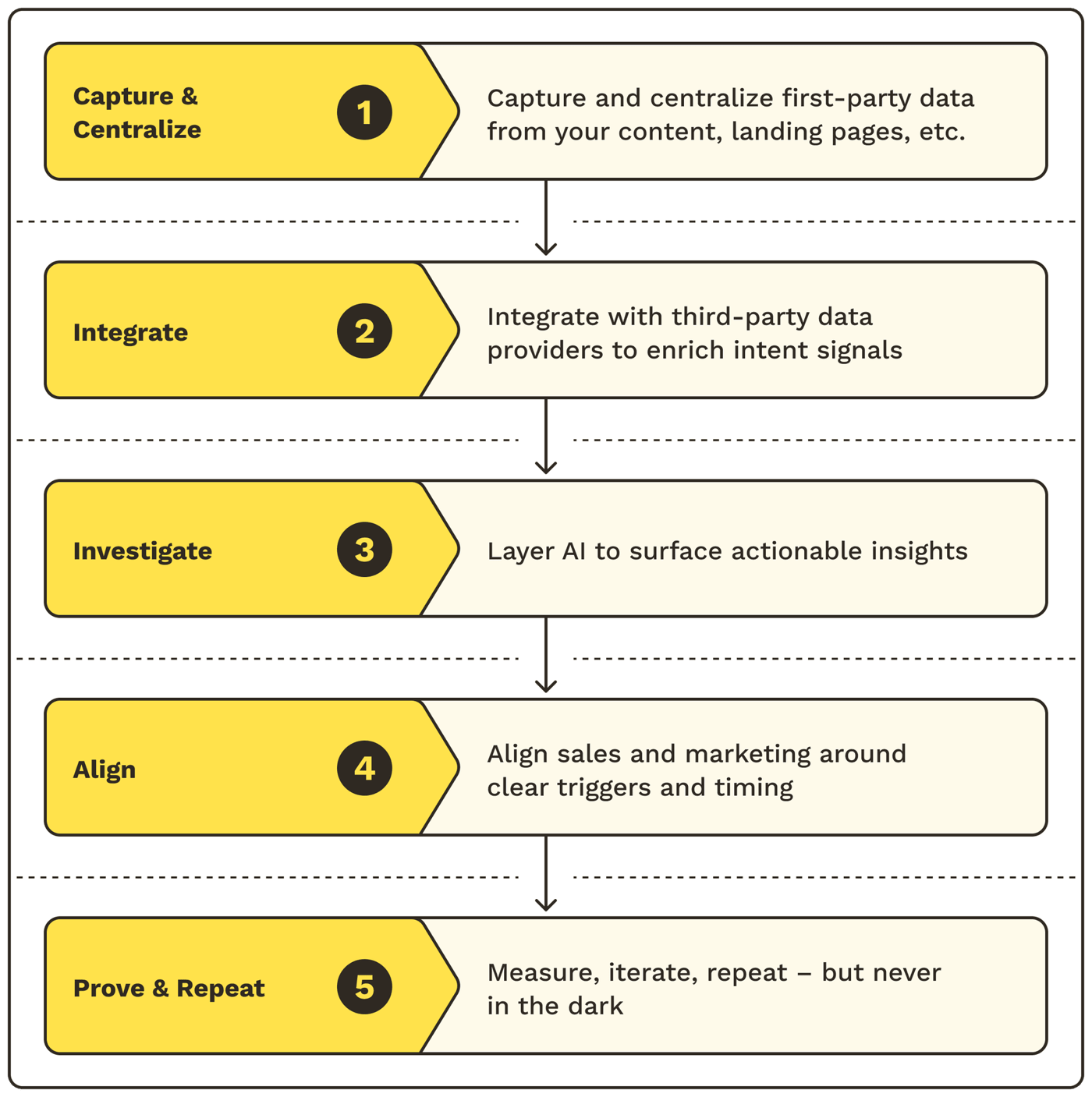
Building a signal-led ABM system
So now that we’ve spelled out why signals should be the foundation of your ABM program, here’s how to create a signal-led ABM system of your very own:
Key takeaways
- Signals, not raw data, drive effective ABM. Too many metrics create noise and make it hard to prioritize the right accounts.
- Intent patterns show real buying readiness. Repeat behavior, deeper content engagement, and multi-channel activity reveal who’s truly in-market.
- First- and third-party data create a full picture. First-party gives accuracy; third-party adds broader context to confirm account readiness.
- AI accelerates insight discovery. It connects touchpoints, highlights meaningful patterns, and updates scoring in real time.
- Signal-led ABM boosts alignment and results. Teams focus on the same high-value accounts, improving personalization, pipeline, and revenue impact.