








.jpg?width=1976&height=1480&name=Turtl%20x%20OneAdvanced%20(1).jpg)





HOW TO SURFACE REAL-TIME BUYING SIGNALS FROM CONTENT ENGAGEMENT TO SALES
Jun 08, 2026

Contents
- Why content engagement produces better buying signals than most intent data
- What a real buying signal looks like in content data
- How to build the signal identification workflow
- How to prioritize which signals to act on
- The integration layer: getting engagement data into the systems that drive sales action
- What good looks like in practice
- Frequently asked questions
Head of Product Marketing and AI GTM @ Turtl, Award-Winning PMM and globally recognized PMM leader. Author of the best-selling book "The Product Momentum Gap.”
See Turtl for yourself
Clicks, opens, and downloads tell you that someone interacted with something. They tell you nothing about whether that person is evaluating, comparing, or moving toward a decision.
The engagement data that actually predicts buying behavior sits one level deeper: which sections a reader spent time on, whether they returned to a specific chapter, whether multiple people from the same account read the same asset in the same week. That signal layer is sitting in your content platform right now. The gap is not data collection; it is the workflow that gets those signals to your sales reps at the moment they matter.
This guide covers what makes a content engagement signal meaningful, how to identify the patterns that correlate with buying readiness, and how to build that workflow end to end.
Why content engagement produces better buying signals than most intent data
Third-party intent data shows you what buyers research across the wider web. It gives you category-level interest, but limited context. You know an account is searching for solutions in your space. You do not know what specifically they care about, which argument resonates, or how seriously they are evaluating.
First-party content engagement fills that gap. When a buyer reads your content inside your ecosystem, you see exactly which topics they engaged with, how deeply they read, and what they came back to. That is a much closer signal to actual buying behavior. As we cover in B2B buyer intent data, first-party data is the most accurate reflection of buying readiness because it comes directly from the buyer's own actions with your content, not from inferred behavior elsewhere.
The practical advantage: when a sales rep receives an alert that someone at a target account has spent 18 minutes reading your pricing-tier comparison and then forwarded it to two colleagues, they have context, not just a lead score. That context changes the conversation.
What a real buying signal looks like in content data
Not all engagement is equal. A reader who opens a top-of-funnel blog post and bounces after 30 seconds is not exhibiting the same buying behavior as someone who reads 80% of your ROI methodology guide and then returns three days later to read the integration overview.
The patterns that correlate most reliably with purchase intent in content are:
-
Depth of engagement on evaluation content
Pricing pages, comparison sections, ROI calculators, and integration documentation attract buyers who are actively assessing options. Time-on-page and scroll depth on these sections are stronger signals than on awareness-stage content. -
Return visits to the same asset
A single read suggests interest. A return visit to the same content suggests the buyer went away, thought about it, and came back with a reason. That behavior pattern is a meaningful indicator of active consideration. -
Multi-stakeholder engagement from the same account
When two or three people from the same company read the same asset within a short window, it is a reliable indicator that someone has shared it internally. Internal content sharing within a buying committee is one of the strongest available signals that an account is in active evaluation. -
Progression through late-stage content
Buyers who move from category-level content to product-specific, vendor-specific, or commercial content are demonstrating journey progression. The direction of engagement matters as much as the volume. -
Engagement with personalized assets
When a buyer engages deeply with content that was personalized for their account or industry, the signal is amplified. They are not just reading generic material; they are engaging with something built for them. Turtl's analytics layer tracks this at the chapter and section level, giving you visibility into exactly which parts of a personalized asset are landing.
How to build the signal identification workflow
Getting useful signals to your sales team requires more than a content platform with engagement tracking. It requires a system that converts raw engagement data into scored, prioritized, and actionable intelligence. Here is the workflow structure that works in practice.
Step 1: Define your signal threshold
Not every engagement event warrants a sales notification. Set thresholds that reflect genuine buying intent rather than casual browsing. A useful starting framework: a signal is worth routing to sales when it meets two or more of the following criteria.
-
The buyer spent meaningful time on evaluation-stage content, such as more than five minutes on a pricing or comparison section.
-
The same contact has visited the same asset more than once within a 14-day window.
-
Two or more people from the same account have engaged with the same asset.
-
The engagement includes a section that directly maps to a qualification criterion, such as an integration that matches their known tech stack.
Teams that route every engagement to sales create noise and erode trust in the alert system. Signal thresholds protect that trust.
Step 2: Map signals to your lead scoring model
Content engagement signals should feed directly into your existing lead scoring model, not sit in a separate reporting layer that sales has to check manually. The scoring logic converts engagement events into point increments. Deep engagement with evaluation content scores higher than awareness-stage reads. Return visits score higher than first-time views. Multi-stakeholder engagement triggers an account-level score uplift rather than a contact-level increment.
When engagement data flows automatically into your CRM scoring rules, the lead score itself becomes the trigger for sales action. There is no separate step where someone has to interpret a dashboard and decide whether to notify a rep.
Step 3: Connect the content platform to your CRM or MAP
The signal workflow only works if the content engagement data is in the system your sales team operates from. Most CRMs and marketing automation platforms can receive custom event data. Turtl sends behavioral events directly into HubSpot, Marketo, and Pardot, including section-level engagement, completion rates, shares, and return visits.
Once those events are in your CRM, they appear on the contact and account timeline, feed into scoring models, and can trigger automated workflows, such as a task assigned to the account's rep or an enrollment in a targeted sales sequence.
The detail covered in new ways to power your CRM with real audience intent explains how to configure this directly within your CRM's integration settings, including enabling passive reader identification so known contacts are attributed to engagement even without form submissions.
Step 4: Set up the sales rep alert
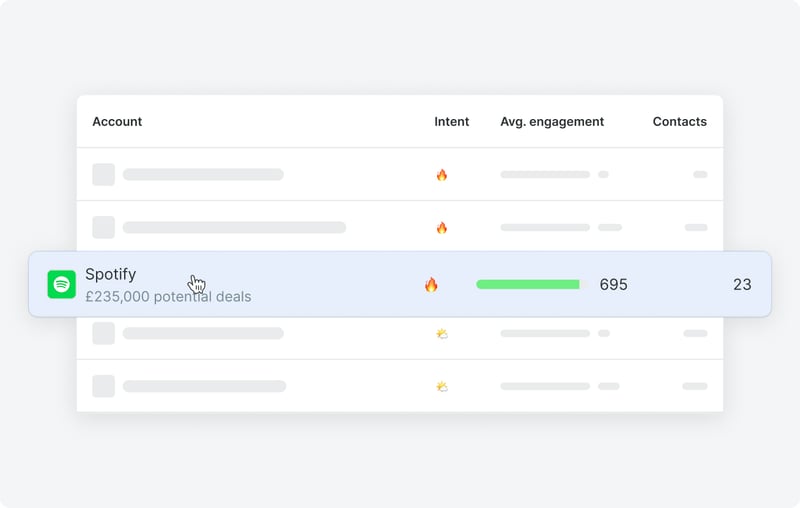
The final step is getting the signal to the right person at the right time. A well-configured alert tells the rep three things: who engaged (the contact and account), what they engaged with (the specific asset and the sections that saw the most time), and when (a timestamp that lets the rep contextualize the engagement against other known activity on the account).
Alerts can be delivered via CRM task, Slack notification from a CRM workflow, or directly through a sales engagement platform. The format matters less than the timing and specificity. A rep who receives an alert four days after the engagement and has to log into a separate dashboard to understand what happened will stop acting on it.
How to prioritize which signals to act on
Signal volume increases as your content program scales. A well-instrumented content program across 200 target accounts generates more engagement data than any sales team can respond to individually. Prioritization is essential.
A practical framework: route signals to sales in three tiers based on account status and signal strength.
Tier 1: active accounts already in pipeline. Any meaningful engagement from an account that already has an open opportunity should trigger an immediate rep notification. The rep has context on the account and can act on the signal in an existing relationship.
Tier 2: target accounts not yet in pipeline. High-signal engagement from accounts on your ICP target list, especially multi-stakeholder engagement or engagement with late-stage content, warrants a proactive outreach task for the rep or SDR assigned to that account. This is the signal-led ABM motion: letting buying behavior on your content determine when to escalate outreach rather than running outreach on a calendar cadence.
Tier 3: accounts not on the target list. Log the engagement and let it accumulate rather than routing to sales immediately. If an account outside your ICP shows sustained high-signal engagement across multiple assets over a short period, that is a prompt to re-evaluate whether the account should be added to the target list.
The tiering logic can be automated in your CRM using account properties and scoring rules. You do not need to manually triage incoming signals once the workflow is configured.
The integration layer: getting engagement data into the systems that drive sales action
The technical setup for a working signal-to-sales workflow has three components.
-
Content tracking configured for behavioral depth. Surface-level click tracking does not give you what you need. You need section-level engagement, time-on-page by chapter, scroll depth, return visit tracking, and the ability to identify known contacts from your CRM database as readers, without requiring a form submission at every entry point.
-
Custom event delivery to your CRM or MAP. Engagement events need to flow into the system of record your sales and marketing teams use for scoring, segmentation, and workflow automation. When configured correctly, this means behavioral signals from content update the same contact and account records that drive sales rep prioritization, without any manual data transfer step.
-
Workflow rules that convert events into rep actions. The engagement data in your CRM is only useful if it triggers something. Workflow rules should convert qualifying events, defined by your signal thresholds, into CRM tasks, rep notifications, scoring increments, or enrollment in targeted sales sequences.
Teams that connect Turtl's first-party analytics to 6sense or Demandbase account intelligence alongside CRM data get a particularly rich signal layer: you can cross-reference what someone read in your content against the third-party intent topics they are researching, giving the rep both behavioral context from your assets and market context from broader research activity.
What good looks like in practice
A B2B marketing team running a 150-account ABM program has Turtl connected to HubSpot. Engagement events flow into HubSpot as custom behavioral properties on each contact record.
A mid-level VP at a financial services account in Tier 1 spends 22 minutes reading a Turtl Doc sent by the account's rep. She reads the case study section twice, skips the implementation chapter, and spends four minutes on the pricing tier comparison. HubSpot receives the event data, the contact's lead score increments, and the rep receives a task with a summary of which sections generated the most engagement.
The rep uses that context to skip the generic product overview in their follow-up and leads with the commercial conversation the buyer is already in. Cycle time on that account compresses because the rep is not re-establishing context that the buyer has already signaled through their reading behavior.
That is what surfacing real-time buying signals from content engagement to sales actually looks like in practice. The technology is available. The workflow described here is repeatable. The gap for most teams is not capability; it is the configuration step between content platform, CRM, and sales process.
Frequently asked questions
What is the best way to surface real-time buying signals from content engagement to sales reps?
The most reliable workflow has four steps: define signal thresholds that distinguish genuine buying behavior from casual browsing, map those engagement events into your existing lead scoring model, connect your content platform to your CRM so events update contact and account records automatically, and configure workflow rules that convert qualifying signals into rep notifications or tasks. The critical detail is that signals need to include context, not just a score increment. A rep who receives an alert showing which specific sections of an asset a buyer spent time on has a far stronger basis for a follow-up conversation than one who receives only a lead score change. Turtl delivers section-level behavioral events directly into HubSpot, Marketo, and Pardot, giving reps that context inside the CRM they already use.
What content engagement signals most reliably indicate buying intent?
The highest-signal behaviors are: deep engagement with evaluation-stage content such as pricing, comparison, and ROI sections; return visits to the same asset within a short window; engagement with the same asset from multiple contacts at the same account; and engagement with personalized content built specifically for the account or industry. These patterns indicate active consideration rather than passive browsing. A single top-of-funnel read is not a buying signal. A pattern of escalating engagement with late-stage content across multiple stakeholders is.
How do you connect content engagement data to your CRM for sales alerts?
Most modern content platforms can send custom event data to CRM and marketing automation systems via native integrations or webhooks. In Turtl, behavioral events including views, section completions, shares, and return visits flow directly into HubSpot, Marketo, and Pardot as custom properties on contact and account records. Those events can then be used in scoring rules, workflow triggers, and sales notifications without any manual data transfer. The setup is configured within your CRM's integration settings and does not require developer involvement.
How do you avoid overwhelming sales with too many engagement alerts?
Set signal thresholds that require more than a single engagement event before triggering a rep notification. Require two or more qualifying behaviors from the same contact or account: for example, a return visit combined with engagement on a pricing section, or multi-stakeholder engagement within a 14-day window. Tiering your target accounts also helps: route immediate notifications only for accounts already in pipeline or on your tier-one target list, and let engagement from lower-priority accounts accumulate as scoring data rather than triggering individual rep tasks.
How does content engagement data complement third-party intent signals?
Third-party intent data shows you what buyers research across the wider web. First-party content engagement shows you what they actually did with your content. When layered together, you get a more complete account picture: third-party signals confirm that an account is actively researching your category, while first-party engagement shows which specific topics, proof points, and commercial details they engaged with inside your assets. Sales reps working from both signal types can enter conversations with category-level context from intent data and asset-level specificity from content engagement.
Turtl is the Revenue Content Platform that connects content engagement to pipeline. First-party behavioral signals from every Turtl asset flow directly into your CRM, giving sales reps real-time context on what target accounts are reading, revisiting, and sharing internally.