








.jpg?width=1976&height=1480&name=Turtl%20x%20OneAdvanced%20(1).jpg)






Contents
- Why content engagement data belongs in your MAP
- What Turtl sends to Pardot by default
- How sales and marketing teams actually use this data
- Custom content events on Grow AI and Scale AI plans
- As simple as one, two, toggle
- Frequently asked questions
- The signal was always there
Head of Product Marketing and AI GTM @ Turtl, Award-Winning PMM and globally recognized PMM leader. Author of the best-selling book "The Product Momentum Gap.
See Turtl for yourself
Account Engagement is typically built around web traffic: what prospects clicked, which forms they filled, which emails they opened. That data matters, but it misses the moment where real buying intent shows up. When a prospect spends eight minutes reading your proposal, clicks through to your pricing section, and downloads the PDF, none of that typically makes it into Pardot.
Turtl's Pardot integration changes that. As prospects engage with any Turtl content, their behavior gets captured and sent directly into Account Engagement in Pardot as Prospect activities. Page views, time on page, link clicks, and form submissions all surface in Pardot, giving your sales and marketing teams a clear read on what buyers actually engaged with before they respond or go dark.
TL;DR:
Turtl's native Pardot integration sends reader engagement signals from every piece of Turtl content activity automatically. Enable it with one toggle in the Integrations Hub. Your entire workspace starts tracking immediately.
Why content engagement data belongs in your MAP
Pardot tracks web traffic well. A prospect lands on your pricing page, visits your blog, fills out a form, and Pardot sees all of it. But when a prospect spends four minutes reading your proposal, clicks through to your ROI chapter, and watches the embedded demo video, that tells a different story, and standard MAP tracking misses it entirely.
According to Turtl's Revenue Gap research, 96% of marketing executives say reliable data would give them a competitive edge. For teams running ABM programs, measuring ABM content engagement is often the richest signal available. It shows which buyers are actively evaluating, which topics hold their attention, and how far they progress through a long-form piece before they reach out or go quiet. That kind of signal should be driving your scoring and automation. Instead, it disappears.
Turtl's Pardot integration puts it back. Reader-level content signals flow directly inside Pardot, where they can drive automation, scoring, and sales follow-up without any additional platform or manual export.
What Turtl sends to Pardot by default
When you enable the integration, Turtl applies its tracking code to every piece of content in your workspace automatically. For each visitor who engages, Pardot receives:
- The content URL
- Total page views within the session
- Session type (entry point, last page viewed)
- Time spent on each page
- Session date and time
- Referring URL
These events appear in two places in Pardot’s Account Engagement: the Visitors report, which captures both anonymous and identified visits, and each Prospect's activity feed, where page views are grouped under a Visit activity. Once a visitor is identified through a form fill or email click, their full engagement history retroactively attaches to their Prospect record. Every minute they spent reading before they became a known contact is preserved.
How sales and marketing teams actually use this data
The engagement data Turtl sends is structured identically to Pardot's standard page-tracking data, so it works with every automation rule, scoring model, and Page Action you already have in place.
In practice, teams put this data to work in three ways.
Prospect scoring. Add a scoring rule for Turtl content visits the same way you would for any other tracked page. Assign points for time on page or specific chapter views to surface prospects who are deep into evaluation rather than just browsing. If you're building or revisiting your prospect scoring models, content engagement thresholds are a natural addition.
Automation triggers. Build automation rules that fire when a prospect views a specific piece of content or reaches a read time threshold. Route them to a sales rep, enroll them in a nurture sequence, or update their lifecycle stage based on what they engaged with.
Sales context before the call. SDRs and AEs can see content visits in the Prospect activity feed before they reach out. A prospect who spent six minutes on the pricing section the day before a scheduled call deserves a different opening conversation than one who bounced after the introduction, and now that context surfaces automatically rather than disappearing before it reaches a rep. For a deeper look at how content engagement signals reach your sales team, there's more on that here.
Custom content events on Grow AI and Scale AI plans
On Turtl's Grow AI and Scale AI plans, the standard tracking code extends to send specific reader actions as custom events to Account Engagement. Each one is configured as a Page Action in Pardot, giving you precise control over what triggers automation.
Custom events include page turns and chapter navigation, read time milestones from 30 seconds up to 10 minutes, PDF downloads, video and audio plays, form submissions (both lead capture and personalization forms), link clicks with destination URLs, and poll responses with the question and answer recorded.
Each event can be marked as a Priority Page in Account Engagement, which surfaces it as a standalone Prospect activity rather than bundling it into a Visit. For high-signal moments like a PDF download or a form submission, that distinction makes it easy for sales to spot what matters at a glance.
As simple as one, two, toggle
The Pardot integration lives in Turtl's Integrations Hub. Click Integrate in the left navigation, select Pardot, expand the Reader Intent Data section, and toggle it on. The tracking code activates across every piece of Turtl content in your workspace instantly. Setup is developer-free and applies to your entire workspace automatically.
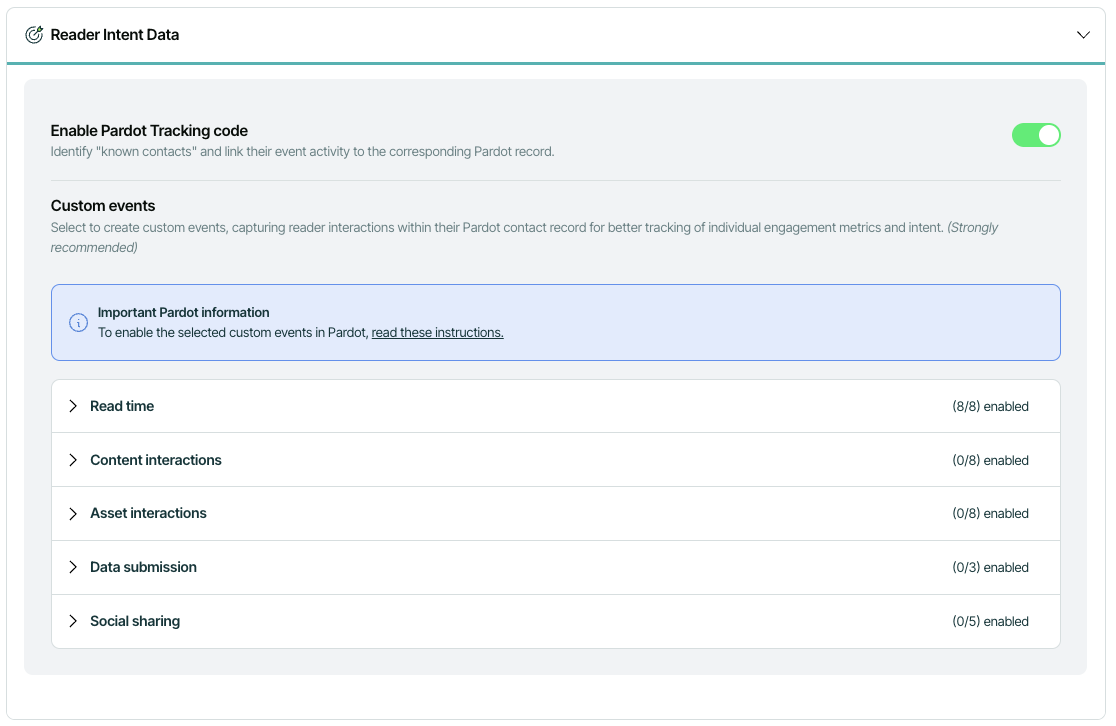
For custom events on Grow AI and Scale AI plans, you create a corresponding Page Action in Account Engagement for each event you want to capture. Turtl's support team assists with the configuration to match your Pardot setup.
Frequently asked questions
Does Turtl's Pardot integration require developer support to set up?
Turtl's Pardot integration is enabled from the Integrations Hub with a single toggle. The tracking code applies to every piece of Turtl content in your workspace automatically. For teams on Grow AI or Scale AI plans who want custom events, setup involves creating Page Actions in Account Engagement. Turtl's support team handles the event configuration.
What engagement data does Turtl send to Account Engagement by default?
By default, Turtl sends the content URL, total page views, session type, time on page, session date and time, and referring URL for every visitor who opens any Turtl content. This data appears in the Account Engagement Visitors report and in each identified Prospect's activity feed. On Grow AI and Scale AI plans, custom events extend this to include specific page turns, read time milestones (30 seconds to 10 minutes), PDF downloads, video and audio plays, link clicks with destination URLs, form submissions, and poll responses including the answer given.
Can I use Turtl engagement data in Pardot automation rules and scoring?
Yes. Turtl content visits use the same data structure as standard Account Engagement page visits, so they work with existing scoring models and automation rules without additional configuration. You can score prospects based on specific content views or read time thresholds, and trigger automation rules from Turtl content engagement the same way you would from any other tracked page.
Does Turtl track anonymous visitors in Pardot?
Yes. Turtl content visits from anonymous visitors appear in the Account Engagement Visitors report. When a visitor is later identified through a form fill or email click, their full history of Turtl content engagement retroactively attaches to their Prospect record, preserving the complete engagement timeline. For more on which accounts are engaging with your content before they identify themselves, see our guide on turning anonymous traffic into account intelligence.
What Turtl plans support custom content events in Pardot?
Custom content events are available on Turtl's Grow AI and Scale AI plans. Standard tracking (page views, time on page, session data, and referring URL) is available on all Turtl plans.
How does Turtl content engagement appear inside Pardot?
Standard Turtl content visits appear as Visit activities in the Prospect activity feed and in the Visitors report. For teams on Grow AI or Scale AI, each custom event is configured as a Page Action in Pardot’s Account Engagement. When you mark an event as a Priority Page, it surfaces as a standalone Prospect activity, making high-value interactions like a PDF download or form submission immediately visible in the feed without having to expand a Visit entry.
The signal was always there
Your buyers have been engaging with your content, spending real time on the sections that matter to them, and Turtl's Pardot integration means none of that gets lost. Every interaction reaches Pardot automatically, ready to inform your scoring, automation, and the conversations your sales team has next.
[Request a demo] | [See Turtl's integrations]