








.jpg?width=1976&height=1480&name=Turtl%20x%20OneAdvanced%20(1).jpg)




Contents
- What is Dynamic Personalization?
- Why this matters for revenue teams
- How it works
- Turtl's expansion of Revenue Content
- Announcing partnerships with 6sense and Demandbase
- Getting started
- FAQs
Head of Product Marketing and AI GTM @ Turtl, Award-Winning PMM and globally recognized PMM leader. Author of the best-selling book "The Product Momentum Gap.”
See Turtl for yourself
Here’s a problem most marketers can relate to: You target multiple segments, but everyone sees the same content.
Your go-to-market strategy includes healthcare, manufacturing, and financial services. Your ICP spans enterprise and mid-market buyers. You've built messaging frameworks for each segment because you know different buyer groups need different approaches.
But when a prospect lands on your content? There's little to no B2B personalization available.
Healthcare companies read manufacturing use cases, SMBs see enterprise pricing, and financial services buyers review retail testimonials. Everyone gets the same examples, the same case studies, the same statistics.
Why is this a problem?
You want to personalize, but creating separate versions for every segment and every piece of content is impossible. Your team can't build five versions of every landing page, ten versions of every case study, and fifteen versions of every white paper. So you choose one version and hope it works for everyone.
Spoiler alert: It doesn't.
Healthcare prospects bounce because nothing addresses their compliance challenges. Mid-market companies assume you only serve enterprises. Financial services buyers see examples from industries that don't match their regulatory environment.
By the time someone fills out a form, they've already decided if your content speaks to them.
Generic content makes that decision for you.
Today, we're changing that with Dynamic Personalization.
What is Dynamic Personalization?
Dynamic Personalization adapts your content in real time based on the company visiting your site.
Same content. Different experience. Zero form fills required.
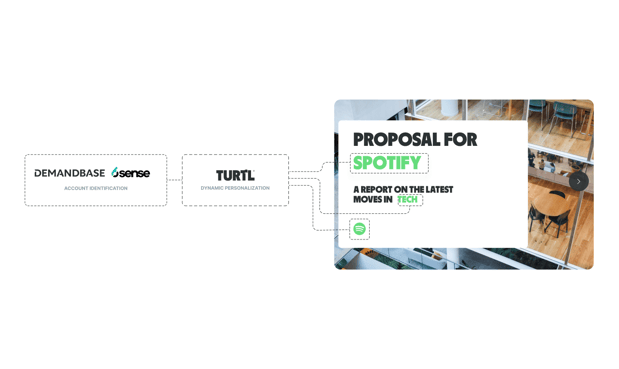
The technology works through reverse IP lookup. When someone from Acme Corp visits your Turtl content, we identify the company instantly and pull firmographic data – like industry, revenue, employee count, and buying stage.
This data is used to adapt your content on the fly: text changes, images swap, and entire sections appear or disappear based on relevance.
You set the rules once, and personalization happens automatically in real time for every visitor after that.
Why this matters for revenue teams
Generic content kills deals before they start, and your analytics prove it. The bounce rates keep climbing, your sales team complains about unqualified leads, and your conversion rates stay stuck – no matter how much traffic you drive.
The problem isn't volume. The problem is relevance.
When a prospect lands on your content and sees examples that don't match their industry, company size, or use case, they make an instant judgment: this isn't for me. They won't fill out a form to ask if you serve their segment. They just leave, and you lose the opportunity before you even knew it existed.
The old solution was gating content to capture identity, then personalizing follow-up emails. This was ineffective because most prospects don’t fill out forms, meaning even your best opportunities only see generic content. The ones who do convert formed their opinion based on what they saw before the gate.
Dynamic Personalization cuts down on that friction by personalizing at first touch.
The healthcare buyer group sees healthcare examples the moment they arrive, the manufacturing buyer group sees manufacturing case studies, and the retail buyer group sees stats from companies their size. Each segment immediately knows the content was built for someone like them.
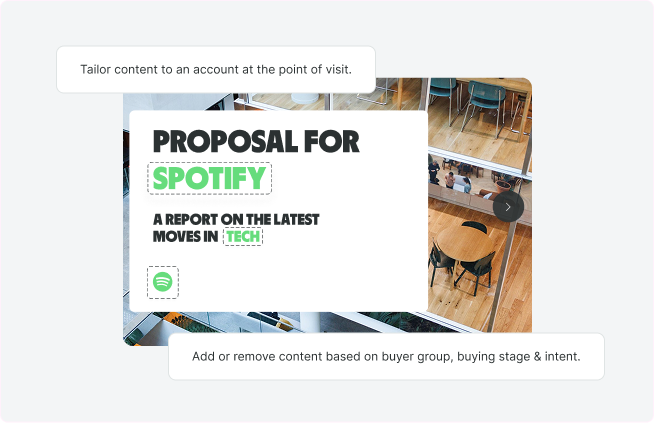
For ABM teams, Dynamic Personalization makes it possible to automate personalized campaigns at scale and in real time. Target a list of 500 accounts across five industries and create one piece of content with dynamic rules. The result is one asset, 500 personalized experiences, and no more friction points.
For demand gen teams, this feature means higher engagement from cold traffic. Someone discovers your content through search or social, and they immediately see examples from companies like theirs. The content feels relevant from word one, so they keep reading instead of bouncing – and you reclaim prospects at the top of the funnel.
For sales teams, this means better context when prospects do convert. You can see exactly which personalized version they engaged with, what industry messaging resonated, and which use cases they spent time reading. More importantly, more prospects actually convert because they saw relevant content during their research phase instead of generic messaging that made them leave.
How it works
You create content in Turtl the same way you always have. The difference is in how you set up personalization.
Define what changes for each buyer group: Healthcare companies see healthcare case studies and compliance-focused messaging. Manufacturing accounts see supply chain examples and operational ROI. Enterprise prospects see enterprise pricing, while mid-market companies see pricing scaled to their size.
Personalize based on any firmographic data available from your 6sense or Demandbase integration: Use company attributes in dynamic tokens throughout your content, or create rules that show and hide entire sections, chapters, or pages based on who's reading. The result is different images, statistics, case studies, and calls to action for different segments.
Set the rules once, and they apply automatically: When someone from a healthcare company visits, they see healthcare content straight away. When someone from a 50-person company arrives, they see mid-market examples, with no additional work required.
Turtl's expansion of Revenue Content
Dynamic Personalization is one piece of a larger evolution.
Turtl was built to close the revenue gap, the disconnect between marketing's content investment and its ability to prove that content’s revenue impact. That mission now extends across an expanding set of formats, including Turtl Docs and landing pages, with deeper intelligence powered by intent provider partnerships.
This means personalization is no longer limited to a single content type or campaign. As Turtl's format library grows and its integration with intent platforms deepens, every piece of content in your library becomes a personalized, measurable, revenue-connected asset.
The platform scales with your content strategy, so every format benefits from the same dynamic rules, the same engagement analytics, and the same pipeline attribution.
Announcing partnerships with 6sense and Demandbase
Dynamic Personalization is powered by our new integrations with 6sense and Demandbase.
These platforms provide the account intelligence that makes real-time personalization possible. They identify which company is visiting based on IP address, then supply the firmographic and behavioral data needed to personalize effectively. Industry, revenue, employee count, technology stack, buying stage, and intent signals all flow into Turtl to drive content adaptation.
For teams already using 6sense or Demandbase, this integration extends your investment. The account data you're already capturing now powers personalized content experiences across your entire library.
The combination delivers something neither platform can do alone: intent data tells you who's in market, while Turtl shows them content that matches their specific context. The result is higher engagement, better conversion, and clearer signals about what each account cares about.
Getting started
Dynamic Personalization is available now for Grow AI and Scale AI customers. Connect your 6sense or Demandbase account, set your personalization rules, and watch your content adapt for every visitor.
Higher engagement, better conversion, and more qualified pipeline – now available in Turtl.
FAQs
What is Dynamic Personalization?
Dynamic Personalization adapts your content in real time based on the company visiting your site. Using reverse IP lookup and firmographic data from 6sense or Demandbase, it automatically shows different content versions to different companies based on industry, size, buying stage, and other attributes, all before anyone fills out a form.
How does Dynamic Personalization identify anonymous visitors?
Dynamic Personalization uses reverse IP lookup technology to identify which company is visiting your content. When someone from Acme Corp visits, we identify the company and pull firmographic data including industry, revenue, employee count, and buying stage from your 6sense or Demandbase integration.
Do I need to use 6sense or Demandbase?
No, Dynamic Personalization does not require an integration with intent providers. All legacy and AI customers that have personalization available will have access. Upgrades are available for extended usage.
What can I personalize with Dynamic Personalization?
You can show or hide chapters in Turtl Docs or sections in landing pages based on company attributes, change statistics to match company size, or modify calls to action based on buying stage. Personalization rules can be based on industry, revenue size, employee count, geographic region, or buying stage. For a full list, please refer to 6sense and Demandbase documentation.
Do I need to create multiple versions of my content?
No. You create one piece of content and define personalization rules within it. The same asset automatically adapts based on who's viewing it. For example, one landing page can serve five different industries by swapping examples and case studies dynamically.
How is this different from traditional content personalization?
Traditional personalization requires form fills to identify visitors, then personalizes follow up emails or subsequent page views. Dynamic Personalization works immediately on anonymous visitors at first touch (before any form fill) using company level identification rather than individual identity.
Can I personalize content based on buying stage?
Yes. If your 6sense or Demandbase account includes buying stage data, you can create rules that show different content to prospects in Awareness, Consideration, and Decision stages. Early stage prospects might see educational content while late stage prospects see pricing and implementation details.
How do I set up personalization rules?
Within the Turtl editor, you define rules for when specific content should appear. For example: "If industry = FinTech, show Section A" or "If employee count > 1000, show enterprise pricing." Rules can be as simple or complex as your data allows, and they apply automatically to all visitors.
Will this slow down my content loading time?
No. The reverse IP lookup and content adaptation happen in milliseconds. Visitors see personalized content immediately without any noticeable delay in page load time.
What happens if we can't identify the company?
If the reverse IP lookup cannot identify the company (for example, if someone is on public Wi Fi without a VPN), they see the default version of your content. You define what this default experience looks like.
Is Dynamic Personalization available on all Turtl plans?
Dynamic Personalization is available for Grow AI and Scale AI customers, as well as any customers who had personalization as an add-on.