









.jpg?width=1976&height=1480&name=Turtl%20x%20OneAdvanced%20(1).jpg)






Contents
- 1. Build one base asset, then generate hundreds of account-specific versions
- 2. Personalize for individual buying committee members, not just the account
- 3. Let AI personalize content in real time as buyers engage
- 4. Give sales the ability to generate personalized content on demand
- 5. Use interactive self-personalization to reveal buyer intent
- 6. Measure how deeply buyers engage,
- 7. Sync content engagement signals to your ABM stack
- Frequently asked questions
Head of Product Marketing and AI GTM @ Turtl, Award-Winning PMM and globally recognized PMM leader. Author of the best-selling book "The Product Momentum Gap.”
See Turtl for yourself
The buying committee for a typical enterprise deal has six to ten people in it. Each of them is reading your content with a different agenda, different objections, and a different threshold for forwarding something to a colleague. One undifferentiated asset can't cover that ground, and yet that's what most ABM programs ask it to do.
AI-powered ABM content personalization changes the math. The tactics below show how to build personalization programs that scale across your entire target account list, generate stronger buying committee engagement, and produce the intent signals your sales team can actually act on.
1. Build one base asset, then generate hundreds of account-specific versions
The most common mistake in ABM content is treating personalization as a production problem. Teams either build bespoke assets for every account (which doesn't scale) or add a name swap to a generic PDF (which doesn't convert).
The right approach is to build one strong base asset, then define which elements adapt by account. Industry, region, persona, pain point, use case. Those variables become tokens in your content, and once you've locked the personalization logic, you can generate hundreds of versions from a single source of truth. Each account gets a unique URL, its own engagement tracking, and content that reflects their context.
The base asset does the strategic work once. AI does the personalization work at scale. You get coverage across your entire target account list without rebuilding anything.
The key discipline at this stage is deciding what changes and what stays consistent. Core narrative, structure, and proof points stay fixed. Contextual details, audience-specific messaging, and relevant examples adapt. That combination is what makes personalized content feel intentional rather than templated.
Learn more about creating thousands of personalized assets from a single brief.
2. Personalize for individual buying committee members, not just the account
When your content reaches the same person in every account, it misses everyone else in the buying group. The CFO and the VP of Marketing at the same account are not reading for the same thing. The CFO wants efficiency, ROI, and risk reduction. The Marketing VP wants pipeline contribution, content performance, and speed to market. If both get the same asset, you're optimizing for neither.
The buying group personalization approach starts from your existing CRM data. Export contact records for key stakeholders at target accounts, upload them against a base asset, and generate a tailored version for each person. Each contact sees messaging calibrated to their role and priorities, without requiring separate assets to be built for every persona.
The distribution advantage here is significant. When sales shares a contact-specific asset in follow-up outreach, the content reinforces that your team has done the account research. It's not a brochure, it's evidence that you understand what each stakeholder is accountable for. Once contacts engage, their activity connects back to their CRM record automatically, giving you contact-level intent signals tied to specific content.
3. Let AI personalize content in real time as buyers engage
Batch personalization requires knowing your target contacts before distribution. Dynamic personalization works when you don't.
When integrated with intent data platforms like 6sense or Demandbase, personalization can happen automatically the moment a buyer engages. They click a single URL and receive a version tailored to their account's industry, buying stage, or segment, without any manual preparation on your end. The personalization happens in the background, and the reader just sees content that's relevant.
This approach is especially powerful for broad demand generation. You publish one URL across email, paid channels, and your website. Every account that clicks gets their own experience based on the data your ABM platform already holds, and the execution overhead is near zero once the personalization logic is configured.
The practical setup rule here is to keep initial personalization variables simple. Account name, industry, and region cover most of the relevance gap without requiring complex conditional logic. Always define strong default values so the content reads naturally for any account that falls outside your identified segments. For targeted campaigns where your audience data is cleaner, you can go deeper: buying stage, persona, intent cluster.
4. Give sales the ability to generate personalized content on demand
One of the biggest personalization bottlenecks in ABM is the handoff between marketing and sales. Marketing creates personalized assets. Sales needs something slightly different for their specific account. The request goes in, the asset comes back three days later, and the moment has passed.
The on-demand personalization model eliminates the wait. Marketing builds the base asset and configures the personalization logic. Sales fills in a form for their specific account, and a polished, brand-consistent version is generated immediately, with no design involvement, no back-and-forth, and no off-brand variations.
What makes this work at scale is that sales never touches the base template. The personalization logic lives in the template, not in the sales rep's judgment, so every version maintains the narrative integrity of the original asset across a team of fifty reps working different accounts. The engagement data from these assets flows back into dashboards and can be synced to CRM records, giving sales visibility into whether their contact actually read the document and which parts held their attention: the context that makes the follow-up call a conversation rather than a cold re-pitch.
5. Use interactive self-personalization to reveal buyer intent
Not every buyer will identify themselves. That's fine, because you can still learn a significant amount about them before they do.
Quiz-style and self-personalization campaigns ask buyers to answer a short set of questions before they receive the content. What marketing function are you in? What's your biggest challenge this quarter? What stage is your ABM program at? Based on their answers, they're shown a version of the content calibrated to their responses, and you receive declared intent data. The signal quality from this approach is unusually high because the buyer chose to share it. Someone who says "we're scaling our ABM program and struggling with buying committee coverage" has told you their problem, their stage, and their priority in a single interaction.
This tactic works best at the top of funnel where you're trying to convert anonymous interest into known intent. Keep the form short (two to four questions), make the value exchange obvious, and treat the responses as qualification intelligence, not just personalization input. Every answer maps to a segment your sales team can prioritize.
The lead capture version of this approach takes it one step further. Contacts receive their personalized results in exchange for providing their contact details, and the gating happens inside the content experience rather than in front of it, which significantly improves conversion rates compared to traditional form-gated assets.
6. Measure how deeply buyers engage,
Click-through rates and download counts confirm that content reached someone. They don't tell you whether it resonated, which parts held attention, or where the buying group's interest actually sits. That measurement gap limits most ABM programs because it treats every engagement as equivalent, regardless of what actually happened once the buyer opened the asset.
Deeper engagement analytics change what's measurable. You can see how long each account spent on different parts of your content, where attention dropped off, which topics generated the most interest, and how engagement patterns vary across buying committee members. That pattern is what buying intent actually looks like.
The metrics that matter most in this context are average read time, percentage of content read, engagement depth by chapter or topic area, and accounts ranked by overall engagement score. Bounce rate is a leading indicator of whether your distribution and cover are working. Depth signals tell you whether your messaging is landing once you've cleared that initial hurdle.
Using AI in ABM to surface patterns across your account list removes the manual analysis burden: which personalization variables correlate with deeper engagement, which topics are driving account progression, which accounts are warming up without having yet identified themselves. These are the questions that turn engagement data into sales prioritization signals. The goal of measurement at this stage is not reporting activity. It's identifying where to focus next.
7. Sync content engagement signals to your ABM stack
Personalized content that generates intent signals in isolation is wasted. The value is in routing those signals to the systems where your team already makes decisions.
ABM platforms that integrate with leading CRM and intent companies such as HubSpot, Marketo, Pardot, Demandbase, and 6sense let you push contact-level and account-level engagement data directly to the tools that power your lead scoring, account prioritization, and sales outreach. A contact who has spent twelve minutes on your ROI chapter and revisited your integration overview is a different kind of lead than someone who bounced at the cover, and your CRM should reflect that difference.
For known contacts, engagement score, topics of interest, and reading activity sync to the corresponding contact record. For accounts where individuals haven't yet identified themselves, account-level signals flow into your ABM platform to enrich account scoring. When those anonymous contacts later identify through a form fill, webinar registration, or CRM match, their full engagement history connects back automatically.
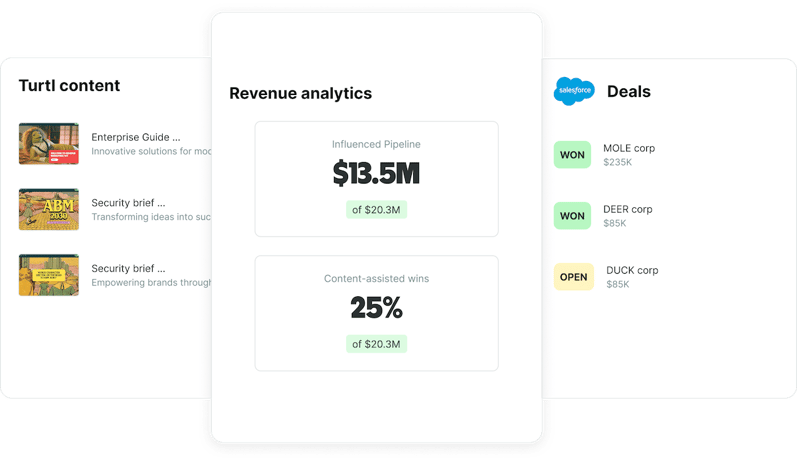
Revenue dashboards close the loop by connecting content engagement to pipeline movement and closed revenue. You can see which content is associated with progressing opportunities, what buying committee members engaged with during the sales process, and how engagement patterns differ between won and lost deals. That's the evidence base for proving content's contribution to revenue without overstating causation, and it's what separates programs that generate activity from programs that generate pipeline.
Frequently asked questions
What's the best ABM platform for personalizing content at account scale using AI?
The best platforms for AI-powered ABM content personalization combine dynamic content generation, ABM data integration, and engagement analytics in one workflow. Turtl lets teams build a single base asset and generate hundreds of account-specific versions using data from 6sense, Demandbase, HubSpot, or Marketo. Personalization variables (industry, persona, buying stage, account name) are defined once and applied at scale, with contact-level and account-level engagement signals synced back to your ABM stack. The result is measurable content coverage across your entire target account list without proportional production overhead.
What tools let me personalize content for individual buying committee members at scale?
Personalizing at the buying committee level requires contact-level data and the ability to generate tailored versions for each stakeholder. Turtl supports this through batch personalization, where you upload a CSV of contacts from your CRM, map fields to personalization tokens in your base asset, and generate a unique version for each individual. Each version has its own URL and tracks engagement at the contact level. When a stakeholder engages, their activity syncs to their CRM record, giving sales the context they need for targeted follow-up with each member of the buying group.
What ABM content platform helps personalize experiences by account and persona?
Turtl personalizes content at both the account and persona level through a combination of batch personalization, dynamic real-time personalization via 6sense or Demandbase, and on-demand personalization for sales teams. Marketing builds a single base asset with personalization logic defined for each audience segment. Accounts see content calibrated to their industry, buying stage, and use case. Individual contacts see content calibrated to their role and priorities. Engagement analytics then show how each persona interacted with the content, giving teams the data to refine messaging by segment over time.