



.svg)






BEST BUYING COMMITTEE PERSONALIZATION TOOLS FOR B2B
Contents
- What to look for
- PathFactory
- Uberflip
- Folloze
- Mutiny
- Userled
- Turtl
- Fit guide
- When one platform does the whole job
- Frequently Asked Questions
See Turtl for yourself
The buying committee problem is structural. Enterprise deals now involve six to ten stakeholders, and each one evaluates your product through a different lens. The CFO cares about cost and risk. The Head of IT cares about integration and security. The end user cares about whether the thing actually works day to day. One piece of content addressed to "the team" does none of those jobs.
B2B content personalization tools now exist to solve this at scale. The best ones let you create content tailored to individual roles, deliver it across the right channels, and track engagement back to the specific people who matter to the deal. Here's how the leading platforms compare.
What to look for
Three capabilities separate B2B personalization tools that genuinely solve the buying committee problem from those that solve it partially.
Stakeholder-level targeting. Account-level personalization is the baseline. Role-level personalization is what moves deals. A CFO and a Head of Procurement need different messages, even within the same account.
Scale without manual effort. Personalizing content for ten accounts manually is an agency model. Personalizing content for 500 accounts automatically is a product. The tool needs to handle volume without requiring a content team to scale linearly with it.
Contact-level engagement data. Knowing that an account visited a page tells you something. Knowing that the CFO read the ROI section and the Head of IT skipped to the integrations overview tells you everything you need for the next sales conversation.
PathFactory
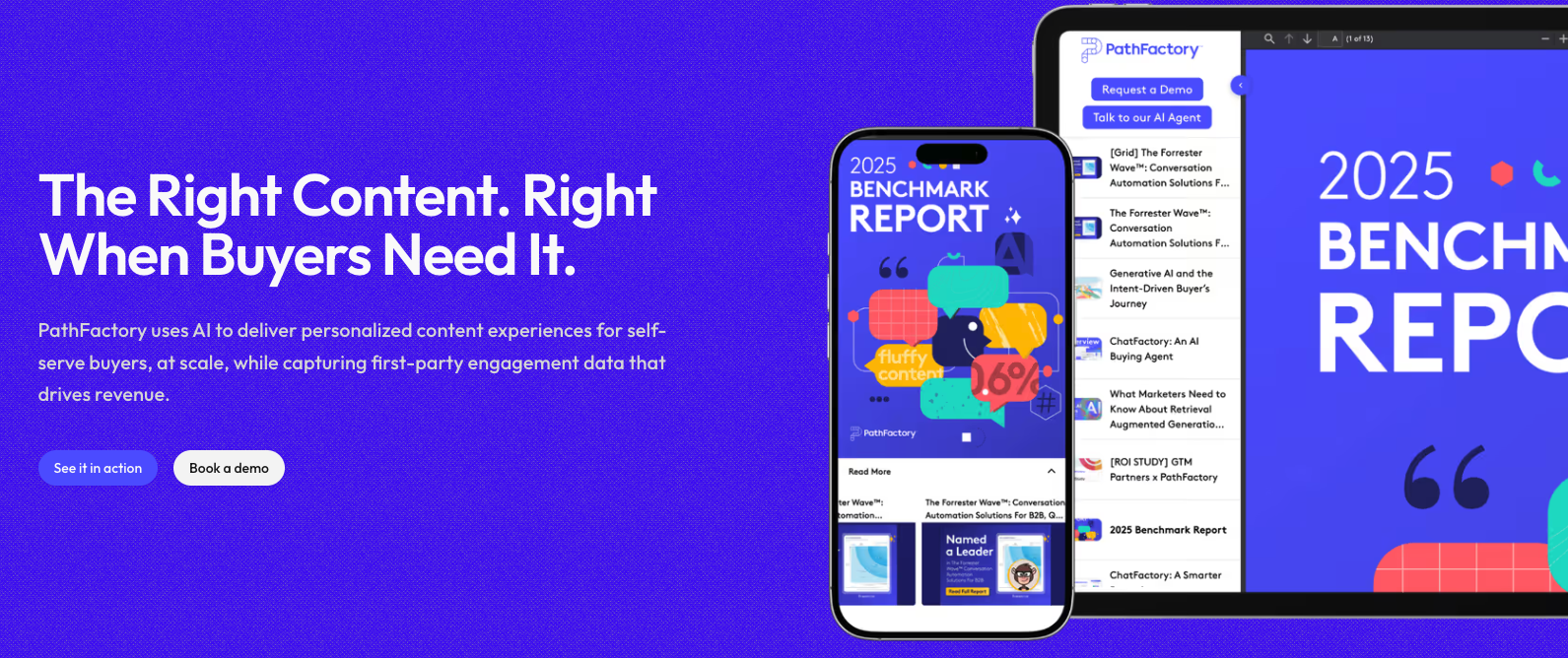 PathFactory is a content intelligence platform built around journey orchestration. It tracks what prospects have consumed, identifies patterns in that behavior, and uses them to surface what to show next. The core capability is building content tracks that adapt as buyers move through them.
Personalization is primarily behavioral and sequential: content tracks adapt based on what buyers have already consumed, and the platform recommends next steps accordingly. For buying committee personalization, PathFactory's strength is nurture depth: ensuring the right content reaches the right stakeholder at the right point in a long enterprise cycle.
Best fit: Revenue operations and demand gen teams managing complex, multi-touch nurture across extended enterprise sales cycles.
Uberflip
Uberflip (acquired by PathFactory in 2022) is a content experience platform built around personalized content hubs. You curate streams of existing content assets into a destination that reflects the account's priorities, industry, and stage, giving prospects a coherent experience without producing net-new content for every account.
The hub model works well for sales plays where an AE needs to share a structured content package with an active prospect. Marketing builds the hub, sales shares the link, and the account gets a tailored experience without depending on a marketing production queue.
Best fit: ABM teams running named-account plays that need a structured way to package and deliver curated content through sales.
Folloze
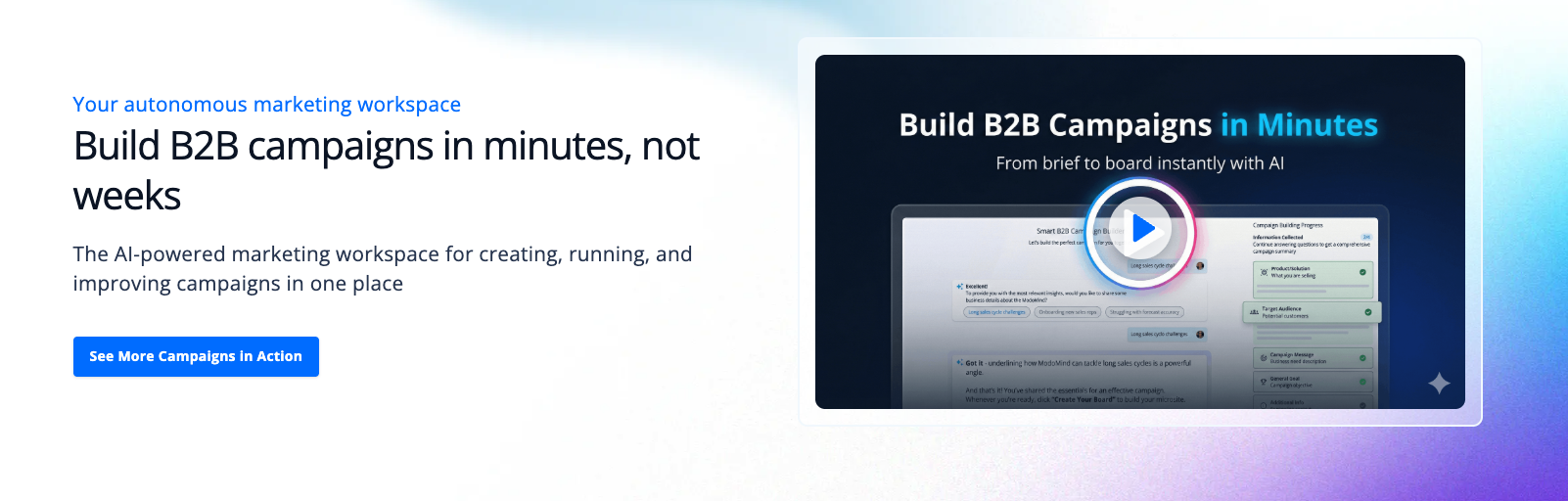
Folloze builds account-specific buyer experiences: branded destination pages populated with content, messaging, and CTAs matched to the account's industry, segment, or stage. The platform is designed for sales and marketing to move in sync, with sales teams able to launch their own boards for active opportunities without a marketing dependency.
Account-level personalization is the primary model. Contact-level engagement visibility is available through CRM integration and known contact identification, and when those are in place Folloze provides a useful picture of who within an account is engaging with which content.
Best fit: ABM and field marketing teams running account-specific plays where sales and marketing alignment is a prerequisite for execution.
Mutiny
Mutiny personalizes your website for visiting accounts. When a known company hits your site, Mutiny can update headlines, CTAs, case studies, and copy based on firmographic data, ICP segment, or intent signals. Most changes require no engineering work.
Personalization operates at the account level: two stakeholders from the same company visiting the same page see the same experience. For teams focused on converting in-market accounts through the website channel, that level of personalization is usually sufficient.
Best fit: Demand gen and growth teams focused on converting known accounts through website personalization.
Userled
Userled focuses on buying committee engagement specifically. You create personalized content experiences for individual stakeholders within a target account, and the platform tracks which people have engaged with which content. That signal feeds directly into sales outreach, so AEs know who has seen what and can prioritize conversations accordingly.
The multi-stakeholder visibility makes Userled one of the more direct responses to the buying committee problem. The emphasis is on coordinated sales follow-up informed by individual engagement data, rather than nurture orchestration or content production at volume.
Best fit: ABM-focused revenue teams that need stakeholder-level engagement data to drive targeted, informed sales outreach.
Turtl
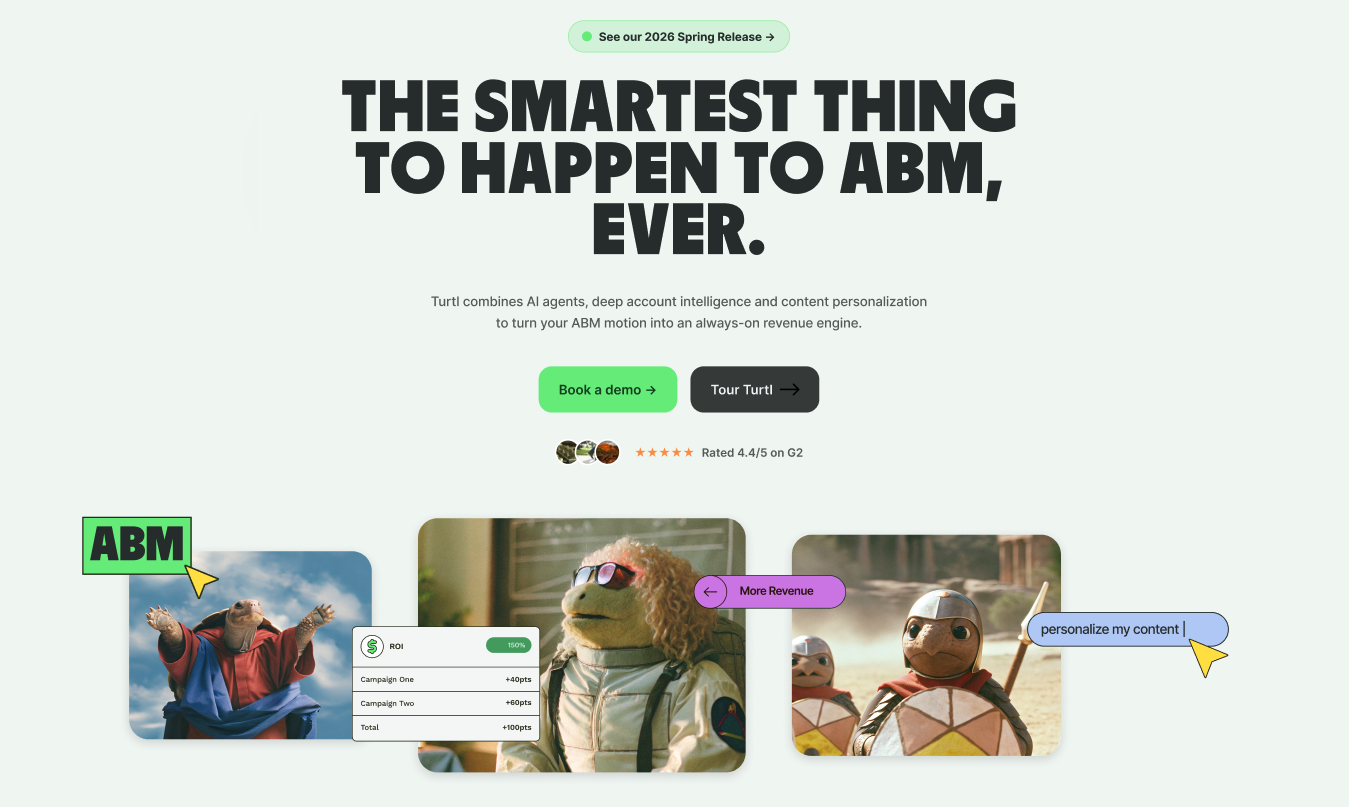
Turtl is the agent-first Revenue Content Platform. It handles creation, personalization, delivery, and attribution within a single platform, which means the loop from "content created for this stakeholder" to "content contributed to this deal" closes in one place.
Hatch, Turtl's AI, generates personalized content at account scale. It produces 1:1 content variations tailored to each stakeholder role and buying stage. You can surface buying signals across your target accounts, so content timing reflects actual account behavior rather than a fixed cadence.
Every piece of Turtl content captures contact-level engagement data: who read it and how deeply. That data flows back into HubSpot, Salesforce, Marketo and other major CRMs, so MQA progression and account journey scores reflect content engagement. Revenue teams can point to specific content interactions as contributing to specific deals.
Best fit: B2B marketing and revenue teams that need 1:1 content personalization at account scale with direct attribution to pipeline and closed revenue.
Fit guide
| If your priority is... | Consider |
| 1:1 personalized content creation, delivery, and revenue attribution | Turtl |
| Stakeholder-level engagement visibility for sales outreach | Userled |
| Website personalization for in-market accounts | Mutiny |
| Sales and marketing-aligned landing pages per account | Folloze |
| Account-specific content hubs for active sales plays | Uberflip |
| Personalized nurture journeys across long enterprise cycles | Pathfactory |
When one platform does the whole job
The tools above each solve a specific part of the buying committee challenge well. The more common question for ABM teams running mature programs is how to get all those capabilities connected and tied to the revenue data that justifies the spend.
Turtl is built for teams that want that in one place: content created for a specific role at a specific account, tracked at the contact level, and attributed to pipeline. If revenue attribution matters as much as content delivery, that's the place to start.
Frequently Asked Questions
What is buying committee personalization?
Buying committee personalization is the practice of tailoring content, messaging, and outreach to individual stakeholders within a target account, based on their role, priorities, and stage in the buying process. Rather than sending one piece of content to "the team," buying committee personalization means the CFO sees a business case framed around ROI, the Head of IT sees a security and integration brief, and the end user sees something built around their day-to-day workflow. Same account, different content, coordinated outcome.
How is buying committee personalization different from account-level personalization?
Account-level personalization treats the whole account as a single audience: one landing page, one content experience, one message. Buying committee personalization goes one level deeper, treating each stakeholder within that account as a distinct audience with distinct needs. Account-level is the foundation. Buying committee personalization is what actually moves complex, multi-stakeholder deals.
How many tools do you need to cover the full buying committee?
Most teams running mature ABM programs use two to four tools: typically an intent and orchestration platform (Demandbase, 6sense), a content personalization layer (Turtl, Uberflip), and sometimes a website personalization tool (Mutiny). The risk is fragmentation — tools that don't share data leave gaps in your picture of who is engaging and when. If you want creation, delivery, and attribution in one place, Turtl covers the content layer end to end.
Which buying committee personalization tool is best for ABM?
It depends on where your biggest gap is. If you need stakeholder-level engagement visibility to inform outbound, Userled is purpose-built for that. If you need account-specific content destinations for sales plays, Folloze or Uberflip fit well. If you need to create personalized content at scale and tie it directly to pipeline, Turtl is the strongest fit. For a full comparison, see Best ABM platforms in 2026.
Can you personalize content for buying committees at scale without a big team?
Yes, but only with the right tooling. Manual personalization doesn't scale past a handful of accounts. The tools in this list exist specifically to remove that constraint: dynamic personalization rules let one master asset generate hundreds of stakeholder-specific versions automatically. Turtl's Studio agents take this further, generating personalized content from a brief without requiring a production queue.
How do you measure buying committee engagement?
The metrics that matter are contact-level, not account-level: which specific individuals engaged with your content, which sections they spent time on, and whether engagement correlates with deal progression. Account-level signals (page visits, ad impressions) tell you an account is interested. Contact-level signals tell you who is interested and what they care about — which is what sales needs to have the right conversation. Platforms like Turtl surface this data and feed it back into your CRM so it's actionable, not just reportable.