









.jpg?width=1976&height=1480&name=Turtl%20x%20OneAdvanced%20(1).jpg)





Contents
- Why content brief adaptation is the right frame
- The 3-layer brief structure
- How to adapt one brief for 1000 target accounts: step by step
- What makes personalized marketing content perform
- Frequently asked questions
- What this looks like in practice
Head of Product Marketing and AI GTM @ Turtl, Award-Winning PMM and globally recognized PMM leader. Author of the best-selling book "The Product Momentum Gap.”
See Turtl for yourself
B2B marketing teams focused on ABM have been working like it's still 2009: writing one content brief and producing one asset. Maybe two versions if someone has the bandwidth. For account-based programs, that math doesn't work. You have 1000 target accounts, each with distinct industry pressures, buying groups, and business priorities. A single asset doesn't move all of them.
The question isn't whether to personalize. It's how to do content brief adaptation at scale without rebuilding your workflow from scratch so B2B personalization for all your accounts becomes a reality.
This post walks through a repeatable process for turning one core brief into tailored content assets across your full target account list, with the performance data to back up why it's worth doing.
Why content brief adaptation is the right frame
Most teams treat personalization as a production problem: too many versions, not enough time. But the real bottleneck sits earlier, in the brief itself.
If your brief is written around a generic buyer profile, you'll produce a generic asset. Personalizing that asset after the fact means retrofitting context that should have been built in from the start. The result is surface-level personalization that buyers see through immediately.
Content brief adaptation flips that sequence. You start with a strong core brief that captures your message, proof points, and call to action, then you adapt the variables that make it relevant to each account: industry, business priority, buying stage, and the specific outcome the account cares about.
That separation between what stays fixed and what gets adapted is what makes scale possible.
Here’s how it drives results:
More engagement
Personalized content consistently outperforms static formats with longer read times, stronger interaction rates, and better conversion outcomes.
Less effort
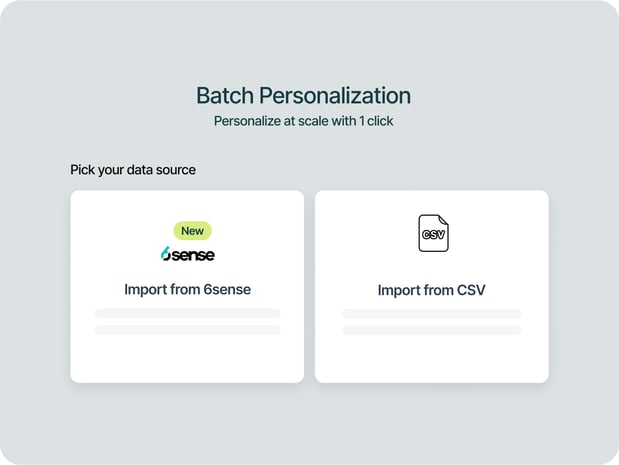
Generate up to 25,000 personalized items per upload. Each one comes with its own unique URL, branded cover assets, and metadata, ready for use across your CRM, MAP, or outbound tools.
Measurable business impact
Turtl links content performance directly to pipeline and revenue. Batch personalization helps marketing, sales, and customer teams deliver relevant content that’s proven to move deals forward.
The 3-layer brief structure
Before you can adapt a brief for 1000 accounts, the brief needs to be built for adaptation. Most aren't. Here's the structure that makes it work:
Layer 1: The fixed core This is everything that doesn't change regardless of account. Your primary value claim. The proof point that anchors the asset. The call to action. This layer represents your brand's position and shouldn't move.
Layer 2: The segment variables These adapt by industry vertical or company profile. A financial services account and a technology account might receive the same asset with different sector-specific use cases, regulatory context, or business outcomes highlighted. Write two to four segment variants here, not 1000 individual versions.
Layer 3: The account-level variables This is where true personalization lives. Company name, the contact's role and buying stage, any account-specific signals you've captured through intent data or CRM enrichment. At this layer, you're filling fields, not rewriting content.
The key insight: most of the work happens at layers 1 and 2. Layer 3 is systematic if you've done layers 1 and 2 correctly.
How to adapt one brief for 1000 target accounts: step by step
Step 1: Audit your account list before you write
Group your 1000 accounts before you touch the brief. Sort them by the dimensions that actually affect message relevance: industry vertical, company size or tier, buying stage, and any product fit signals you have. You're not segmenting for the sake of it, you're identifying how many meaningfully different briefs you actually need. For most lists, it's three to five.
Step 2: Write the fixed core first
Write your brief as if it's for your strongest segment. This forces you to make real decisions about message priority rather than writing to a vague average buyer. The discipline of writing for a specific, sharp ICP produces better copy than writing for everyone.
Confirm the fixed core answers these questions before moving on:
- What is the primary outcome this account cares about?
- What proof point makes that outcome credible?
- What do we want them to do next, and why now?
Step 3: Define the adaptation variables
Go through your brief and tag every element that could differ by segment or account. Common adaptation points for B2B target account content:
- The opening sentence (industry-specific problem statement)
- Use case examples (sector-relevant scenarios)
- Proof points or case studies (matched by industry or company size)
- The specific outcome named in the headline or summary
- Any regulatory, competitive, or market context
For each variable, write the segment variants. If you have four industry segments, write four versions of the opening, four sets of use case examples, and so on. This is the work. It takes time upfront, but it produces four briefs that can scale to 1000 assets, not 1000 briefs that need 1000 rounds of review.
Step 4: Map account-level fields
Create a structured data layer that maps each account to:
- Segment variant (which version of layers 1 and 2 applies)
- Account-level fill fields (company name, contact name, role, any personalization tokens)
- Any dynamic content triggers (if your platform supports conditional content by account stage or score)
This is the input file for batch generation. Every account on your list should map cleanly to a segment and a set of fields.
Step 5: Generate at scale
With the brief structured and account data mapped, you can produce tailored content assets across your full list in a single pass. Platforms like Turtl's Personalization Engine connect directly to popular CRMs like HubSpot and Salesforce, generating personalized assets for every account simultaneously, each with a unique URL, branded assets, and account-specific content.
The output isn't 1000 generic assets with names swapped in. It's 1000 genuinely tailored pieces of content built from the segment and account data you defined in the brief.
Step 6: Track by account, not by asset
Once distributed, track engagement at the account level. Which accounts read the full asset? Which sections got the most attention? Which contacts from the buying group engaged? That data feeds back into your next round of brief adaptation, and you'll see which segment variants perform, which proof points hold attention, and which accounts are showing genuine buying intent.
What makes personalized marketing content perform
Surface-level personalization produces marginal results because buyers have seen it for 15 years. Tailored content assets that reflect a specific industry problem, a relevant proof point, and the outcome the buyer is accountable for perform measurably better.
The performance gap shows up in engagement data, not impressions. Personalized content earns longer read times and higher interaction rates because it's actually relevant. That engagement translates into pipeline signals: accounts that spend real time with your content are telling you something about buying intent.
The briefs that produce this kind of performance aren't longer or more elaborate. They're more precisely targeted. Content brief adaptation is the discipline that gets you there without rebuilding every asset from scratch.
Frequently asked questions
How do I adapt the same content brief into tailored assets for 1000 different target accounts?
Start by structuring your brief in three layers: a fixed core (message, proof points, CTA that don't change), segment variables (industry-specific context and use cases), and account-level fields (company name, contact role, and buying stage). Write your segment variants, then map each account to a segment and a set of fill fields. Use a personalization platform to generate assets in batch from that structured input. The output is genuinely tailored content for every account on your list, produced in a single pass.
What's the difference between personalized content and customized content?
In practice, most teams use the terms interchangeably, but there's a useful distinction for planning purposes. Personalization typically refers to dynamic fields (account name, contact role, location) that change per recipient without changing the underlying message. Customization goes deeper: different use cases, different proof points, and different outcomes highlighted for different segments. A strong account-based content approach does both: segment-level customization combined with account-level personalization.
How many versions of a brief do I actually need for 1000 accounts?
Far fewer than you'd expect. Most lists of 1000 target accounts sort into three to five meaningful segments when you group by industry, buying stage, or product fit. Within each segment, the message structure stays consistent; only account-level fields change. You're writing three to five core briefs, not 1000.
What data do I need to personalize content for target accounts?
At minimum: industry vertical, company name, and primary contact role. With CRM enrichment or intent data, you can add buying stage, product fit score, and engagement history, all of which improve relevance. The more structured your account data before you write the brief, the more precise your adaptation variables will be.
How do I measure whether my personalized content assets are working?
Track engagement at the account level: read time, section-level attention, and which contacts from the buying group viewed the asset. Connect that data to pipeline stage. Accounts that engage deeply with tailored content are showing buying intent signals. That is what justifies the brief adaptation effort and informs which segments and messages to prioritize in the next campaign.
What's the fastest way to scale account-based content creation without adding headcount?
The brief structure is the leverage point. A well-built brief with clean segment variants and mapped account fields can produce hundreds of tailored assets in a single generation pass using a platform like Turtl. The production cost per asset drops to near zero. The investment is in the brief design and account data, which you'd need for any effective account-based program regardless.
Can I use the same approach for different content types, not just one-pagers or reports?
Yes. The brief adaptation framework applies to any content format: email sequences, landing pages, event follow-up materials, sales leave-behinds. The layer structure stays the same. What changes is which variables are most impactful for that format; e.g., in email, the opening line and CTA do the most work; in a report or Turtl Doc, section relevance and proof point selection matter most.
What this looks like in practice
A marketing team running an ABM program across 1000 accounts doesn't have the bandwidth to write 1000 briefs. With a structured approach to content brief adaptation, they write five. Those five briefs, built with clean segment variants and mapped to account-level fields, produce 1000 tailored content assets in a single batch. Each asset has a unique URL, tracked individually, tied to a specific account in the CRM.
When the campaign closes, the team can see which accounts engaged, which sections held attention, and which messages drove pipeline movement. That's not just a more efficient content workflow, it's the kind of performance data that connects marketing effort to revenue outcomes.
If your current approach to target account content is producing assets that are technically personalized but not actually relevant, the brief is where to start.
See it in action
PERSONALIZATION ENGINE
See how Turtl's Personalization Engine handles batch content generation at scale.