









.jpg?width=1976&height=1480&name=Turtl%20x%20OneAdvanced%20(1).jpg)





WHAT IS A BROCHURE? HOW ABM TEAMS BUILD DIGITAL BROCHURES THAT DRIVE PIPELINE
Jun 08, 2026

Contents
- What a brochure is designed to do
- What goes into an effective B2B brochure
- Why ABM teams use digital brochures
- Personalizing brochures for ABM
- Measuring brochure performance beyond opens and clicks
- Where brochures fit in your ABM content program
- The brochure is still one of the most useful assets you have
- Frequently asked questions about brochures
Elliott is VP of Marketing at Turtl, an award-winning marketing leader, and a startup advisor. With over 15 years of commercial experience, he helps businesses drive rapid and sustainable growth through the art and science of marketing.
See Turtl for yourself
A brochure is a short-form marketing document that presents a company, product, service, or solution to a specific audience. Traditionally produced as a printed, folded sheet, the brochure's function in modern B2B marketing is to give a buyer enough information to understand what you offer, why it matters to them, and what to do next. In enterprise marketing today, brochures are almost always digital, distributed via link rather than printed and handed over, and built to generate engagement data as well as inform the reader.
The brochure is one of the most versatile pieces of sales collateral in B2B marketing. It works at every stage of the buying journey: as an account-awareness asset for prospects who are just beginning to evaluate options, as a solution-specific document for buyers comparing vendors, and as a post-meeting leave-behind that keeps your argument in front of a buyer group after the conversation ends.
What a brochure is designed to do
A brochure answers one question for the buyer: "Is this worth my time to explore further?" It is not a substitute for a detailed proposal, a case study, or a product specification. Its job is to communicate your core value clearly enough that the right buyers want to learn more, and to do so in a format compact enough that busy senior stakeholders will actually read it.
In B2B marketing, brochures serve three distinct functions depending on where they appear in the buying journey:
Awareness stage brochures introduce a company or category to buyers who are not yet actively evaluating vendors. These lead with the problem the buyer is experiencing and position your solution within the context of that problem. They earn attention by demonstrating relevance before asking for anything in return.
Evaluation stage brochures support buyers who are actively comparing options. These are more specific about capabilities, differentiators, and proof points. They are often sent directly by sales into named accounts, where they need to hold up against competitive scrutiny from multiple stakeholders with different priorities.
Enablement brochures give internal champions inside a target account the material they need to make the case to colleagues and decision-makers who were not in the original conversation. A well-designed enablement brochure travels through a buyer group independently, carrying your argument into rooms you will never personally enter.
Understanding which function a brochure needs to serve is the first decision in building one. It determines the content, the depth, the proof points, and the call to action. For context on how brochures fit within a broader content program, the marketing collateral guide covers the full range of assets enterprise marketing teams use across account stages.
What goes into an effective B2B brochure
The structure of an effective B2B brochure has changed very little even as the format has shifted from print to digital. What has changed is the expectation of specificity. Generic brochures that could apply to any company in any industry produce less engagement than brochures tailored to the reader's industry, role, or known business priorities.
The core components of a strong B2B brochure are:
-
An opening statement that establishes relevance immediately. The first thing a reader sees should connect directly to a challenge they recognize. If your target audience is a marketing director at a financial services firm dealing with content attribution problems, your opening statement names that situation. A buyer who sees their own challenge reflected in the first sentence keeps reading.
-
A clear articulation of your solution and why it is different. This is not a features list. It is a statement of what your solution does for the buyer and what makes it a better choice than the alternatives they are likely considering. The differentiation should be specific and grounded in outcomes, not generic claims about quality or innovation.
-
Proof that the solution works for buyers like them. Industry-specific case studies, measurable outcomes, and recognizable customer names are significantly more persuasive than general market statistics. One concrete example from a comparable organization will do more work than three abstract proof points.
- A single, clear next step. The closing call to action should be obvious and low-friction. A request for a demo, an offer of a relevant resource, or an invitation to a specific conversation all work. Multiple competing calls to action reduce response rates.
Why ABM teams use digital brochures
The shift from printed brochures to digital formats is not simply a cost decision. Digital brochures do things that printed brochures cannot, and for enterprise ABM teams those capabilities are directly tied to pipeline performance.
A printed brochure leaves the room and disappears. You have no way of knowing whether it was read, how long the buyer spent on it, which sections they focused on, or whether it was shared with other stakeholders at the account. A digital brochure, shared via link, generates a continuous stream of engagement signals that tell you all of those things.
For ABM teams running plays across named accounts, those signals are the difference between operating with and without visibility into account behavior. When you can see that three different contacts at a tier-one target account have opened your brochure in the past week, two of them have returned to the pricing section multiple times, and the document has been shared to a fourth contact you did not previously know about, your sales team has everything they need to time their outreach and personalize their conversation.
Turtl's digital brochures are built for exactly this use case. You upload your brochure, including existing PDFs, and Turtl hosts it as a trackable Turtl Doc. Every interaction generates contact-level engagement data: who opened it, how long they spent on each page, which sections they revisited, and whether the document traveled further inside the account. That data flows directly into your CRM so your sales team has a live view of account engagement without any manual tracking.
The revenue connection is direct. Accounts that engage deeply with a brochure, particularly when multiple stakeholders are involved, are demonstrably more likely to progress to an active sales opportunity. Turtl surfaces that signal at the account level, so your team can prioritize the accounts that are showing the strongest buying signals rather than the ones that simply received the most outreach.
Personalizing brochures for ABM
A brochure sent to every account on your list with the same content is a mass-marketing asset dressed up as an ABM asset. The accounts that receive it can tell the difference, and the engagement reflects that.
Personalized brochures, where the account name, industry context, relevant proof points, and specific business challenges are reflected in the document, generate significantly higher engagement rates and more buyer group activation than generic versions. The practical challenge is producing personalized brochures at a scale that matches your account list without creating an unsustainable production burden. This production load is why personalization is the real bottleneck to ABM maturity: most teams can tier their accounts long before they can create tailored content for each tier.
The approach that works is a templated structure with dynamic content fields. The brochure's core argument, design, and formatting remain consistent. The content that changes at the account or segment level, including the headline, the proof points, the opening problem statement, and the call to action, is populated from your CRM or intent data at the point of distribution. The result reads as purpose-built for the account, because the substance genuinely reflects what you know about them.
For the full framework on how enterprise teams apply personalization across content formats and account tiers, the B2B personalization guide covers the methodology in detail, including where personalization has the highest leverage in the buying journey.
Measuring brochure performance beyond opens and clicks
Most marketing teams measure brochure performance the same way they measure email performance: delivery rate, open rate, and click-through rate. Those metrics confirm that the document was received and opened. They do not tell you whether the brochure actually advanced the account conversation.
Meaningful brochure measurement at the ABM level requires account-level engagement data connected to pipeline outcomes. The metrics worth tracking are:
-
Time spent per section across target accounts, which reveals which content themes generate the most genuine interest
-
Multi-stakeholder engagement per account, which indicates buyer group activation and is one of the strongest early signals of an account moving toward evaluation
-
Return visits from the same contact, which signals active consideration rather than a passive scan
-
Document sharing within the account, which identifies internal champions and buyer group expansion
-
Correlation between brochure engagement and opportunity creation, which validates whether the asset is actually influencing pipeline
When brochure engagement data connects to your CRM at the contact and account level, it becomes part of the revenue attribution picture that marketing is increasingly accountable for. For the methodology on building that attribution layer, the content marketing ROI guide covers how to connect content engagement to pipeline and closed revenue in a way that holds up to scrutiny from finance and leadership.
Brochures that generate measurable pipeline signals are also a strong input to your ABM metrics framework, particularly for tracking engagement coverage across your target account list and identifying which accounts are moving from awareness to active evaluation.
Where brochures fit in your ABM content program
A brochure is most effective when it arrives in the context of a broader account play, not as a standalone document sent cold. Within an ABM strategy, the brochure typically plays one of three roles:
-
It arrives after an initial piece of thought leadership has generated account interest, providing a more specific view of your solution to accounts that have already demonstrated they find the topic relevant.
-
It travels to new stakeholders at an account after a first sales conversation, giving the original contact something credible to share internally.
-
It functions as a reference document during an active evaluation, giving the buyer group a clear and consistent view of your differentiation while they work through their decision process.
In each of these scenarios, the brochure works best when it is personalized to the account's context, distributed through a trackable channel, and connected to a follow-up play that your sales team can execute based on the engagement signals the document generates.
For examples of how leading ABM teams sequence content assets including brochures, one-pagers, and research reports across a full account play, the ABM campaign examples guide covers the plays in detail.
The brochure is still one of the most useful assets you have
The format has been around for decades because it solves a problem that has not changed: buyers need a concise, credible summary of what you do and why it matters to them before they are willing to invest more time. What has changed is the precision with which enterprise marketing teams can now build, distribute, and track brochures, and the directness with which brochure engagement translates into revenue signals.
A digital brochure that tells you which accounts are reading it, which stakeholders are engaged, and how that engagement maps to pipeline is a fundamentally different asset from a PDF that disappears into an inbox. The teams building and tracking brochures at the account level are the ones generating the kind of content intelligence that closes the gap between marketing activity and revenue outcomes.
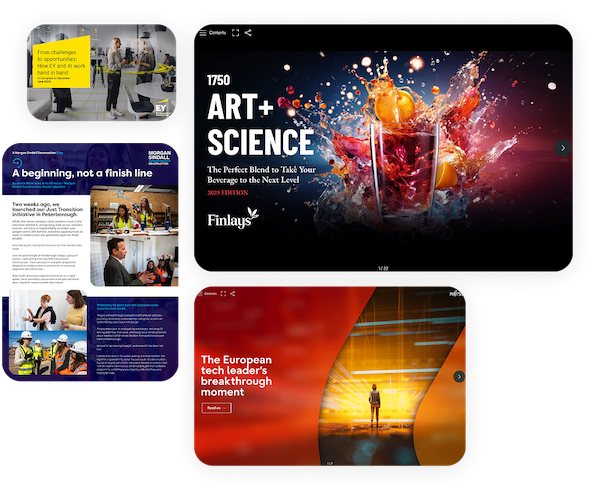
Learn more
CREATING BROCHURES WITH TURTL
See how Turtl helps enterprise marketing teams build, personalize, and track digital brochures that generate real account intelligence.
Frequently asked questions about brochures
What is a digital brochure?
A digital brochure is a brochure delivered as an online document rather than a printed, physical asset. Digital brochures are shared via link, can be hosted on a platform that generates engagement data, and can include interactive elements that static PDFs cannot. For enterprise marketing teams, the key advantages of a digital brochure over a printed one are shareability across a buying committee, trackability at the contact and account level, and the ability to update content after distribution.
What is a brochure used for in marketing?
A brochure is used to present a company, product, or solution to a target audience in a concise, decision-ready format. In B2B marketing, brochures serve three main purposes:
-
building awareness with accounts that are early in their evaluation,
-
supporting buyers who are actively comparing vendors,
-
and giving internal champions the material they need to make the case to colleagues who were not in the original sales conversation.
What is the difference between a brochure and a one-pager?
A one-pager and a brochure are closely related formats and the terms are often used interchangeably. In practice, a one-pager typically refers to a document with a single, focused argument, often used in ABM to target a specific account or buying committee with a highly personalized message. A brochure tends to cover slightly more ground, including company overview, product range, or a fuller solution summary. Both are short-form assets designed to be read quickly and shared across a buying committee.
How do you measure the effectiveness of a brochure?
For printed brochures, measurement is limited to distribution counts and anecdotal sales feedback. For digital brochures, effective measurement covers time spent per section, return visits from the same contact or account, multi-stakeholder engagement at named accounts, and document sharing within a target organization. The most meaningful measurement connects brochure engagement at the account level to pipeline progression and closed revenue, which requires a platform that tracks contact-level engagement and integrates with your CRM.
Can you track who reads a digital brochure
Yes, when a digital brochure is hosted on a platform like Turtl and shared via a tracked link. Turtl captures contact-level engagement data for every content asset, including which contacts opened the document, how long they spent on each page, which sections they returned to, and whether the document was shared further within a target account. That data flows into your CRM and gives your sales team a live view of account interest without manual tracking.
What should a B2B brochure include?
A strong B2B brochure includes five elements:
-
An opening statement that names the buyer's challenge or desired outcome.
-
A clear description of your solution and what makes it different from alternatives.
-
Proof that the solution works for buyers in a comparable situation.
-
A summary of key benefits stated in terms of business outcomes rather than product features.
-
A single, clear next step.
The most effective B2B brochures are specific to the reader's industry, role, or account context rather than generic across all buyers.
What is the difference between a brochure and a white paper?
A brochure is a short-form asset designed for quick reading and broad sharing, typically one to four pages. A white paper is a longer, research-backed document that argues a specific position in depth, typically ten to thirty pages. Brochures support awareness and evaluation conversations. White papers build thought leadership and establish credibility with buyers who are researching a complex problem. Both formats have a place in a B2B content program, but they serve different stages of the buying journey and different types of buyer engagement.