









.jpg?width=1976&height=1480&name=Turtl%20x%20OneAdvanced%20(1).jpg)





Contents
- What is marketing collateral?
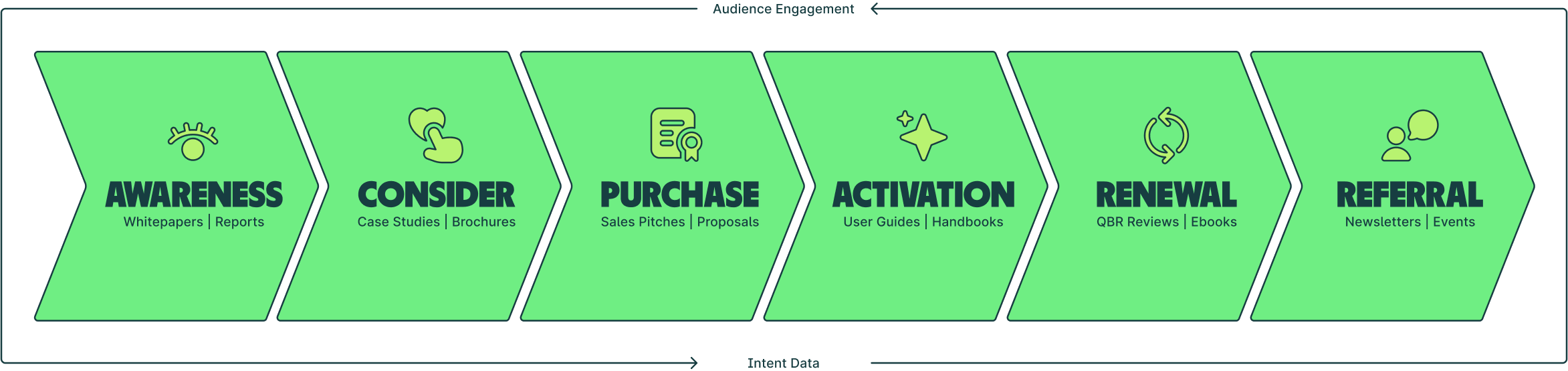
- Types of marketing collateral by funnel stage
- ABM marketing collateral: how to create content that converts target accounts
- Marketing collateral best practices
- How to create effective marketing collateral: a step-by-step guide
- Frequently asked questions
- Turtl takeaway
- Related reading:
See Turtl for yourself
Whether it's a research report that opens a conversation with a new account or a personalized case study that closes one, marketing collateral is how your brand shows up throughout the buyer journey. The challenge isn't finding collateral to create. It's knowing what to create, for whom, and when.
This guide covers the full picture: what marketing collateral is, which types to use at each stage, and a deep dive into ABM marketing collateral for teams running account-based programs.
What is marketing collateral?
Marketing collateral is any content, media, or resource created to support your marketing efforts. That covers a wide range, from a LinkedIn post to a 40-page enterprise buyer's guide. What holds it all together is purpose: collateral exists to attract, educate, convert, or retain an audience.
The breadth of the definition is also what makes it hard to master. Teams that try to create everything end up with libraries full of assets nobody uses. The smarter move is to map collateral to goals, and build only what moves people through the funnel.
Related: What is revenue content and how it connects collateral to pipeline
Types of marketing collateral by funnel stage
Top-of-funnel collateral (awareness and lead generation)
Top-of-funnel collateral is designed to be found — by search, by social sharing, by syndication. Its job is to earn attention and pull people into your world.
Interactive eBooks and guides Long-form content that educates a broad audience on a topic your buyers care about. Interactive formats (chapter navigation, embedded video, data visuals) increase time-on-content and signal intent more clearly than static PDFs.
Research reports Original research is the strongest top-of-funnel asset a B2B brand can produce. It earns backlinks, press coverage, and social sharing while positioning you as a credible voice in your category. See Turtl's Revenue Gap Report as an example.
Thought leadership blog posts Blog content at this stage should answer real questions buyers are asking. The goal is organic search visibility and brand credibility.
Video content and webinars Video is the highest-consumption format in B2B, particularly on LinkedIn and YouTube. Webinars work especially well for mid-to-senior audiences who want depth without a vendor call.
Podcasts For categories where buyers are passionate or specialized, podcasts build trust over time. Guest interviews extend your reach to audiences that follow your guests.
Related: 11 data-driven content marketing tips to drive conversions
Mid-funnel collateral (nurture and consideration)
Mid-funnel collateral talks to people who already know you exist. Its job is to build preference — to make your solution the most credible option before a buying conversation starts.
Case studies The most persuasive mid-funnel asset in B2B. Buyers want to see proof from companies like them. A case study that matches the prospect's industry, size, and use case is worth ten product brochures. Strong case studies lead with outcomes, not features.
White papers White papers work for complex, high-consideration purchases where buyers need to understand a problem before they're ready to evaluate solutions. They establish authority and earn trust. See what makes a great white paper for a breakdown of what separates the ones that land from the ones that don't.
Digital brochures When a prospect wants to understand your product, a digital brochure lays out what you do, for whom, and why it matters. Interactive digital brochures — where the reader can navigate sections, watch clips, or jump to relevant use cases — hold attention far longer than static equivalents. See how to create digital brochures that work.
Product guides Deeper than a brochure, product guides let prospects explore capabilities in detail. The best ones are organized by use case or buyer persona so each reader gets to the content most relevant to them fast.
Gated content Gating high-value content behind a form is still one of the most reliable lead generation mechanics in B2B. What is gated content and how to use it covers when gating makes sense and when it backfires.
Bottom-of-funnel collateral (conversion and decision)
Bottom-of-funnel collateral is for people in an active buying process. Speed and specificity matter here.
Sales presentations and decks Decks handed off to sales should be built to be delivered, not read. Keep them focused on the prospect's situation. Generic decks sent untailored to an account are one of the most common ways B2B teams lose late-stage deals.
Proposals and business cases Proposals win when they frame the investment in the buyer's language — their goals, their metrics, their risk. A template is fine to start from; a template sent unchanged is a trust signal in the wrong direction.
ROI calculators and value tools Interactive tools that let a prospect model their own business case are powerful at the decision stage. They transfer ownership of the numbers from vendor to buyer.
Comparison and battlecard content Buyers at this stage are comparing options. Comparison content — whether internal battlecards for your team or external comparison pages — helps your sales team handle objections before they become deal blockers.
Related: Sales collateral: meaning, types and best practices
Always-on collateral (brand and presence)
These assets aren't tied to a campaign. They're persistent expressions of your brand.
Brand identity assets: logo, color system, typography, templates. These set the standard everything else is measured against.
Email signatures: every email your team sends is a brand touchpoint. A consistent signature keeps your logo visible across thousands of conversations.
Social media presence: even accounts that don't post regularly serve a function: prospects will check your LinkedIn before they respond to outreach. A dormant profile with no description and a generic header photo is collateral working against you.
Website: technically not collateral in the traditional sense, but in practice it's the first asset most buyers evaluate. Everything else directs people here.
ABM marketing collateral: how to create content that converts target accounts
ABM operates on a fundamentally different logic from traditional demand generation. In demand gen, you create content for a broad audience and capture whoever engages. In ABM, you identify specific accounts, understand their situation, and create content targeted directly at them.
That distinction changes what marketing collateral means. Generic collateral that works for demand gen often fails in an ABM context — not because the content is bad, but because it isn't speaking directly enough to the account to move them.
Related: Account-based marketing vs. lead generation: what's the difference?
What makes ABM collateral different
The defining characteristic of ABM collateral is account specificity. Where a demand gen ebook speaks to "B2B marketers," an ABM version speaks to the marketing team at a specific company — referencing their industry, their competitive context, their stated priorities.
This doesn't mean writing a bespoke document from scratch for every account. It means building a personalization layer on top of your core content: company name, industry data points, relevant use cases, the right case study, the right buyer persona emphasis.
The accounts that receive personalized content engage more deeply, progress through the pipeline faster, and close at higher rates. How to stop losing prospects to generic content covers the evidence behind this.
Types of ABM marketing collateral
Personalized ebooks and guides Your core thought leadership content, adapted for the target account. Company name in the introduction, an industry-relevant data pull, the case study closest to their use case surfaced first. The structure stays the same — what changes is who it speaks to.
Account-specific landing pages Landing pages built for a target account or segment, with messaging tailored to their industry, their pain, and their stage. These pages convert at significantly higher rates than generic campaign pages because they feel built for the reader, not blasted at them. Build landing pages that drive revenue covers what goes into them.
Personalized case studies Case studies matched to the prospect's profile are the single most persuasive piece of collateral in an ABM program. When a prospect from a mid-size financial services firm sees a case study from a company that looks exactly like them, the credibility transfer is immediate. Maintaining a library of case studies segmented by industry, company size, and use case is essential infrastructure for ABM at scale.
Executive briefing decks For enterprise accounts where multiple stakeholders are involved, executive-level decks that speak to business outcomes give your champions something they can share internally. The tone is different from a product deck: it's strategic, not demonstrative.
Intent-triggered collateral sequences ABM done well is signal-led. When a target account shows buying intent the right collateral arrives at the right moment rather than on a fixed schedule. This requires connecting your content to your intent data. B2B buyer intent data: the good, the bad and the ugly is a good primer on how to use it.
Related: ABM campaigns: examples that turned targets into pipeline
How to scale ABM collateral without scaling your team
The objection to ABM collateral is almost always the same: "We don't have time to create personalized content for every account." This was true when personalization meant rewriting documents manually. It's less true now.
Platforms that automate personalization at the document level let small teams run full-coverage ABM programs across hundreds of accounts simultaneously. How to personalize 1,000 documents in minutes without lifting a finger covers how this works in practice.
The underlying principle: build your collateral with a personalization layer built in from the start. A core template with variable fields is far easier to scale than 50 separately written documents.
Measuring ABM collateral performance
Standard content metrics don't tell you what you need to know about ABM content. What matters is account-level engagement: which target accounts are interacting with your content, which buying committee members have engaged, how deeply they've read, and what that signals about their stage.
The shift from individual-level to account-level measurement is what separates an ABM analytics practice from a standard content analytics practice. 9 essential ABM metrics to track and measure success covers the full measurement framework.
Marketing collateral best practices
Anchor everything to a buyer goal, not a business unit Collateral created to satisfy internal stakeholders, eg "we need a brochure for the new product" — tends to underperform. The question to ask before creating anything is: what does this help a buyer understand, believe, or decide?
Match format to where the buyer is A 20-page technical guide sent to someone at awareness stage will be ignored. A one-page case study sent to someone who's already compared three vendors will feel light. Format fit matters as much as content quality.
Consistency across the portfolio Collateral that looks like it came from three different companies undermines credibility. Brand consistency — visual, tonal, and structural — signals that the company behind the content is organized and trustworthy.
Build for measurement from the start Collateral you can't track is collateral you can't improve. Whether that means UTM parameters on PDF links, interactive formats with built-in analytics, or gating to capture lead data — know before you publish how you'll measure whether it worked.
Audit and retire Most collateral libraries have more outdated content than useful content. A regular audit that identifies which assets are being used, which are converting, and which can be retired keeps your library from becoming a liability. Measuring content performance: how to prove your content ROI covers how to run this process.
How to create effective marketing collateral: a step-by-step guide
- Define the audience and goal. Before choosing a format, know who the content is for and what you want them to do after engaging with it. A case study for a financial services VP has different requirements than one for a marketing ops manager.
- Choose the right format for the stage. Use the funnel-stage framework above. Top of funnel demands findability and broad appeal; bottom of funnel demands specificity and speed.
- Build in a personalization layer. Even for non-ABM programs, segment-level relevance matters. An ebook for financial services buyers that opens with financial services data will outperform a generic version.
- Write to outcomes, not features. Buyers don't read collateral to learn what your product does. They read it to understand whether it solves their problem. Frame everything in terms of their situation and the results they're accountable for.
- Design for the medium. Content designed for print and repurposed for digital loses most of what makes digital formats effective: navigation, interactivity, analytics, shareability. Build for where it will be consumed.
- Embed measurement. Define how you'll measure success before publishing. Engagement rate, lead capture rate, pipeline influence, and account-level activity are all valid depending on the asset's purpose.
- Distribute with intent. Great collateral sitting in a resource library no one visits is wasted. Match your distribution channel to your audience: gated content via paid social for demand gen, direct delivery via sales for ABM, always-on SEO for top-of-funnel.
- Review and iterate. Run a quarterly review of your collateral library. Retire what isn't working, update what's outdated, and double down on what's driving results.
Frequently asked questions
What is marketing collateral?
Marketing collateral is any content or resource created to support marketing goals — from brand awareness through to purchase. It includes digital content such as ebooks, case studies, white papers, and landing pages, as well as physical materials like brochures and event collateral. The common thread is purpose: marketing collateral is designed to attract, educate, or convert a target audience.
What are examples of marketing collateral?
Common examples include research reports, interactive ebooks, case studies, white papers, digital brochures, product guides, sales presentations, email newsletters, landing pages, and video content. In ABM programs, personalized versions of these formats — tailored to specific accounts or industries — are the most effective type of collateral.
What is ABM marketing collateral?
ABM marketing collateral is content specifically created or personalized for target accounts in an account-based marketing program. Unlike general marketing collateral that speaks to a broad audience, ABM collateral is tailored to a specific company, industry, or buying committee — making it more relevant, more persuasive, and more likely to drive action from the accounts that matter most.
How do you create ABM marketing collateral?
Start with your core content library and add a personalization layer: company name, industry-specific data, the most relevant case study, and messaging that reflects the account's known pain points and buying stage. For scale, use a platform that automates variable substitution across documents so you can produce personalized versions across hundreds of accounts without manual effort for each.
What is the difference between sales collateral and marketing collateral?
Marketing collateral supports the marketing team's goal of generating awareness, leads, and pipeline. Sales collateral supports the sales team's goal of advancing and closing deals. In practice, they overlap significantly — case studies, product guides, and proposals serve both functions. The key difference is who controls distribution: marketing collateral is typically self-serve or gated; sales collateral is delivered directly by a sales rep. See our full guide to sales collateral for the breakdown.
How do you measure marketing collateral effectiveness?
For demand gen collateral, track engagement rate, lead capture volume, lead quality, and pipeline influence. For ABM collateral, measure at the account level: which target accounts engaged, which buying committee members consumed the content, how deeply they read it, and how that activity correlates with pipeline stage. The most useful signal is usually whether content engagement predicts deal progression — if accounts that consume your collateral move through the funnel faster, it's working.
What types of marketing collateral work best for B2B?
It depends on the goal. For top-of-funnel awareness, original research and thought leadership content consistently performs. For mid-funnel consideration, case studies and white papers build credibility. For ABM and late-stage conversion, personalized collateral that speaks directly to the account's situation outperforms everything else. The single most important variable is relevance — collateral that feels built for the reader converts better than collateral that doesn't, regardless of format.
Turtl takeaway
Effective marketing collateral isn't a library of assets — it's a system that connects content to revenue. The right piece, reaching the right person at the right account at the right moment, is what moves pipeline. That's the goal.
Turtl is the Revenue Content Platform built for exactly this: creating interactive, trackable, personalized collateral that your team can produce at scale and measure at the account level. See how it works.