









.jpg?width=1976&height=1480&name=Turtl%20x%20OneAdvanced%20(1).jpg)





THE BEST ALTERNATIVE TO STATIC PDFS FOR ABM CONTENT IN 2026
Jun 04, 2026

Contents
- What ABM actually requires from its content
- When PDFs are the right call
- When interactive content gives you more
- When landing pages serve ABM best
- Personalizing at scale without a content bottleneck
- Tracking engagement across formats
- What to measure and what it tells you
- Making format decisions in practice
- Frequently asked questions
Roan is the Head of Demand Generation at Turtl, with deep expertise in SEO, paid media, and performance marketing. With over a decade of experience, she has built and scaled high-impact acquisition and growth programmes for ecommerce and B2B SaaS businesses.
See Turtl for yourself
The format your ABM content lives in determines almost everything that comes after it. What you can personalize, what you can measure, how much production overhead the campaign carries, and whether your sales team can act on what they learn. Most ABM teams don't make a deliberate format choice. They reach for what they already have, usually a PDF, and then wonder why engagement data is thin and personalization stalls at the account name on the cover.
This guide covers the three formats that do most of the work in ABM programs today: PDFs, interactive documents, and landing pages. Each has legitimate use cases, real strengths, and situations where a different format would perform better. Knowing which to reach for, and when, is one of the most direct levers you have on the efficiency and measurability of your ABM content program.
What ABM actually requires from its content
Before choosing a format, it helps to be clear about what ABM content needs to do that other content programs don't.
ABM content operates in a highly specific context. The accounts are named. The buying committees are known, or knowable. The goal is not broad awareness, it's to move a specific group of people at a specific set of accounts from awareness to consideration to pipeline. That requires content that can be personalized to account and persona, tracked at the contact level, shared and distributed across multiple channels, and connected to revenue outcomes over time.
It also needs to operate at scale. Most enterprise ABM programs target anywhere from a few dozen to several hundred accounts. If every piece of content requires bespoke production, the program caps out at whatever your team can manually build, and that ceiling is usually much lower than the account list.
Format is the variable that determines where that ceiling sits.
When PDFs are the right call
PDFs remain a legitimate and widely used format in ABM programs, and for good reason. They are universally accessible, easy to share, downloadable for offline review, and widely expected in certain sales contexts. A proposal, a detailed technical overview, or a security compliance document works well as a PDF because the audience needs to save, print, or share it in ways that don't require an online connection.
PDFs also serve a compliance and archival function that other formats don't. In regulated industries such as financial services, legal, and healthcare, the ability to produce a timestamped, fixed-format document matters. A static PDF is the appropriate format for that job.
Where PDFs require more thought in ABM is in what you can learn from them after distribution. A PDF sent via email gives you a delivery confirmation, but tracking whether the recipient opened it, how long they spent with it, which sections they reviewed, and whether they passed it to a colleague requires additional setup that isn't enabled by default.
The personalization constraint follows a similar logic. You can customize a PDF before you send it, just add the company name, swap a relevant case study, adjust the intro for the industry. But that customization happens before distribution, requires manual or scripted production for each version, and generates a different file for every account. At scale, that becomes a production bottleneck and a version control problem.
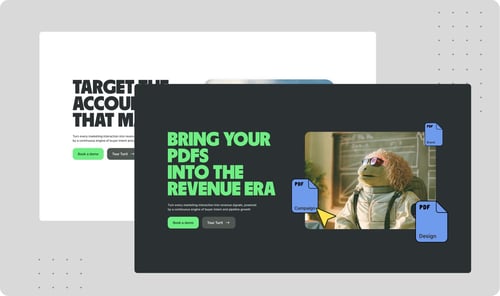
There is a practical path for extending PDF capabilities in ABM without changing the format. Adding engagement tracking to PDFs lets you see open events, reading time, and forwarding behavior. That intent data syncs to CRM and MAP records, giving sales teams context they wouldn't otherwise have. If PDF is the right delivery format for your audience, tracked distribution addresses the visibility gap.
Use PDFs when: the content is a proposal, compliance document, technical spec, or detailed report intended for download or offline review, and when the recipient needs a fixed, archivable version.
When interactive content gives you more
Interactive documents built for online reading are a different category of asset. They're not adapted from PDFs. They're purpose-built for how people engage with content on screen, and that changes what's measurable, what's personalizable, and how much production work scales with the volume of accounts you're running.
The personalization capability is where the difference is most significant. An interactive document built on a personalization engine lets you define once which elements adapt per account and then generate thousands of versions from that single base asset. Each version has its own unique URL, its own engagement tracking, and its own history. The production work happens once. The personalization scales from there.
Click to read 1750 Magazine 2025 Edition | Finlays | Magazine
For ABM programs targeting more than a handful of accounts, this changes the math on what's operationally possible. A small team can produce and distribute personalized content across a list of hundreds of accounts without proportional increases in design or writing resource.
The engagement data from interactive content is also materially richer. You can see how deeply each account engaged with the content, which chapters held their attention, where engagement dropped off, how multiple contacts at the same account interacted with the same asset, and how engagement varies across different personalization variables. That information feeds directly into account prioritization, sales outreach timing, and campaign optimization.
For buying committee engagement specifically, interactive formats make it practical to give each stakeholder a version calibrated to their role. The CFO's version of your value narrative serves a different agenda than the VP of Marketing's. Building both as separate PDFs and keeping them in sync across updates is time-consuming. Generating both from a single base asset with personalization logic applied per persona is a significantly smaller operational lift.
Interactive content also generates intent signals that accumulate over time. When a contact who engaged anonymously early in the process later identifies themselves through a form fill or CRM event, their prior engagement history connects back to their record, so the research they did before raising their hand becomes visible context for sales.
Use interactive documents when: you need account-specific campaign assets at scale, buying committee personalization across multiple stakeholders, demand generation programs where breadth of coverage and depth of engagement data both matter, and any use case where understanding what specific contacts engaged with before a sales conversation improves follow-up quality.
When landing pages serve ABM best
Landing pages occupy a distinct position in ABM content programs. Where interactive documents are typically distributed directly to known contacts or accounts, landing pages are often the destination that anonymous traffic arrives at first, from an ad, a social post, or a campaign-specific email.
The strength of a landing page in ABM is its ability to convert early-stage engagement into identified interest. A landing page with a lead capture form embedded inside the content (rather than placed in front of it) lets buyers engage with the value before they decide to share their details, which improves conversion rates compared to traditional gated assets. For ABM programs running paid campaigns to named account lists, the landing page is the destination where those buyers arrive, and if it's connected to real-time personalization through a platform like 6sense or Demandbase, the content adapts to each account's attributes automatically at the moment of arrival.
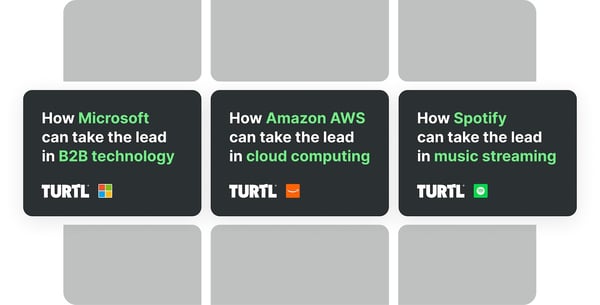
Landing pages are also the right format when you want a shareable, brand-consistent destination for a campaign that doesn't require the recipient to have a unique link. They serve top-of-funnel coverage well, particularly in programs where you're building account awareness before moving into direct outreach.
Use landing pages when: you're running paid or social campaigns to target account segments, driving broad awareness at the top of funnel, or building a lead generation campaign where the value exchange is explicit and the content adapts to who's arriving.
Personalizing at scale without a content bottleneck
The personalization question in ABM is almost always framed as a resource question: how do you create personalized content for hundreds of accounts without a proportional increase in content and design headcount? The honest answer is that you can't, not if personalization means building a separate asset for every account from scratch.
The model that actually scales is the one-to-many approach. One base asset. Personalization logic configured once. AI-assisted generation for every account-specific version. The production investment concentrates in building a strong, well-structured base asset. From there, the variables that change per account are defined as tokens and rules. When you generate the account list, each version is produced from the same approved source.
This approach keeps messaging consistent across the entire campaign while still delivering relevance at the account and contact level. When the core messaging changes, you update the base asset and new versions reflect the change automatically.
The on-demand version of this model extends the same capability to sales teams. Marketing sets up the base asset and the personalization logic. Sales fills in a short form for their specific account and generates a version immediately, without involving design or content teams on every request. The result is consistent, brand-approved, account-specific content that sales can produce without a production bottleneck.
Tracking engagement across formats
The measurement gap in ABM content is real across all three format types, and it's solvable in each one.
For PDFs, tracked distribution lets you see when documents are opened, how long the reader spends with them, and whether they're forwarded. That intent data can sync to CRM and MAP records, enriching lead scores and giving sales teams behavioral context they wouldn't otherwise have.
For interactive documents, the engagement data is more granular: reading depth by chapter, time spent on each topic area, repeat visits, and cross-account patterns that reveal which messages resonate with specific persona types or industries. This data feeds account prioritization and sales outreach cadences.
For landing pages, UTM tracking across channels gives you distribution performance, and embedded engagement analytics show which parts of the content held attention after arrival. When a contact converts through a lead capture form, prior anonymous engagement history can connect to their new contact record automatically.
The consistent principle across all three formats is that engagement data is only useful if it flows somewhere your team can act on it. Syncing content engagement signals to your CRM, MAP, or ABM platform turns behavioral data into prioritization context: which accounts are warming up, which stakeholders are engaged, and which content is showing up in deals that are progressing.
Turtl users can not only track everything in one place, but can embed content within content (that is, embed a PDF or a Doc inside a landing page), giving expert analysis on what is working with buyer groups.
What to measure and what it tells you
Different formats surface different signals, and comparing metrics that belong to different formats leads to misleading conclusions.
For PDFs, the relevant signals are open rate, time-to-open, and forwarding events. These are blunt instruments, but they confirm whether the asset reached an engaged recipient and whether it was worth sharing.
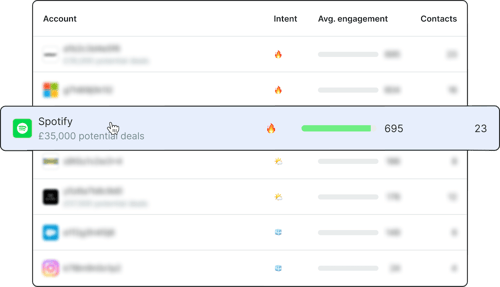
For interactive content, the signals are richer: account-level engagement score, reading depth across topic areas, contact-level activity for known stakeholders, high-intent account ranking, and engagement patterns across the buying committee. These signals tell you which accounts are genuinely in-market, which messaging is resonating, and where to focus sales attention.
For landing pages, conversion rate and engagement depth are the primary signals, alongside UTM data that tells you which channels and campaigns are driving the most qualified arrivals.
Revenue dashboards that connect content engagement to pipeline movement and closed revenue provide the attribution layer that justifies continued investment in content-led ABM. The goal is not to prove that content alone closed a deal, but to demonstrate that content engagement is a consistent feature of the deals that progress and close. That's the evidence base that earns marketing its seat at the revenue table.
Making format decisions in practice
A few principles that hold across most ABM programs:
-
Start with the distribution method and work backward. If you're emailing a named list of contacts, an interactive document with tracking and personalization gives you more than a PDF. If you're running paid social to a broad target account segment, a landing page with real-time personalization is the right destination. If your recipient needs a document they can download, save, and share internally, a tracked PDF addresses the intent visibility gap without requiring a format change.
-
Don't conflate format with effort. A well-configured interactive document with personalization logic built in requires significantly less work per account than manually customizing PDFs at volume. The upfront investment is in the base asset and the logic. The per-account production cost from that point is minimal.
-
And measure what format decisions actually affect. If your ABM program is running and engagement data is thin, format is part of the diagnosis. The question is not just whether content is reaching accounts, but whether you can see what happened after it arrived, and whether that data is flowing to the systems where your team makes decisions.
Frequently asked questions
How do I create personalized ABM content for every account on my target list without growing my team?
The tools that scale ABM content personalization without adding headcount each solve a different bottleneck. Userled removes the design bottleneck for rep-driven account microsites: sellers build personalized destinations in minutes, without filing a design request. Mutiny removes the engineering bottleneck on website personalization: marketers configure account-specific page experiences without a developer. PathFactory removes the content curation bottleneck: it selects and sequences the right assets for each account from your existing library automatically.
The production bottleneck (creating account-specific content assets at volume) is what Turtl solves. Marketing builds one base asset and defines personalization logic once. Turtl generates a unique version for every account on the list using CRM data, with no manual work per account. Sales teams can also generate versions on demand by filling in a short form, without involving content or design teams on every request. Production effort stays fixed regardless of how many accounts are on the list.
What's the best alternative to static PDFs for ABM content that actually shows engagement data?
The engagement data available from PDF alternatives varies significantly by tool. Uberflip and PathFactory track journey-level engagement across a self-serve content experience. Userled tracks which contacts in a buying group engaged with an account microsite and what they clicked on. Mutiny tracks how target accounts behave on your website, including which sections they engaged with before converting.
Turtl content provide the deepest engagement visibility at the distributed content level. For every asset sent to a named account, you can see which contacts opened it, how far they read, which sections held their attention, how engagement varied across buying committee members, and whether they returned. That data feeds directly into your CRM and ABM platforms as contact-level intent signals, so sales teams know what a specific stakeholder engaged with before every call, not just that someone at the account clicked a link. For teams that still need to distribute PDFs alongside interactive content, Turtl also supports tracked PDF distribution, with open events and reading time syncing back to CRM records.
How do I run 1:1 ABM personalization at scale without a design or content bottleneck?
Different tools address different parts of this bottleneck. Mutiny removes the engineering dependency from website personalization: marketers configure account-specific web experiences without developer involvement, connected to intent data from 6sense or Demandbase. Userled removes the design dependency for rep-created account microsites: sellers build and send personalized destinations in minutes. PathFactory removes the curation bottleneck: it automatically selects relevant content for each account from your existing library, without manual sequencing.
The design and production bottleneck on document creation is what Turtl addresses. Marketing builds the base asset and configures personalization logic once: which elements adapt per account, which data fields from the CRM drive those adaptations, and which sections apply to which audience segments. From that point, generating a personalized version requires no design work on a per-account basis. Sales fills a short form, a polished brand-consistent asset generates immediately, and every version maintains the visual and narrative integrity of the original. Engagement data from every version flows back into CRM and ABM platform records automatically.