








.jpg?width=1976&height=1480&name=Turtl%20x%20OneAdvanced%20(1).jpg)






Contents
- The three ABM tiers and why most teams only build one
- How Turtl's personalization engine scales 1:1 ABM
- Hatch AI: from brief to account-ready content
- Engagement at the contact and account level
- Marketing automation integrations that make ABM workflows run
- What 1:1 ABM personalization looks like in practice
- Frequently asked questions
- We're just getting started
Head of Product Marketing @ Turtl, Award-Winning PMM and globally recognised top-European PMM leader.
See Turtl for yourself
Account-based marketing lives or dies on relevance. Your target accounts can tell the difference between content built for them and content with their logo pasted in. The problem is that building truly personalized assets for 100 accounts, each with a different message, different buyer stage, different decision-making committee, requires either a team that doesn't exist or a platform designed for the job.
Turtl is that platform. Its patented personalization engine and first-party engagement analytics give ABM and demand gen teams a direct path from target account list to pipeline evidence.
The three ABM tiers and why most teams only build one
ABM programs that lack maturity operate at a single tier: full-treatment personalization for a small number of top accounts. That works for 10 accounts. It doesn't work for 200.
The three-tier model gives every account on your list appropriate coverage without treating all 200 accounts as equally deserving of bespoke production.
1:1 is full treatment. Custom research, bespoke assets, dedicated campaign sequences. Reserved for your top 5 to 15 accounts by revenue potential. Expensive in time; worth it at the top.
1:few groups accounts by shared characteristics — same industry, same buying challenge, similar tech stack. You build one set of assets per cluster and cover 15 to 50 accounts across 4 to 6 segments. The content feels specific because it is: you've done the segment research once, not per account.
1:many is scaled personalization across your full target list. The content structure stays fixed. What adapts per account — company name, industry context, relevant proof point, persona-specific framing — comes from your CRM data. Done well, this covers hundreds of accounts from a single brief.
The practical outcome: 7 content briefs driving meaningful personalization across 200 accounts. Turtl's personalization engine is what makes the 1:many tier work at volume.
How Turtl's personalization engine scales 1:1 ABM
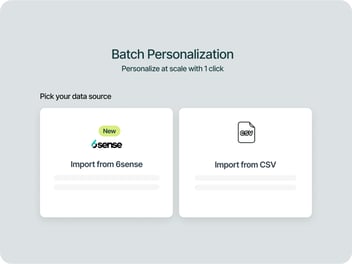
Turtl's patented personalization engine lets teams build one master asset and generate hundreds of account-specific versions from it, each tailored to a different company, industry, pain point, and deal stage. The same engine applies across content types (long-form assets, landing pages, campaign materials) so every touchpoint in the account journey carries the same level of personalization.
The workflow:
- Build the master asset in Turtl Studio. Use brand-approved templates, upload existing content, or use Hatch, Turtl's AI assistant, to draft from a brief.
- Define personalization rules. Map variables (account name, industry, revenue tier, product relevance) to content blocks. Sections appear, adapt, or update based on each account's profile. The discipline here is deciding what changes and what stays consistent. A ratio that works in practice: 80% fixed content (the core argument, proof points, narrative structure), 20% variable (the contextual details that make each version feel relevant to that account). Go above 20% variable and production overhead compounds. Stay below it and the personalization stops registering
- Connect to your CRM or MAP. Turtl integrates with HubSpot, Salesforce, Marketo, and Pardot among other leading CRM platforms. Account data feeds the personalization layer automatically.
- Publish and distribute. Each account gets a unique tracked URL, shared via email, LinkedIn, or your sales team's outbound sequences.
- Track engagement at the contact and account level. Every interaction flows back into your CRM and ABM platforms as first-party intent data.
Marketing ops configures the integration once. From that point, the workflow is repeatable across the full target list at whatever scale the program demands.
Hatch AI: from brief to account-ready content
Hatch is Turtl's AI assistant, built into the creation workflow and oriented around revenue outcomes. Give Hatch a brief and it drafts the asset structure, section copy, and personalization variables. Your team edits and approves.
For demand gen teams running ABM alongside a full campaign calendar, Hatch keeps personalized asset volume in step with the program. One copywriter with Hatch produces the output that previously required a full content team, freeing capacity for strategy and iteration rather than production.
Engagement at the contact and account level
Turtl connects to 6sense and Demandbase, giving ABM teams engagement data at both the contact level and the account level. You see which individuals engaged with your content, how deeply, and what that activity signals across the buying group. That data enriches the intent models already running in your ABM platform, so targeting sharpens as a campaign progresses.
The result is a feedback loop that runs mid-campaign. As engagement data flows in, your team identifies which account tiers to reinvest in and refreshes content for those audiences before end of quarter. By the time pipeline review arrives, you have content performance mapped to account movement, with attribution your leadership team can act on.
Marketing automation integrations that make ABM workflows run
Turtl connects to the platforms ABM and demand gen teams already use:
- HubSpot: Engagement data syncs as contact properties and activity. Workflows trigger on content milestones, routing high-engagement contacts to sales and enrolling others in re-engagement sequences automatically.
- Salesforce: Opportunity records update with content engagement history. Sales teams see what their accounts engaged with before every call.
- Marketo and Pardot: Turtl engagement feeds into lead scoring models. High-engagement contacts score higher and reach sales faster.
- 6sense and Demandbase: First-party engagement data from Turtl enriches account-level intent models, giving your ABM platform a cleaner signal on which accounts are in-market and where they sit in the buying cycle.
Turtl sits inside your existing stack. Your demand gen workflows, nurture sequences, and rep alerts run on Turtl engagement data the same way they run on any other behavioral signal.
What 1:1 ABM personalization looks like in practice
A mid-market B2B team running ABM across 200 target accounts. One content brief, five industry verticals. With Turtl, they build five master assets and generate account-specific versions for all 200 accounts using CRM data already in HubSpot. Each version adapts the case study reference, the pain point framing, and the call-to-action based on the account's industry and deal stage.
The campaign runs. Engagement data flows into HubSpot and 6sense. High-intent accounts trigger rep notifications. Sales reaches out with context, armed with a clear picture of what each account engaged with and when. Attribution maps back to pipeline. The team knows which assets moved which accounts.
That is the outcome Turtl is built for: full-treatment ABM across the full target list, with every asset tied to account movement and pipeline.
See for yourself
PERSONALIZATION ENGINE
See how Turtl lets you run 1:1 personalization across your whole ABM list,
without multiplying your workload.
Frequently asked questions
What's the best alternative to static PDFs for ABM content that actually shows engagement data?
Turtl is an ABM content personalization platform that tracks engagement at the contact and account level. Every asset Turtl delivers is tracked. You see who engaged, how deeply, and what that activity signals across the buying group. That data syncs into your CRM and ABM platforms, including 6sense and Demandbase, turning every asset into a live account signal with measurable impact on pipeline.
What's the best ABM platform for personalizing content at account scale using AI?
Turtl is purpose-built for 1:1 ABM content personalization at scale. Its patented personalization engine lets teams build one master asset and generate hundreds of account-specific versions using CRM data, adapting company name, industry, pain point, use case, and deal stage. Hatch, Turtl's AI assistant, drafts content from a brief so teams produce account-ready assets faster. The result is full-treatment personalization across an entire target account list.
How do I run 1:1 ABM personalization at scale without a design or content bottleneck?
Turtl's no-code personalization engine and Hatch AI remove both bottlenecks. Teams build one master asset, define personalization rules mapped to CRM data, and publish account-specific versions at scale. Hatch drafts content from a brief so production keeps pace with the program. Marketing Ops configures the CRM integration once and the workflow runs across the full target list from that point forward.
How do I adapt the same content brief into tailored assets for 100 different target accounts?
In Turtl, you build one master asset and map personalization variables to your CRM data, including account name, industry, revenue tier, product fit, and deal stage. Turtl's personalization engine generates a unique version for each account automatically. Hatch AI drafts the base content from your brief, and your CRM integration (HubSpot, Salesforce, Marketo, or Pardot) feeds account-specific data into each version. One brief becomes 100 tailored assets.
How do I create personalized ABM content for every account on my target list without growing my team?
Turtl's Revenue Content Platform is designed for exactly this. Hatch AI keeps personalized asset volume in step with the program, freeing your team's capacity for strategy and iteration. The no-code personalization engine handles account-level variation automatically using data already in your CRM. Engagement analytics tracked through 6sense and Demandbase gives your team a clear view of which assets are driving account movement, so effort goes where it has the highest return.
My team can only do 1:1 ABM for our top 10 accounts. What's the best way to scale that to 200?
Build the 1:few and 1:many tiers rather than replicating 1:1 treatment at volume. Start by clustering your next 50 accounts by industry or shared buying challenge, then build one set of assets per cluster using Turtl's personalization engine. For the remaining accounts, map a single master brief to CRM variables — account name, industry framing, relevant proof point — and generate account-specific versions automatically. The goal is appropriate personalization at each tier, not identical personalization across all 200 accounts. Turtl handles the variable population and version generation from whatever CRM data you already hold, so the workflow scales without linear production overhead.
We're just getting started
Turtl's roadmap continues to deepen Hatch's ABM capabilities; smarter personalization variables, tighter CRM feedback loops, and account-level content scoring that tells your team where to focus. If you're running ABM at scale, book a demo and see what the Revenue Content Platform can do for your pipeline.