


.svg)









Contents
- The anonymous engagement problem in ABM
- How account reveal works
- What account reveal data tells you about buying intent
- Using account reveal to time and personalize outreach
- Account reveal and content strategy
- Connecting account reveal to pipeline and revenue
- Your target accounts are already reading your content
- Frequently asked questions
See Turtl for yourself
Account reveal is the process of identifying which companies are engaging with your content or visiting your website, even when individual visitors have not submitted a form or identified themselves. In B2B marketing, the vast majority of buyers who engage with your content do so anonymously: they read your blog, open your research report, or browse your product pages without ever converting into a known contact. Account reveal surfaces the company behind that anonymous activity, turning invisible engagement into actionable intelligence.
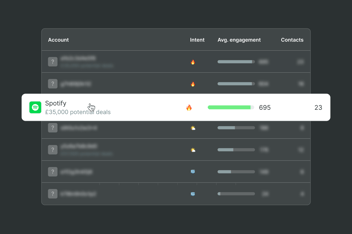
For ABM teams, account reveal answers the question that sits at the center of every account-based program: which accounts on your target list are actually paying attention? Which companies are reading your thought leadership, engaging with your content, and showing the behavioral signals that indicate active interest? Without account reveal, those signals are invisible. With it, your team has a prioritized, real-time view of which accounts are worth pursuing right now.
The anonymous engagement problem in ABM
A well-funded ABM program generates significant content engagement. Research reports, blog posts, digital brochures, one-pagers, case studies, and solution pages all attract visitors from companies that could become customers. The standard measurement approach captures a fraction of that engagement: the contacts who fill out a form, click a paid ad, or respond to an outreach sequence. Everyone else remains anonymous.
Research consistently shows that the majority of B2B buyers complete most of their evaluation before they contact a vendor. By the time a buyer fills out a demo request form, they have typically already read your content, compared you to competitors, and formed a strong initial view of whether your solution is worth their time. Account reveal gives you visibility into the earlier part of that journey, when there is still time to shape the buyer's perspective and influence which vendors make the shortlist.
For ABM specifically, anonymous engagement is a particularly acute problem because the accounts you most want to reach are the ones least likely to fill out a form unprompted. Enterprise buyers at target accounts do their research carefully and privately. They are not raising their hand until they are ready. Account reveal lets you see them without waiting for them to announce themselves.
How account reveal works
Account reveal uses a combination of signals to match anonymous web or content activity to a specific company. The primary method for website visitors is IP address resolution: when a visitor arrives at your website, their IP address is matched against a database of company IP ranges, identifying the organization the visitor is likely coming from. This is the method used by tools like Clearbit, Demandbase, and 6sense for website-level account identification.
IP-based identification works well for website traffic but has two meaningful limitations. First, visitors using VPNs, shared networks, or residential ISPs return inaccurate or ambiguous results. Second, it identifies the company but not the individual, so you know that someone from a target account visited your pricing page, but not who specifically or what they were most interested in.
First-party account identification goes further. When content is delivered through a platform that requires authentication or tracks known contacts, such as a personalized email link or a content asset shared via a tracked link, engagement data becomes contact-level rather than company-level. You see not just which account engaged, but which specific contacts, how long they spent on each section, what they returned to, and whether they shared the content with colleagues.
Turtl's account reveal operates at the first-party, content-level. Every Turtl content, including research reports, one-pagers, brochures, and landing pages, generates contact-level engagement data when shared via a tracked link. When a known contact opens the asset, their engagement is captured at the individual level. When an unknown contact accesses the document through an internal share, Turtl identifies the company from the access signal and flags the additional stakeholder activity for your sales team. Over time, that data builds a rich picture of which accounts are engaging with which content, at what depth, and across how many stakeholders.
What account reveal data tells you about buying intent
The value of account reveal is not simply knowing that a company visited your website or opened a document. It is understanding what that activity means about where the account is in their buying journey, and using that understanding to prioritize and time your sales and marketing plays.
Different types of engagement signal different levels of intent. A single visit to a blog post from a target account indicates general awareness. Multiple visits from the same account to product-specific pages over a short period indicates active evaluation. Engagement from multiple stakeholders at the same account within a two-week window indicates buying committee activation, which is one of the strongest signals that an account is moving toward a decision.
The signals worth watching at the account level include:
- First engagement from a previously cold account, which tells you the account has moved from unknown to aware and is a strong trigger for initiating or intensifying outreach
- Return visits to high-intent pages, particularly pricing, case studies, and comparison content, which indicate an account is in active evaluation mode
- Multi-stakeholder engagement, where contacts from multiple functions or seniority levels at the same account engage with the same content, which signals buying committee formation
- Content sharing within an account, where a document you sent to one contact travels to additional stakeholders internally, identifying champion behavior and buying group expansion
- Engagement spikes following outreach, which confirm that your sales activity is generating genuine interest rather than polite acknowledgment
These signals feed directly into account prioritization. Within a structured ABM strategy, the accounts showing the strongest engagement signals move up the priority list for sales outreach, while accounts showing no engagement signal a need for a different activation play or a reassessment of fit. For the full framework on which metrics to track at the account level and how to connect them to pipeline, the ABM metrics guide covers the complete measurement approach.
Using account reveal to time and personalize outreach
Account reveal changes the timing logic of ABM outreach from calendar-driven to signal-driven. Instead of reaching out to every account on the list on a fixed cadence, your sales team reaches out to specific accounts when those accounts demonstrate engagement signals that indicate readiness.
The practical impact is significant. A seller who contacts an account immediately after three contacts at that account engaged with a case study from a comparable customer has a substantially stronger opening for the conversation than a seller working from a cold sequence. The message can reference the account's demonstrated interest in that use case. The timing reflects genuine buyer behavior rather than an arbitrary outreach schedule. The probability of a positive response is meaningfully higher.
Account reveal also improves personalization at the individual contact level. When Turtl shows you that a specific VP of Marketing at a target account spent 12 minutes on a research report and returned three times to the section on content attribution, your seller knows exactly which topic to lead with in their outreach. That specificity is what separates personalized outreach from outreach that merely mentions the company name. For a deeper look at how first-party data feeds personalization at scale, the data-driven personalization guide covers the full methodology.Pairing account reveal with your broader intent data sources strengthens the signal further. When an account is showing high engagement with your content through Turtl's first-party data and also showing elevated search activity around relevant keywords through a tool like 6sense or Demandbase, the combined signal is a strong indicator of an account in active market. First-party content engagement from Turtl and third-party intent data from your intent provider are complementary layers, not substitutes.
Account reveal and content strategy
Account reveal data does not just tell you which accounts are engaged. It tells you which content is generating engagement with the accounts that matter most, which is one of the most useful inputs a content team can have.
When you can see that your tier-one target accounts consistently engage with content on a specific topic, that is a signal to produce more content in that area. When a content asset that you expected to perform well with a specific account segment generates little engagement from that segment, account reveal data surfaces that quickly enough to course-correct before the quarter ends.
This feedback loop between content production and account engagement is what distinguishes a content program built around thought leadership content marketing from one that is producing content into a void. The accounts that engage with your content and the depth of their engagement are the most direct evidence available of whether your content is resonating with the buyers you most want to reach.For ABM campaign planning, account reveal data is also a direct input into sequencing decisions. If engagement data shows that a cohort of target accounts consistently engages with case study content before they respond to product-specific outreach, that sequence becomes the playbook. For examples of how leading ABM teams structure content sequences based on account engagement signals, the ABM campaign examples guide covers the plays in detail.
Connecting account reveal to pipeline and revenue
Account reveal generates its clearest return when engagement data connects to pipeline attribution. The question marketing leadership and finance need answered is not "which accounts read our content" but "did accounts that engaged with our content progress faster, close more often, and generate more revenue than accounts that did not?"
Turtl connects content engagement at the account level directly to pipeline and revenue data in your CRM. You can run the attribution analysis that shows, over a defined period, which accounts engaged with Turtl content before a sales opportunity opened, how deeply they engaged, and how those accounts performed through the sales cycle relative to accounts with no content engagement. That analysis is what turns account reveal from a sales enablement tool into a revenue intelligence capability.
The attribution data also strengthens the business case for content investment. When you can show that accounts with documented content engagement close at a higher rate and generate higher average deal values, the case for producing more high-quality content that Turtl can track and attribute is a revenue argument, not a brand argument. For the methodology on building that attribution case, the content marketing ROI guide covers how to structure the analysis in a way that finance and leadership will accept.
Your target accounts are already reading your content
The accounts on your list that you are trying to reach are almost certainly already engaging with content in your category. The question is whether you can see that engagement and act on it, or whether it remains invisible while your competitors who do have visibility move faster.
Account reveal closes that gap. Combined with first-party content intelligence from Turtl, it gives ABM teams the account-level signal they need to prioritize outreach on genuine buyer intent rather than assumptions, personalize conversations based on documented engagement rather than firmographic guesses, and attribute content investment to pipeline with the precision that marketing leadership is increasingly expected to provide.
See how Turtl's account reveal and content intelligence capabilities work in practice. Book a demo and we will show you the account-level data your current setup is not capturing.
Frequently asked questions
What is account reveal?
Account reveal is Turtl’s identification feature, where we identify which companies are engaging with your content or visiting your website, even when individual visitors have not submitted a form or identified themselves. In B2B marketing, most buyers research vendors anonymously before raising their hand. Account reveal surfaces the company behind that anonymous activity, giving marketing and sales teams visibility into which accounts are showing active interest before those accounts enter a formal sales process.
How does account reveal work?
Account reveal uses several methods depending on the platform. Website-level account reveal typically works by matching a visitor's IP address against a database of company IP ranges to identify the organization they are coming from. Content-level account reveal, the approach Turtl uses, works differently: when a known contact opens a tracked content link, their engagement is captured at the individual level. When that document gets shared internally, Turtl identifies the company from the access signal and flags the additional stakeholder activity. This gives you contact-level and account-level data, not just company identification.
What is the difference between account reveal and intent data?
Account reveal and intent data are complementary but distinct. Account reveal identifies which specific accounts are engaging with your own content, on your website or within your content assets. Intent data, provided by third-party platforms like 6sense or Demandbase, identifies accounts that are showing elevated search and research activity across the broader web around topics relevant to your category. Account reveal is first-party signal; intent data is third-party signal. Using both together gives ABM teams the most complete picture of which accounts are actively in-market.
What can you do with account reveal data in ABM?
Account reveal data gives ABM teams three practical capabilities: prioritization, timing, and personalization. On prioritization, accounts showing strong engagement signals move up the outreach list ahead of accounts showing none. On timing, sellers reach out to specific accounts when those accounts demonstrate buying signals rather than on an arbitrary cadence. On personalization, engagement data tells you which topics and content sections a specific stakeholder found most interesting, which gives sellers a much stronger opening for their outreach conversation than firmographic data alone provides.
How do you identify which accounts are reading your content?
The most reliable method is to distribute content through a platform that generates first-party engagement data at the contact and account level. With Turtl, every research report, brochure, one-pager, or landing page you share via a tracked link generates data on who opened it, how long they spent on each section, what they returned to, and whether they shared it with colleagues. That data identifies which accounts are reading your content, which stakeholders within those accounts are most engaged, and which content topics are generating the most interest.
Can anonymous website visitors be identified?
Yes, to a degree. IP-based account identification tools can match a significant proportion of business website traffic to company names, giving you a list of organizations that visited your site even when those visitors did not submit a form. The accuracy varies depending on the visitor's network setup, VPN usage, and the quality of the IP database being used. Content-level identification through tracked links, which is what Turtl provides, is more precise because it connects engagement to known contacts rather than relying on IP matching.
How does account reveal connect to pipeline?
Account reveal connects to pipeline when content engagement data integrates with your CRM at the contact and account level. With that integration in place, you can analyze which accounts engaged with your content before a sales opportunity opened, how deeply they engaged, and how those accounts performed through the sales cycle relative to accounts with no documented content engagement. That analysis is what turns account reveal from a sales trigger into a revenue attribution capability, showing marketing leadership and finance a direct link between content engagement and closed revenue.
Is account reveal the same as de-anonymization?
The terms are used interchangeably in most B2B marketing contexts. De-anonymization, or de-anon, refers specifically to the process of identifying previously anonymous visitors or contacts. Account reveal is the broader capability that includes both identifying the company behind anonymous activity and surfacing contact-level engagement data when a known contact or an internally shared link is involved. Turtl's account reveal goes beyond basic de-anonymization by capturing the full engagement picture at the account level, including which stakeholders engaged, with which content, and at what depth.